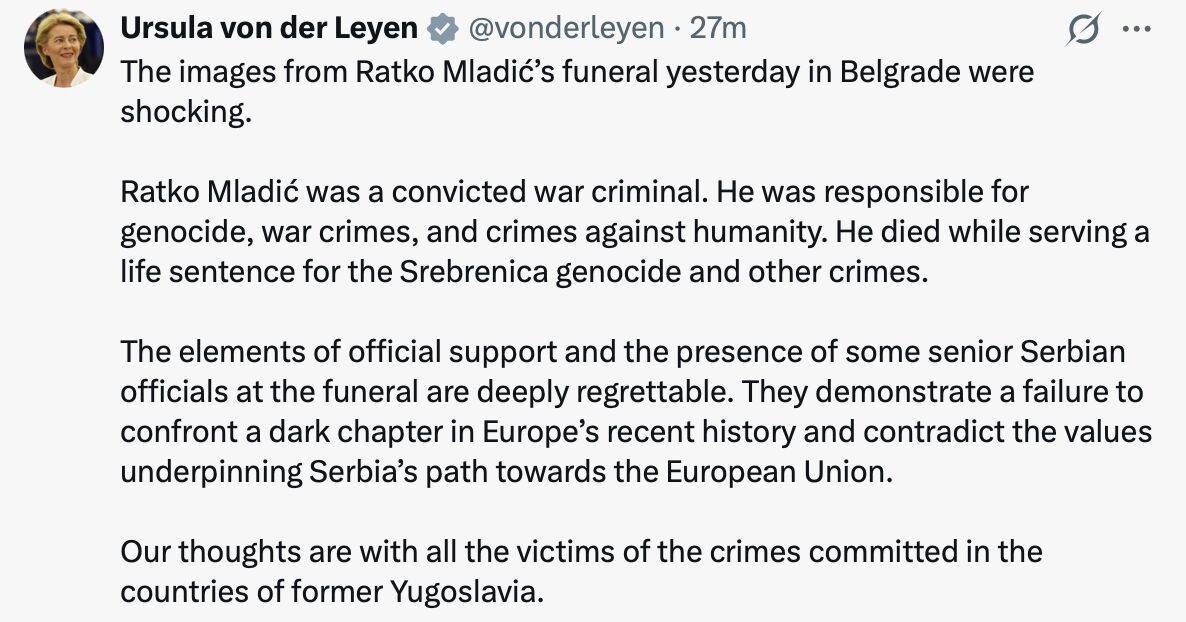
Two presidents have said the right words. The region has one question, and it is not about words.
Editorial Board | 8 September 2026
On Tuesday morning the presidents of the Commission and the European Council posted the same text: the images from Belgrade were shocking, the "elements of official support" regrettable, the whole thing contrary to the values of Serbia's path. Thank you. The spokesperson had told the press room the day before that "we had heard that there was a funeral foreseen with state honor, and that has not been the case". Now her president has said what everyone with a television could see. That is progress of a kind, and it came hours after the Croatian prime minister demanded it.
Now the question. Will Europe do something, or was that it?
We ask it plainly because we have watched the answer before. The enlargement commissioner cancelled her visit to Belgrade. For now. The annual autumn tour of the region, the one in which the Commission president walks through the capitals and reads out the reform scores, is confirmed for the turn of the month, and the Commission has declined to say whether Belgrade is on it. Belgrade is the test, and there are two ways to pass it. Von der Leyen can skip the city and let the absence speak. Or she can go, stand beside Aleksandar Vučić, and announce in his presence what his government's conduct will cost: money withheld, the path formally marked by military honours for a genocide convict, no ifs and no buts. Either is a policy. What she cannot do is go, shake the same hand, repeat the language of reforms and acceleration, and leave behind one more photograph of business as usual. Presence is not appeasement when its purpose is to impose a price. Presence without a price is.
Then the money. Let us not kid ourselves about what the money is. Half of the Reform and Growth Facility is loans paid straight into the beneficiaries' budgets; Serbia's January tranche split almost evenly between its treasury and project funding. And what has that treasury been doing while the transfers arrived? On SIPRI's current-dollar figures Serbia's military spending rose from under two billion dollars in 2023 to nearly three in 2025. It has bought fighter jets from an EU member state. It has budgeted the return of conscription. Its defence minister sat in a Serbia–China defence subcommittee last month, thanked Beijing for its position on Kosovo, and said Chinese acquisitions had "significantly enhanced the operational capabilities of the Serbian Armed Forces". Every European euro that pays for a Serbian road is a Serbian dinar released for a Serbian barracks, and Brussels, which can read a budget as well as anyone, has chosen not to act on what it reads.
So the revisionism and the rearmament are one story. The same government that is building a shrine at Topčider is building an army to match, and it is doing both on a budget that Europe tops up. The rhetoric about a wronged nation and the military buildup are the same policy, described twice, and a blank cheque to that policy is a contribution to it, whatever Brussels calls it.
It is a contribution to something else as well, which Brussels prefers not to discuss. Serbia has a democratic opposition: an explicitly European bloc in parliament, and a student movement that has mounted the strongest challenge to Vučić in years and kept it on the streets for the better part of two years. They are not the same actor and they do not agree on everything. They agree on one thing, which is that they will face him at an election now expected in late October. Neither needs Europe's money or endorsement. What they need is for Europe to stop lending its president to the man they are running against. Every handshake in the Serbia Palace, every joint press conference in which Vučić promises to "accelerate" a European path his own ministers spent Monday burying, is an asset in his campaign and a message to every Serb who still believes the European story: Brussels has chosen, and it has not chosen you. A democratic Serbia will not get its chance while the Ursula and Aleksandar arrangement continues, because the arrangement is precisely what tells Serbian voters that the choice has been made for them.
Nobody on this board is predicting a war. What we are describing is what Europe pays for, and whom it pays against, and we are asking whether Tuesday's words change any of it.
Here is what doing something looks like, and it is political, not mechanical; no clause in the Facility says a funeral stops a payment, and none is needed. Skip Belgrade, or go and announce the price there. No new disbursement to the Serbian budget until the government explains in writing why serving soldiers carried the coffin. Council conclusions, not another statement from a diplomat who would not give a name, recording that this counts against Serbia in the assessment that decides its path. And all of it said before the election, because Serbia's government asked for parliament to be dissolved on the afternoon of the burial, and every quiet day between now and the vote will be read in Belgrade as confirmation that the price has been paid, in full, by a post.
In this region we have learned to wait and see what follows a strong statement from Brussels. Two presidents have spoken. We will know within the month whether they meant it, because Belgrade is either skipped or used to announce consequences, and the money either moves or it does not. Everything else is talk, and Belgrade has already thanked Brussels for it in its own way, on Monday, with a three-volley salute.
