Belgrade never had to declare Ratko Mladic a hero. It distributed the message across an aircraft, a ministry, the Army, the Church and a grave, and gave every institution a reason why its own part meant something else.
by Drizan Shala | 9 September 2026
States communicate through what they declare and through what they coordinate, and the second channel is the one an analyst reads when the first has gone quiet. In the eleven days between Ratko Mladic's death in The Hague and his burial at Topcider, Serbia's ruling establishment produced no document that says what the eleven days said. There was no decision proclaiming a national hero, no decree ordering a state funeral, no ministry statement rehabilitating a convicted war criminal. None was needed. The message was distributed.
A government aircraft brought the body from the Netherlands with Serbia's justice minister, Nenad Vujic, aboard. Soldiers of the Serbian Army carried the coffin from the aircraft beneath the flags of Serbia and Republika Srpska. Gendarmes saluted the convoy on the motorway to the military hospital. On Saturday the Army House hosted the commemoration, with Vujic in the front row, and a retired general told the hall that Serbs would be free on the day a poem about Mladic stood on the first page of the school primer. On Monday Patriarch Porfirije officiated at the church, with five Serbian ministers present, Bratislav Gasic of defence among them. An honour unit of the Serbian Army placed the coffin on a gun carriage, accompanied it to the grave and fired the salute.
Read separately, every act can be reduced, and each has been. The aircraft was transport; Serbia's president called it logistics at Coka, four days before the burial, in the same remarks in which he forecast tens of thousands of mourners. The minister was fulfilling a procedure. The soldiers followed protocol, and Vujic had already said on television that the protocols are known. The Army House was booked by an association of retired officers. The ministers came privately. The Patriarch conducted a religious service. The honours were custom for a former officer. Serbia's president did not attend.
Ask the justice ministry about the aircraft and the answer is transport. Ask about the soldiers and it is protocol. Ask who ordered the whole and there is no single desk to point to. That is the design, and it works because citizens do not experience a state as a filing system. Over eleven days they saw a government plane, a flag-draped coffin, soldiers, the Army's own house, a Patriarch, ministers, a gun carriage and a volley, in that order, and they summed it. No Serbian official had to stand at a microphone and say the sentence. The institutions supplied everything around the noun, and the noun was supplied elsewhere: the Vecernje novosti front page on the night the aircraft landed welcomed the Serbian hero home, and the crowds on the overpasses had not waited for the paper.
The Russian ambassador supplied the final interpretation. Speaking to Rossiya 1 at the graveside on Monday, in a clip his embassy posted on Tuesday, Aleksandar Bocan-Harcenko said he had come out of purely human feelings. He had met Mladic during the Bosnian war while accompanying Vitaly Churkin and Igor Ivanov, and he remembered that the general's soldiers had treated Russian diplomats with the greatest attention, guaranteed their security and helped their diplomatic work. Then he identified the tragedy, and it was Mladic's. So-called Western justice, with the quotation marks spoken aloud, had denied a dying man the sight of his native hearth, and that showed its malice and its anti-Serb face. Two minutes of testimony put into words what the ceremony had already put into uniform: soldier, friend, patriot, victim.
What that construction cannot hold is the people Mladic was convicted of killing.
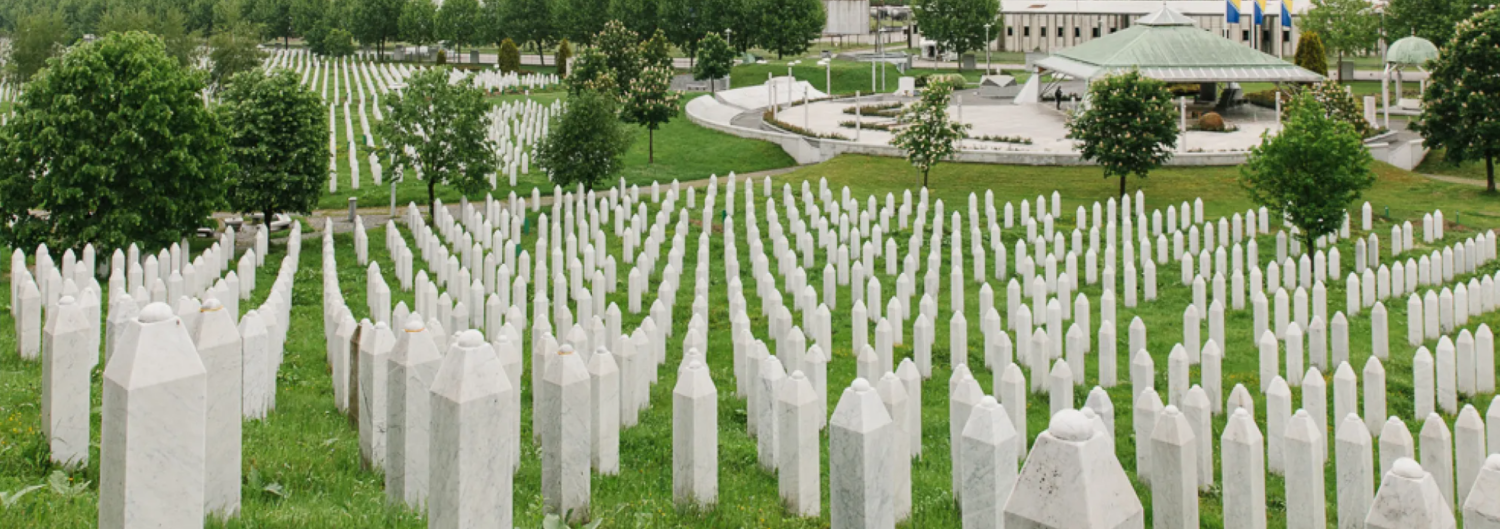
The judgments, in 2017 and on appeal in 2021, established genocide at Srebrenica, crimes against humanity and violations of the laws of war, and put the number of the murdered above eight thousand. They established that in the autumn of 1995 the bodies were taken out of the primary graves with machinery and moved to secondary sites so that they could not be recovered whole, which is why families have spent three decades identifying fragments, why the Memorial Center told the Mechanism this May that identification continues, and why Potocari buries each July, by name, what the excavators returned that year. During the eleven days in which Mladic acquired a flight home, a military escort, ministers, a Patriarch, a gun carriage and a salute, those people left the Serbian establishment's account almost entirely. The retired general at the Army House referred to the genocide once, as a mortgage that foreign intelligence services had arranged to hang on the Serbian nation. Nothing after that.
The absence does work. A state cannot construct one man as honoured soldier and injured party while the consequences of his command stand in the same frame; the second image unsettles the first. So Mladic receives biography: a homeland, a widow who told a newspaper her heart was calmer, friends, anecdotes, a military title, a journey home, a grievance against the court, an ambassador who remembers his hospitality. The dead receive a location.
Srebrenica.
That is a signalling problem before it is a memory problem, because when neighbouring governments and European officials challenged the honours, Belgrade changed the object of the dispute rather than answering it. Serbia's president called the enlargement commissioner's explanation stupid, as usual. He warned her against humiliating his country and said he would take no lectures about who is a criminal. The court became uncivilised. Western justice became a thing that convicts Serbs. The ambassador finished the escalation with malicious and anti-Serb. The question put by Bosnia, Croatia, Albania, Kosovo and, a day late, by the presidents of the European Commission and the European Council, was why the institutions of a candidate state had taken part in honouring a man convicted of genocide. The question answered from Belgrade was why Europe is attacking Serbia. Once that substitution succeeds, scrutiny of a government aircraft or a gun carriage can be presented as hostility toward Serbs, which is why the substitution has to be refused at the first attempt.
None of this is an argument about Serbia as a people. Serbian human rights organisations, journalists, lawyers and some politicians challenged the glorification themselves, and some found the language before governments outside Serbia did. The actors are institutional and identifiable: the ruling establishment, the ministers who participated, the Army structures that carried, escorted and fired, the Church hierarchy that supplied the rite, the newspapers that supplied the word, and the Russian mission that converted the week's symbols into an argument about Serbian victimhood.
The external channel is the European Union, whose membership Serbia still describes as its strategic objective. Toward Brussels the message is procedural: measure us by reforms, chapters and benchmarks. Toward the domestic audience the message around Mladic ran through symbols that need no accession document to decode: uniform, flag, Church, minister, gun carriage, salute. The two channels coexist because the second has been made deniable in parts, and they cannot coexist indefinitely. A state cannot ask Europe to treat Mladic as its past while its own institutions instruct the next generation to receive him as a hero.
That generation is the reason this belongs on a security desk. Serbia's 2026 budget funds the return of conscription. The cohort that will report to it watched, over eleven days, a government aircraft, a flag-draped coffin, soldiers, a Patriarch, ministers and a gun carriage, and heard nothing about eight thousand other graves. No forecast of another war follows from that, and none is offered here. What follows is narrower. Serbia's institutions have shown the young men they are about to put in uniform which predecessor belongs inside their usable memory, and they showed it in parts so that no part could be held against them. Brussels, when it finally looked at the whole rather than at the files, read it correctly. The mistake now would be to go back to reading the files. They were separate only on paper. The signal was the sequence.
Drizan Shala is a security researcher and doctoral candidate at the University of Sarajevo. He writes on defense, private security, and the security architecture of the Western Balkans.
