A Responsible Statecraft analysis rests on a premise that is false. Measured by the restraint school's own criteria, Kosovo is the outcome that school says it wants.
By Ngadhnjim Brovina | 19 September 2026
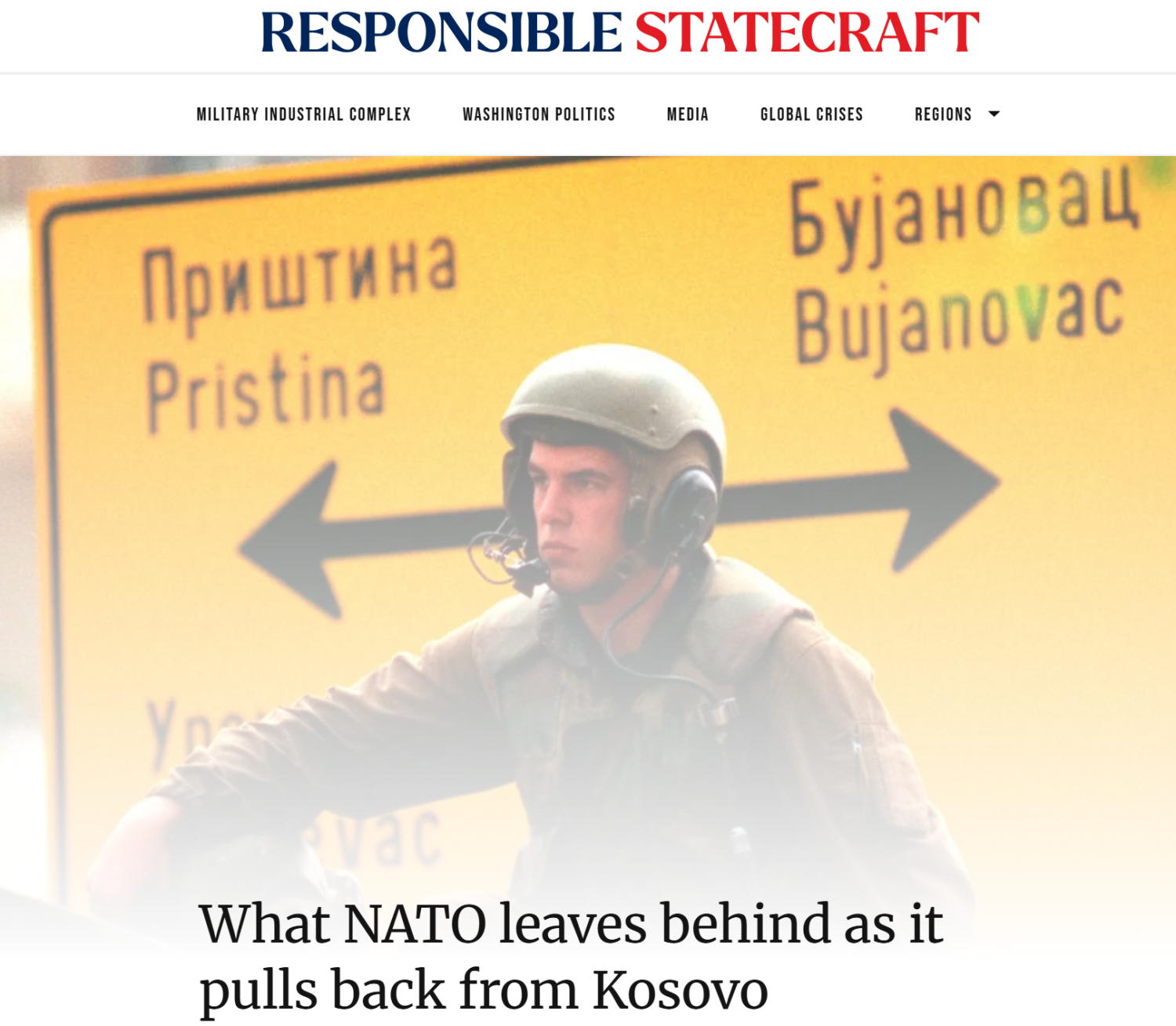
On 16 September, Responsible Statecraft, the magazine of the Quincy Institute in Washington, published an analysis by Sandra Davidović headlined "What NATO leaves behind as it pulls back from Kosovo." Its first sentence states that a NATO-led peacekeeping mission "began to withdraw from the country."
The premise is false. What KFOR announced on 10 August was a gradual reduction of its permanent presence on one bridge in Mitrovica, open to pedestrians since 2017 and now one of eight crossings over the Ibër in the same city. KFOR's statement described the step as conditions-based and coordinated with Kosovo's institutions, EULEX and the Kosovo Police. Its commander told Srpska Lista's leaders the following day that it was reversible. Serbia's chief of defence had been informed on 23 July, and Serbia's president told RTS the decision was "not unexpected." A bridge is passing to the police of the state in which it stands, and NATO is staying.
Everything that follows in the piece is attached to that premise. It calls the step "premature," the word Belgrade used on the day of the announcement. It says the people of the north were "left to pay the price" for Banjska, the sentence Srpska Lista placed in its open letter to the EU. It presents the Dren beating as established police perpetration, the formulation Vučić used in his letter to Mark Rutte. A reader in Washington has no way of knowing that each of these phrases has a prior author. A reader in Prishtina does.
The restraint school has its own way of judging a foreign commitment. As I read its writers, the questions are what a commitment costs, what it exposes American soldiers to, whether local institutions can carry the burden, and whether the partner contributes anything back. Kosovo answers each of them, and the analysis reports none of the answers.
The United States has maintained an embassy in Prishtina since 2008 and soldiers, observers and diplomats in the country since June 1999. The May report to Congress the analysis cites came out of that record, not out of a library. An account of Kosovo written in New York is offered to the one audience that has never needed one.
On cost, the comparison the piece invites with Afghanistan is the comparison that defeats it. The wars in Iraq and Afghanistan cost the United States several trillion dollars. The American contingent in Kosovo is a few hundred soldiers at Camp Bondsteel, mostly rotating National Guard units, on a budget that does not register beside either.
The exposure figure is zero. Since June 1999 no American service member has been killed by hostile action in Kosovo. Afghanistan killed more than 2,400 Americans; Iraq more than 4,400. The violence American troops have faced here on the public record came from crowds in North Mitrovica, in 2000 and 2004. Neither incident involved Albanians. The analysis mentions neither. American troops are welcomed in Kosovo. The capital's main boulevard is named after US presidents, Gallup's polling of approval for American leadership has for years placed Kosovo at or near the top of the world, and few countries offer an American in uniform the same combination of safety and public regard.
Kosovo is a functioning democracy. Its elections have changed governments peacefully more than once. Its courts rule against its government, and its constitutional court has struck down acts of parliament. When a Serb farmer from Dren alleged in August that police had beaten him, the Police Inspectorate opened an investigation the next day and within a week recommended the suspension of two officers. The head of the OSCE mission described that response as evidence of the inspectorate's integrity. The analysis cites the beating and omits the investigation.
It is also a secular democracy in a society that is more than ninety percent Muslim. Article 8 of its constitution declares the Republic a secular state, neutral in matters of religious belief. The cathedral of Mother Teresa stands in the centre of Prishtina. The country has twice elected a woman president. No party defined by religion has ever governed it. Whether Islam and secular democracy can share a state is a question Washington spent two decades and two wars trying to answer elsewhere. The answer has existed, under American protection, for twenty-seven years.
Kosovo has also moved from recipient to participant. In 2021, when Washington needed somewhere to house Afghans evacuated from Kabul, Kosovo agreed within days. On 7 September this year it signed its participating country agreement with the International Stabilization Force for Gaza; its officers had been at the force's headquarters since spring, planning logistics, civil affairs and ordnance clearing, before larger states had decided whether to take part.
None of this is hidden. It is available to anyone with the Pentagon's casualty count, Gallup's tables and a map of Prishtina. When every omitted fact points one way and every borrowed phrase comes from the same side, what remains is a position, and the position was written in Belgrade before it reached Washington.
The analysis asks how many people must leave before anyone reassesses what was built in Kosovo. Washington has reassessed. Its answer is a state where no American has died at an enemy's hand, the American bill bears no comparison with Iraq or Afghanistan, elections count, and officers are on their way to a mission the United States asked them to join. NATO remains in Kosovo. It was never asked to leave.
Ngadhnjim Brovina teaches political science at UBT in Prishtina and writes on enlargement, conditionality and the institutional politics of the Western Balkans.
