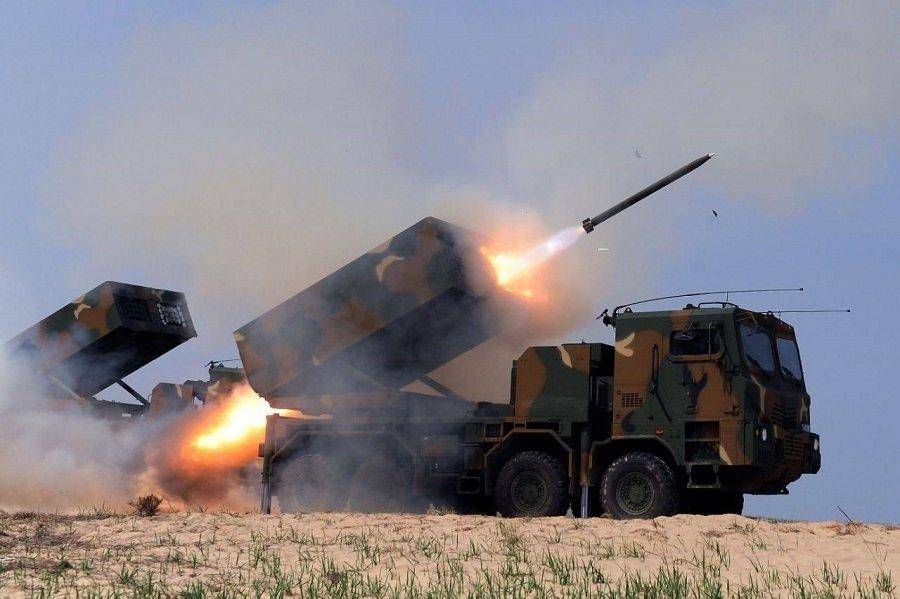
Washington wants to be Serbia's partner of choice. Croatia has just committed €435 million to long-range rockets and called them its answer to Serbia. Before Mr Rubio flies to Belgrade, he should stop in Zagreb.
By Albatros Rexhaj | 4 October 2026
No one knows the Serbs better than the Croats. They lived in one state for seventy years. They served in the same army. They speak a language the other understands without a dictionary. In 1991 they learned in Vukovar what the speeches from Belgrade had meant.
This autumn they stopped warning and started buying. On 4 September the Croatian government approved the purchase of eighteen South Korean Chunmoo rocket launchers for €435.2 million, to replace obsolete launchers with a range of twenty kilometres. The contracts were signed six days later. Prime Minister Andrej Plenković said Croatia was getting a capability it has never had. Defence Minister Ivan Anušić said the launchers and the Rafale jets would be the army's strongest striking force.
On Friday in Zadar, Anušić said who the new rockets are for. Serbia, he said, has spent ten years arming itself with offensive systems. When the news came that Serbia had what he called hypersonic missiles with a range of 400 kilometres, which Aleksandar Vučić had said can hit every capital in the neighbourhood, Croatia was already a year into negotiating Chunmoo. "We have a counter-answer." Croatia will restore "the balance of armed forces" in south-eastern Europe.
Then he described the neighbour. "Someone has to be a counterweight to a neighbour that is arming itself and threatening a return of the 1990s, revenge for Operation Storm, that threatens that the territory of the Republic of Kosovo is Serbian territory." The same neighbour, he added, still invokes the Karlovac-Karlobag-Virovitica line as its border.
"Nobody buys that much weaponry just to have it," Anušić said, or to hold exercises once a year. Serbia is "the main disruptive factor of peace and stability in this area," and nobody should avoid saying so. Europe and the world must treat Serbia differently. Everything Croatia hears, sees and reads, he said, points "in the direction of sharpened relations and possibly some conflict." He does not think Croatia is the first target, "but unfortunately some neighbouring states could be." He knows no other way to deal with that political establishment than to prepare for every scenario. Croatia is arming to "prevent that final scenario we could not prevent in 1990."
Serbia has two neighbours outside NATO. They are Bosnia and Kosovo.
The same day Plenković took the matter from the ministry to the state. "We are following this very closely, and we discussed it at both the Defence Council and the National Security Council." He called it an incredible process of Serbia arming itself, almost a shopping mania reaching every part of the world. "All of us as neighbours have to ask why." Croatia has tripled its own defence budget in ten years, he said, for capabilities that "are a threat to no one" and exist to deter.
President Zoran Milanović asked the same question in July, after the NATO summit in Ankara: what is Serbia's threat assessment? The president and the government agree on little in Zagreb. They agree on this. Belgrade has never given an answer that fits the arsenal. No neighbouring government is preparing to attack Serbia. Every one of them is in NATO, in the European Union, or trying to join both.
In February Serbia's Defence Ministry called the cooperation between Croatia, Albania and Kosovo "a factor of pressure and a security challenge." The same week the General Staff called it a serious security challenge aimed directly at Serbia and announced that, on the order of the supreme commander, the army would secure "capabilities greater than the total capabilities of this military alliance." The supreme commander was Vučić. That is a grievance dressed as a threat assessment.
On Friday he answered Plenković from a campaign rally in Aleksinac. Serbia has a shopping mania but no Nazi mania, which he placed in Croatia. Belgrade is watching Zagreb, Prishtina and Tirana closely. Serbia, he said, will attack no one.
On 15 September a State Department official, Daniel Lawton, told Congress that in Serbia the United States is advocating for itself "as the partner of choice." He listed defence among the subjects of the new Strategic Dialogue. On 23 September Marco Rubio said Serbia is tied up in issues that are "potentially problematic and explosive," and that Washington intends to deepen the partnership anyway.
Engagement and deterrence can live side by side. Washington may believe that closeness will tame Belgrade. Then it should say so, and explain how that fits with a NATO ally buying rockets to balance the same army. If it does not share Zagreb's assessment, it should say that instead. It has said neither.
Moscow has been clearer. The day before Zadar, at Valdai, Vladimir Putin said the Serbs "ended up a divided nation in Europe, and divided by force. That is unjust." Every injustice, he added, leads to difficulties and conflicts. Then he hoped Vučić would be Serbia's next prime minister. Serbia has no enemy at its borders. It has a grievance, and the grievance now has a sponsor.
Anušić's sentence about treating Serbia differently was addressed to Europe. As of Sunday, Brussels had offered no public reply. Serbia is its candidate, and Europe is too weak to repeat what its own member state says at a public conference. So the Croats say it in the language of ministers: counter-answer, balance of forces, final scenario. In plain language it is one sentence. Serbia is preparing for war.
Mr Rubio says he hopes to visit Belgrade. Zagreb is an hour away. Ask the Croats which Serbia he is partnering with.
Albatros Rexhaj is an author, playwright, and analyst with a background in national-security studies and nearly three decades of experience with international organisations dealing with political and security affairs.
