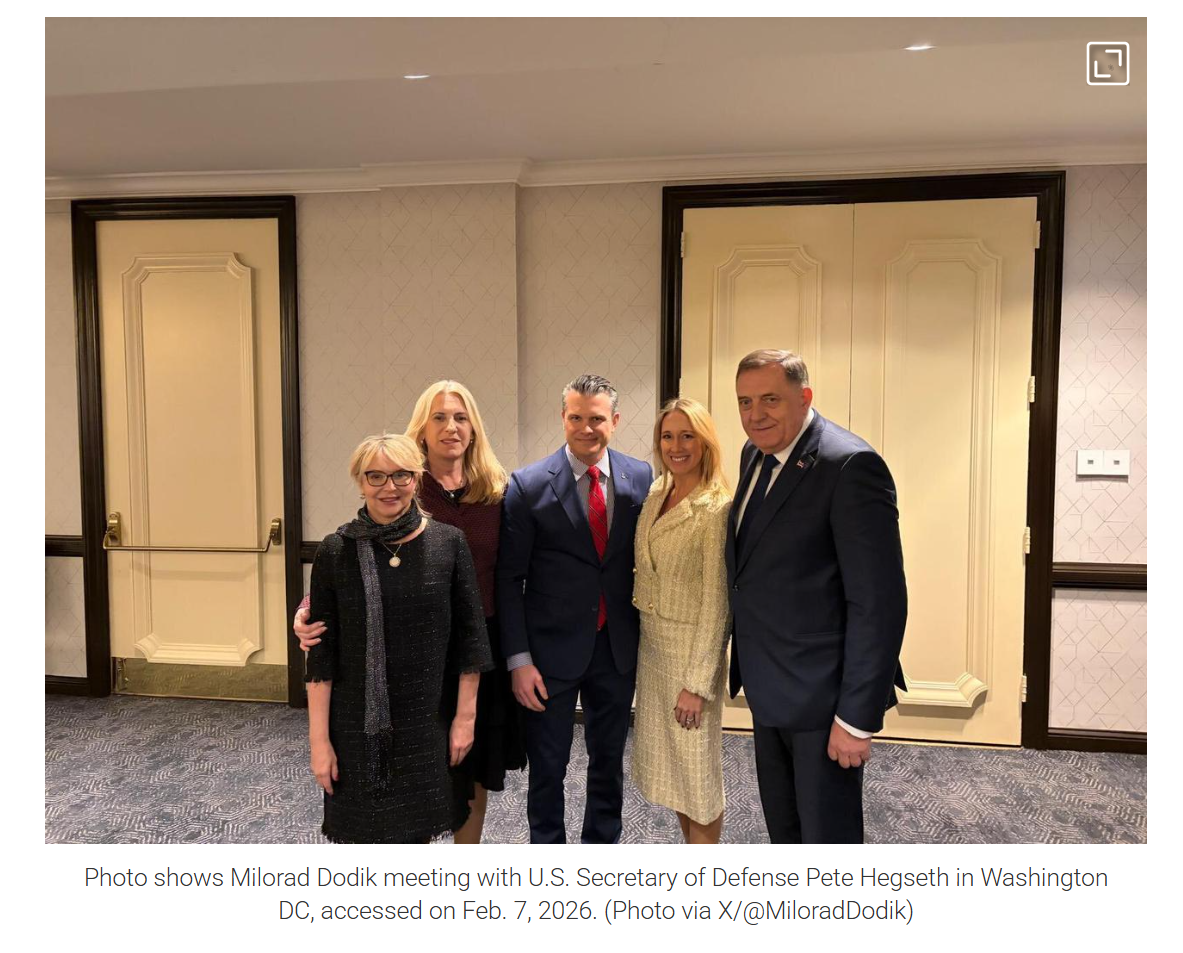
Milorad Dodik is selling the American right a crusade its own president never declared, and the asking price is the coalition the Iran policy actually runs on
By Elmi Berisha | 12 July 2026
This weekend, as American forces struck a third wave of Iranian targets, Milorad Dodik, who still runs Republika Srpska in practice if no longer in title, published a statement of support for President Trump. Read quickly, it says what a hundred allied statements have said: the president showed political will, Iran showed its destructive nature, the response is understandable and justified, peace through strength. Read slowly, it says something else entirely, and the something else is addressed to us, to the American right, in our own vocabulary. It deserves the slow reading, because it is the most efficient specimen yet of an influence operation that has been assembling itself in plain sight for two years, and because the thing it asks us to buy would cost this administration its own Middle East policy.
Here is the load bearing passage. Iran, Dodik writes, is not only a Middle Eastern problem; its malign influence reaches the Balkans. During the Bosnian civil war, he continues, Iran brought in, organized and trained terrorists "to fight against Christians, us Orthodox Serbs," and Republika Srpska will never forget the images of Serb heads severed by terrorists whose presence was the work of "Revolutionary Guard commander Qasem Soleimani."
Two sentences, three moves. The Bosnian war is reclassified as a jihad against Christians. The Serbs are installed as the Christian party, which is to say our party, in that jihad. And the whole construction is bolted to the name Washington knows best, so that the reader completes the syllogism himself: the enemy America is striking today is the enemy the Serbs were fighting in 1993, therefore the Serbs were us before we knew it, and their old war is a front in our new one.
Take the moves in reverse order, starting with the name, because the name is checkable and it is false. Qasem Soleimani did not command the Quds Force during the Bosnian war. He assumed that command in the late 1990s, after Dayton, after the war was over. Through the war years he was a divisional commander inside Iran, a veteran of the Iraq front with no documented operational role in Bosnia whatsoever. The attribution is not an error of detail. It is a marketing decision. Dodik's audience does not know the name of any actual Iranian officer of the 1990s, but it knows Soleimani, the man an American drone killed at Baghdad airport, and so Soleimani is retroactively issued command of a battlefield he never touched. When a statement fabricates its most specific claim for the convenience of a foreign audience, you have learned what the statement is. Not testimony. Product.
Now the kernel of truth, because there is one, and conceding it fully is the only honest way to proceed. Iran did run weapons and intelligence personnel into wartime Bosnia. Foreign mujahideen did fight there, and the record of the Hague tribunal documents atrocities against Serb captives, including beheadings, crimes that were real, filmed, prosecuted and are not in dispute. No honest analysis of Dodik's statement requires denying an ounce of that. But the foreign fighters were overwhelmingly Arab veterans of the Afghan jihad, organizationally distinct from the Iranian channel. And neither of them was the Bosnian war, a war whose adjudicated architecture, rendered by tribunals America built and staffed, found that the campaign of genocide was conducted by Serb forces at Srebrenica, thirty one years ago this weekend. Dodik's frame does not contest a single one of those findings. It swaps the shelf they sit on, from law to theology, where verdicts do not apply and identity is the only evidence.
And watch what gets carried onto the new shelf along with them. The day before the Iran statement, on the anniversary of Srebrenica itself, Dodik stood at the Kozara commemoration and invoked the tens of thousands of Serbs, women and children among them, deported from that mountain to the Jasenovac camp in 1942. Those dead are real, their number is monstrous, and their killers were the Ustasha, the clerical fascist regime of wartime Croatia, a movement that fused its nationalism with militant Catholicism and operated under German patronage. Dodik himself recited its program from the podium: a third of the Serbs to be expelled, a third converted, a third killed. Converted to what? To Catholicism. The formula he quoted convicts his own frame, because it names the perpetrators' religion, and the religion is Christianity. There was no Iranian and no Muslim in the chain of command of that crime; Jasenovac was Christians exterminating Christians under a fascist cross. Yet the Kozara speech and the Iran statement, delivered twenty four hours apart, are one operation, and the operation files Jasenovac and the mujahideen videos in the same ledger, a single continuous martyrdom of Christians at the hands of a single continuous enemy, currently headquartered in Tehran. That is not remembrance. That is the conscription of his own people's dead into a war they were never in, against an enemy who was not there, and a man willing to re-deploy Jasenovac against Islam will re-deploy anything against anyone.
Which brings us to the first move, the reclassification, and to the question every conservative reader should ask before adopting anyone's frame: whose policy does it serve?
Not this president's. Ask the question the way this administration asks questions. The Iran campaign runs on Muslim capitals. It runs on Gulf basing, Gulf airspace and Gulf acquiescence. It runs on a NATO ally in Ankara whose cooperation the entire Syrian file depends on, and on a Damascus this administration spent a year prying out of the Iranian orbit precisely so that the Islamic Republic would stand alone. The president's Middle East is a place where America's Muslim partners invest trillions in American industry, buy American aircraft and sign American brokered accords. So put Dodik's frame to the test it cannot survive. Is a Christian war on Islam the story the president plans to announce in Ankara? Is it the communiqué he intends to read in Riyadh, the toast he means to raise in Doha, the preamble to the next Abraham Accord? The question answers itself. A frame in which the Iran strikes open Christendom's war on Islam does not extend this president's policy. It detonates it, hands Tehran the one narrative capable of dissolving the coalition, and refills the ranks of every jihadist recruiter from Raqqa to Novi Pazar. The people who want this war understood as religious are the ayatollahs' propagandists and Milorad Dodik, and only one of them wrote it in our language.
So the frame is not a description of American policy. It is a license application, and the license it seeks is local. Follow the logic to its destination. If the world war is Christians against Muslims and Iran is merely the first theater, then the Muslims nearest to Republika Srpska, the Bosniaks first and the Albanians after them, are enemy population by definition, and whatever is undertaken against the state they live in is not a violation of the American peace but a contribution to the American war. At Kozara, Dodik supplied the program that wants the license: one people, one state, delivered over the memory of Jasenovac, with the observation that forces are strengthening in the world that wish to hear Republika Srpska. He was more candid still about the mechanism, and here he should be quoted rather than summarized, because no paraphrase improves on the original. The situation in America itself has changed, he told the crowd in remarks carried by the entity's own broadcaster, with the basic narrative there now the protection of Christian values in the world and the struggle to preserve Christianity. Then, of the Serb victimhood exhibition currently touring New York: "And in that environment, I believe, this presentation will have far greater penetration than it would have had if we had done it during the administration of Joseph Biden, who could do nothing to help the Serbs." Penetration. Prodor in the original, a word that belongs to the vocabulary of military operations and market entry, not of mourning. He is standing at a mass grave commemoration, describing America as terrain, the Christian values discourse as the soft point in the perimeter, and his people's dead as the payload. That is not a man describing our policy. That is a man pricing our susceptibility, in public, to applause.
And here the ledger this administration keeps best, the ledger of deals, has an entry of its own. Washington lifted the sanctions on Dodik. The relief was not a gift; it was a transaction, extended against assurances of constructive conduct, the standard terms this White House applies everywhere: behave, and the pressure comes off; test us, and it snaps back. Very well. Audit the deliverables. Within months of relief, the counterparty has stood at Kozara announcing one people one state, packaged a fictional holy war for export to the president's own coalition, and attached the president's name to it without authorization. In the language of this administration, that is not a partner honoring terms. That is a counterparty in breach, spending American goodwill as working capital for a project Washington never underwrote. The art of any deal begins with reading the other side of the table, and the other side of this table has told us, in public, at a genocide anniversary, exactly what he bought the relief to do.
The product itself has a provenance, and the label should be stamped on it. In 1992 Radovan Karadžić and Slobodan Milošević marketed the destruction of Bosnia to the West as Christian Europe's forward defense against fundamentalism. Some European conservatives bought it. Washington did not, the pitch failed, and the men who made it ended in a Hague cell and a Hague dock, convicted on a record that begins at Srebrenica. The pitch has not changed. The bet is that the customer has, that the civilizational vocabulary now circulating on parts of the American right has created buyers who do not know what this vendor's predecessors did the last time someone accepted their framing. The distribution network for that bet is no longer hypothetical. Republika Srpska retains American lobbyists, Rod Blagojevich most conspicuously, registered under FARA to carry precisely this packaging into the president's own coalition. The exhibition is in New York. And Serb media now report, with satisfaction, that American prosecutors are expected in Derventa to investigate wartime crimes against Serbs, which would mean the operation is no longer merely placing narratives. It is generating official American activity aligned with them.
Against all of this, set the scoreboard, because this movement judges by conduct and the conduct is a matter of record. When Israeli and American ordnance ended the life of Ali Khamenei, Tehran buried him at a sorted funeral, closed to Europe, open only to governments whose wartime position the regime judged appropriate. One European accession country qualified: Serbia, which sent a sitting minister to stand among Hamas and Islamic Jihad. This, days after Belgrade halted its arms sales to Israel in protest at the war and reached, as it always does, for the analogy between Iran under American bombs and Serbia in 1999. Meanwhile the two Muslim majority governments of the Balkans compiled the opposite record. Albania severed relations with Iran in 2022 after Tehran's cyberattack crippled its state systems, shelters the Iranian opposition at permanent cost in Iranian intelligence pressure, and answered the strikes with a call to designate the Revolutionary Guard a terrorist organization. Kosovo recognized Israel and put its embassy in Jerusalem when almost nobody else would, paid for it across the Islamic world at the moment recognition mattered most to its survival, and publicly backed the American action. By Tehran's own stated criteria both governments failed the Islamic Republic's examination, which is the only compliment the Islamic Republic pays.
And it is worth asking, in plain terms, who these Balkan Muslims actually are, because the frame depends on the reader never meeting them. They are among the most secular Muslim populations on earth, heirs to centuries of coexistence and, in Albania's case, to a half century of enforced atheism that left religion a matter of heritage more than practice; Kosovo wrote itself a strictly secular constitution and enforces it. When radical preachers backed by Gulf money tried to gain a foothold in the 2010s, these were the governments that shut the networks down and jailed their own returning fighters, in close cooperation with American agencies. And they are, by nearly every measurement ever taken, the most pro American societies in the world. Gallup's global tracking has repeatedly found approval of American leadership higher in Kosovo and Albania than anywhere else on the planet, higher than in America itself; Pristina put a statue of Bill Clinton on a boulevard bearing his name and named a generation of its sons Tonibler. This is the population Dodik's frame invites Washington to file as the enemy's reserve army: the one corner of the Islamic world where American flags fly from private balconies because people want them there.
Hold the two images side by side, because the entire operation exists to prevent you from doing so. On the weekend of the funeral, the Muslims of the Balkans stood with Washington, and the self proclaimed defenders of Christianity stood, through the government of Serbia, at the graveside in Tehran. The civilizational frame is not an interpretation of that scoreboard. It is the eraser for it. Its one function is to replace a record of conduct that flatters America's actual friends with a table of identities that flatters the other side, so that when a Balkan question next lands on an American desk it arrives pre sorted into Christians we owe and Muslims we suspect, the debts and suspicions each assigned to precisely the wrong column.
There is a final cost, and it is the kind this administration weighs better than the last one did. A confessional sorting of the Balkans has an activation sequence. Turkey reads itself as guarantor of the region's Muslims and keeps forces in Bosnia to prove it. Russia is already installed as patron on the other side of the map. An American right seen blessing Dodik's frame would begin mapping great power patronage onto the confessional geography of southeastern Europe, the one configuration every administration of both parties has spent thirty years preventing, because it converts a policing problem, one politician in Banja Luka, into a systemic confrontation with a calendar someone else controls. The president ran against inheriting other people's wars. This is the delivery mechanism for one, gift wrapped in his own slogans. And even Belgrade does not believe the story it exports to us. Serbia's economy is increasingly financed from the Gulf, its Belgrade waterfront built with Emirati capital, its Expo courted in Riyadh, its president assiduous with Erdogan. The holy war is not the Serb world's conviction. It is one product line, manufactured for a single export market, and the market is us.
America First means America picks its own friends, by American interests and American receipts, not by other people's theology. The president did not declare a religious war. His policy could not survive one, his partners in Ankara, Riyadh and Doha would read it in the original, and the man insisting otherwise leads an entity whose patron state sent a mourner to Khamenei's funeral while Prishtina and Tirana stood with the United States. Someone is trying to pick this country's friends for it, against the evidence of who those friends are, on credit extended by this administration's own sanctions relief. The correct response is the one this White House applies everywhere else. Check the conduct. Check the invoice. And when the counterparty is in breach, say so, in the only language he has shown he understands.
Elmi Berisha holds a PhD in National Security Studies. He is a prominent Albanian-American community leader and businessman based in the New York area, and serves as President of the Pan-Albanian Federation of America "Vatra" (Federata Panshqiptare e Amerikës VATRA), the oldest Albanian patriotic organization in the United States, founded in 1912.