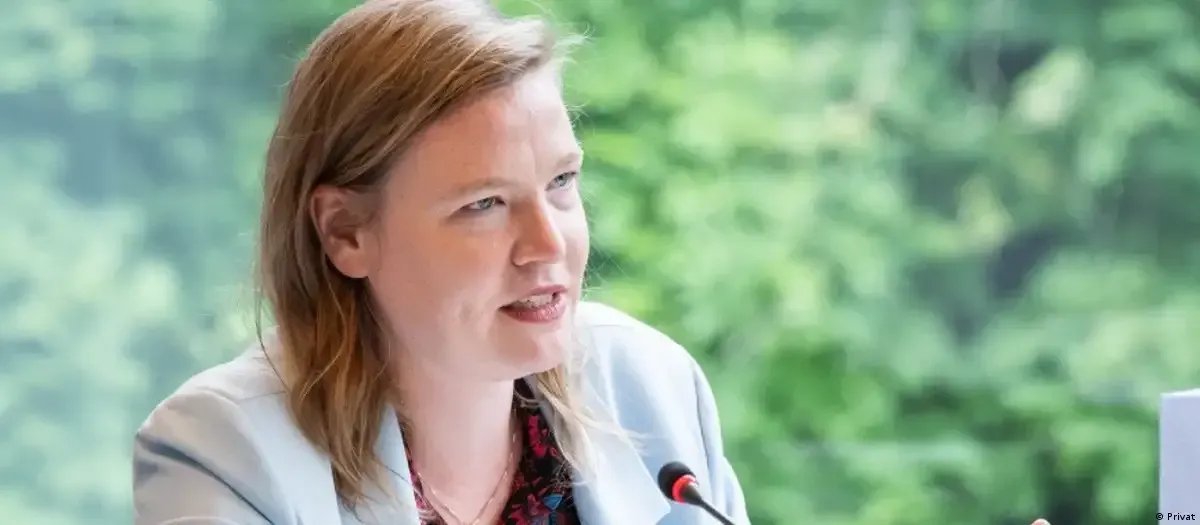
Kosovo is voting for the second time this year. German Balkans expert Frauke Seebass calls for dialogue between political parties and reminds that Kosovo has lost significant international reputation this year.
By Lindita Arapi (DW) | 25 December 2025
DW: For the second time within a year, Kosovo is holding new elections. Do you think these elections will unblock the political situation in the country? During the campaign, other parties have again stated that they will not enter a coalition with Albin Kurti’s party, Vetëvendosje.
Frauke Seebass: Everything will depend on the election results. Vetëvendosje hopes for such a strong majority that it can govern alone or “only” with the support of minority parties, which are guaranteed a certain number of seats by the Constitution. This strategy failed after the February elections.
In the event of a narrow result, Vetëvendosje may try to persuade individual politicians from other parties to support a coalition. The pre-election alliance with the small PSHDK party (in addition to Guxo and Alternativa), which are traditional partners of the LDK, is an indication of this approach. However, it is also possible that opposition parties could mobilize enough support to form a government without Vetëvendosje, although the chances of this are low. If we see a result similar to February, a new deadlock cannot be ruled out.
DW: Why is there such a strong refusal toward Albin Kurti?
First and foremost, this is mainly related to his uncompromising stance, with which he declared war on the “corrupt elites” and, in effect, on all other parties. Before the February elections, Vetëvendosje aimed to regain a constitutive majority, while the other major parties positioned themselves primarily in opposition to Albin Kurti. This created a poisoned atmosphere among them.
After the farce surrounding the election of the Speaker of Parliament—interpreted by Kurti as a deliberate obstruction—there was no room left for compromise. If Kurti fails to engage in dialogue with other parties, further deadlock is to be expected.
DW: Yes, the lack of political will among parties in Kosovo led to these snap elections, but Kosovo did not previously have a tradition of such a profound lack of compromise. How do you explain this level of political polarization?
Vetëvendosje’s victory in 2021 was a protest vote, following the collapse of the coalition with the LDK, with U.S. involvement. While Vetëvendosje had been forced to compromise in that coalition, it was later able to govern virtually uncontested for four years.
The election campaign leading up to the February elections and the subsequent months of deadlock poisoned the atmosphere in parliament and throughout the country. One can only hope that the parties will return to and remember their responsibility toward citizens, regardless of the election outcome.
DW: Albin Kurti has also faced considerable criticism from Kosovo’s international partners. Under a possible Kurti government, how can progress be ensured in the dialogue with Serbia—a key condition for Kosovo’s further integration into the EU?
For the EU, implementation of the 2023 Ohrid Agreement remains essential, and Kosovo must demonstrate progress in establishing the Association of Serb-Majority Municipalities. This is fundamentally linked to all of Kosovo’s progress in transatlantic integration—from membership in the Council of Europe to the handling of its EU membership application.
Due to the political situation in Serbia, rapprochement with the EU is currently very difficult, especially under Kurti. However, Kosovo could make significant progress both domestically and in foreign policy by implementing the Association.
DW: So far, the Association seems distant. Can it be considered the main reason why Kosovo is currently stalled in its EU integration? Until recently, the EU also had sanctions in place, and the U.S. suspended the strategic dialogue.
The measures and blockades are directed against Kurti and his unilateral policies, especially the lack of consultations and escalations in the northern municipalities. Instead of denouncing unequal treatment compared to Serbia, the government should understand that it is in a defensive position and that there is no consensus within the EU.
The measures are legally in a grey zone; unanimity is required to lift them, but many countries want to see Kosovo make concessions first. It can be assumed that international partners would be more open to a government led by someone other than Kurti.
DW: Kosovo fears that the Association could endanger the functionality of Europe’s newest state. How realistic is this risk, given that Serb municipalities seek a form of self-governance within Kosovo through the Association?
I no longer see this risk following the Constitutional Court’s ruling and the current proposals under the Ohrid Agreement. On the contrary, I believe that the Association of Municipalities is a prerequisite for the integration of Kosovo Serbs and further democratization—especially if southern municipalities are also included.
Such deeper integration could also prevent renewed proposals for territorial changes (territory swaps). The Association—protected by the constitution and the right to self-management enshrined in it—would administer areas such as education and urban planning, but it could not block national decisions, as is the case, for example, in Republika Srpska. Vetëvendosje’s idea of forcing integration through reciprocity, on the other hand, has failed.
DW: Meanwhile, Serbia and Kosovo accuse each other of violating the Brussels agreements on normalization. What can the EU do to ensure that an agreement, once signed, is actually implemented?
The EU actually has many levers to bring about progress in implementing agreements, but it lacks political will and, above all, unity. Therefore, I see more potential in a coalition of states taking the lead and offering both positive and negative incentives.
However, given the current situation in Serbia, such a strategy would be delayed by years. I do not see Serbia implementing agreements in the coming years.
DW: Kosovo remains the poorest country in Europe and the only Western Balkan state without EU candidate status. Has the EU been too harsh on Kosovo, or should the reasons be sought within the policies of the current government?
This is complex, but in short, there is truth in both. For me, the turning point was 2018, when EU member states refused visa liberalization for domestic political reasons. The perception in Kosovo was that many compromises had been made without concrete results, and Vetëvendosje capitalized on this atmosphere.
On the other hand, Kurti’s unilateral actions and the recent months of deadlock have played a major role in alienating even Kosovo’s traditional partners. Kosovo’s international reputation has suffered considerable damage.
_____________
Frauke Seebass is currently a visiting researcher at the Brussels office of the German think tank Science and Politics. Her work focuses on the Western Balkans, EU enlargement, and peace and conflict studies.
Editorial Note:
This interview was originally published by Deutsche Welle (DW) in its Albanian-language service. The English version reproduced here is a faithful translation of the original interview and is published for informational and analytical purposes.
