A letter to the White House Faith Office asks conservatives to defend persecuted Christians in Kosovo. It is built to turn a genuine American conviction into leverage for Belgrade and Moscow.
Kosovo Dispatch | DC Bureau | 28 June 2026
A letter reached the White House Faith Office this week, written for the kind of American whose first instinct is to defend a persecuted church wherever he finds one. It asks that instinct to take up the cause of the Serbs of Kosovo, wronged, it says, on their holiest day. If you hold religious liberty to be the first freedom, as I do, the pull is immediate, and it is worth resisting long enough to read past the word that does the pulling. The letter does not depend on its story being true. It depends on the reader seeing the word Christian and concluding the case is already made.
What actually happened
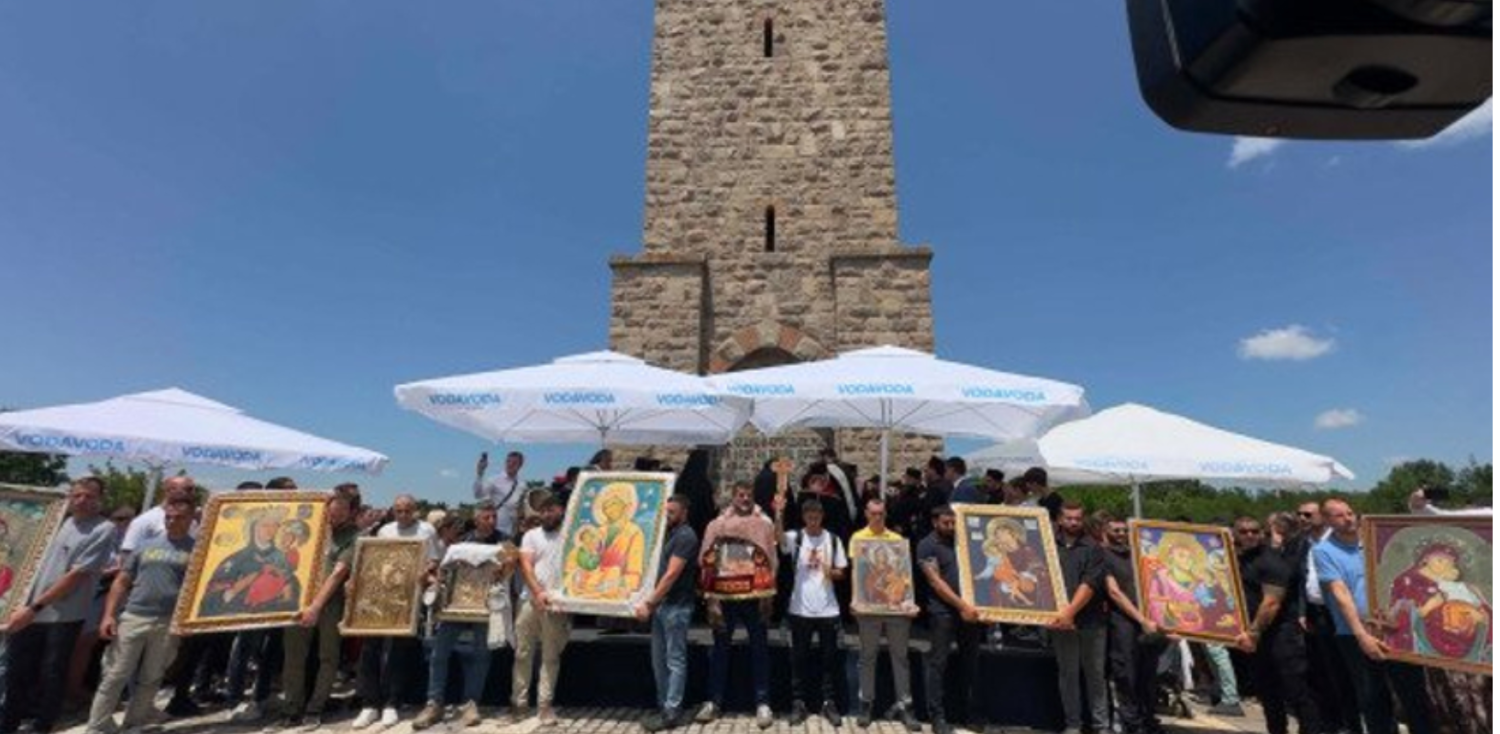
On June 28, Serbs gathered at Gazimestan to mark Vidovdan, the feast that doubles as the anniversary of the 1389 battle. The liturgy went ahead. The memorial service was led by two metropolitans of the Serbian Orthodox Church. No one stopped the prayer, closed a church, or turned a priest away. The notice Kosovo Police handed out at the site, which this publication has read, is an ordinary public-order warning: no violence, no vandalism, and no symbols or banners used to incite interethnic, religious, or political hatred, set beside an explicit pledge to protect the right to mark the day in peace. It imposed no general prohibition on Serbian national flags. The line it drew was at incitement, which is the line most democracies draw at a charged commemoration.
Afterward, as the crowd broke up, police took 37 people in for questioning over chants the force called provocative and hate-inciting, fined one for disorder, and released all 37 the same day, their cases referred to the courts. Strip the adjectives and that is what remains: a tense anniversary, policed for incitement, with everyone home by nightfall.
The trap
Set that against the letter, which speaks of religious persecution, suppressed worship, a faith under siege. The distance between the two is the point of the exercise. Whatever its stated purpose, the letter went not to the State Department or the embassy in Pristina, the offices that run Kosovo policy and could actually act, but to a new domestic office created to police anti-Christian bias inside the American government, one with no authority over Kosovo and no power to release a soul. A complaint that would get nowhere among the people who know the file can travel a long way in a room where the word Christian opens the door.
Why Kosovo
The choice of Kosovo is not incidental, because Kosovo lets two unrelated audiences be moved by a single story. To Moscow's public it reads as one more instance of the West grinding down Orthodox Christians. To Washington's it reads as Christians menaced by a Muslim-majority government. The two narratives flatly contradict each other, and that does not matter, because no one is asked to hold both at once. Each is built to walk a different constituency through a different emotional door to the same place: Kosovo in the wrong, Serbia aggrieved. The objective is not factual consistency. It is political alignment.
Who you would be defending
Here is what should give a conservative pause. The country cast as the persecutor is among the most reliably pro-American societies anywhere. Its streets carry the names of American presidents and other Western figures; its crowds raise American flags at civilian celebrations without being asked; the gratitude for 1999 has not worn off. It is a Muslim-majority democracy that recognized Israel and became the first Muslim-majority country to put its embassy in Jerusalem, a decision American conservatives applauded at the time, the Heritage Foundation among them. Outside its parliament stands a memorial to the Holocaust and Kosovo's Jewish community, raised by a people whose wartime record includes sheltering Jewish families. It seeks NATO membership and trains its soldiers alongside ours. That is the country this letter asks American Christians to treat as an enemy of the faith.
Who wrote it
Consider the return address. Srpska Lista is not a frightened congregation; it is Aleksandar Vučić's political instrument inside Kosovo. And Vučić's Serbia remains Moscow's closest partner in Europe outside Russia's own client states, a government that has declined to join Western sanctions on Russia and keeps in good repair the idiom of Orthodox solidarity that Russian diplomacy has cultivated for generations. The story now sitting in an American faith office originates in Belgrade and flatters Moscow. Carrying it does nothing for American religious liberty. It advances a Serbian information campaign.
The cost
This is not a victimless indulgence. The credibility of religious-liberty advocacy is finite, and it works only because the charge has generally been used with care. Christians are being killed in Nigeria's Middle Belt; pastors are jailed and churches demolished in China; believers vanish into camps in North Korea. American pressure still carries weight in those places because, when Washington says persecution, the word has not been spent on cases that collapse on inspection. Spend it on a manufactured grievance in Kosovo and the loss is not confined to Kosovo. It shows up in the next real case, which will be that much easier to wave away.
The right channel
None of this places Kosovo above criticism. There is a legitimate argument to be had about minority symbols, and Kosovo's own Western partners made it directly: in June the Quint capitals and the EU office reminded Pristina that the constitution protects the national symbols of minority communities. That is how a genuine rights question moves, through the parties with leverage over Pristina, on the merits, and those channels have produced results before. An office with no reach into Kosovo is not where a real grievance goes to be resolved. It is where a manufactured one goes to be amplified. The sober response to this letter is to pass it to the people who handle the Balkans and to withhold the religious-liberty label it was built to borrow.
The actual stakes
The letter appeals to a genuine instinct, the refusal to ignore Christians who are truly persecuted. That instinct is worth something only if it is kept for cases where the persecution can actually be shown, and this is not one of them. The harm in spending it here does not stay in Kosovo. It comes due the next time the charge is real and Washington finds the word worth a little less than it was.
