Kosovo Dispatch is republishing this interview because Kosovo should read what is being said about it in Berlin before it is reduced to a headline.
Tobias Teich’s answer on Kosovo is not a stray remark. It belongs to a larger argument about Germany, the European Union, NATO, Russia and the Western Balkans. In the interview, he describes Kosovo’s 2008 declaration of independence as a mistake, says his parliamentary group opposes Kosovo’s membership in the European Union and the Council of Europe, and says that an AfD government would halt any further deepening of relations and initiate a review of Germany’s decision to recognise the state. He also argues for executive powers for the Association of Serb Municipalities.
Those sentences will attract attention in Kosovo. But extracting them from the rest of the interview would make them easier to quote and harder to understand.
Teich explains the political reasoning that leads to them. He speaks of a “Europe of nations,” argues against further EU enlargement, calls for foreign policy less subordinated to the United States, advocates renewed diplomacy with Russia, and says stability in the Balkans requires respecting what he calls the “ethnic reality on the ground.” The Kosovo position sits inside that framework.
That is why we are publishing the interview in full.
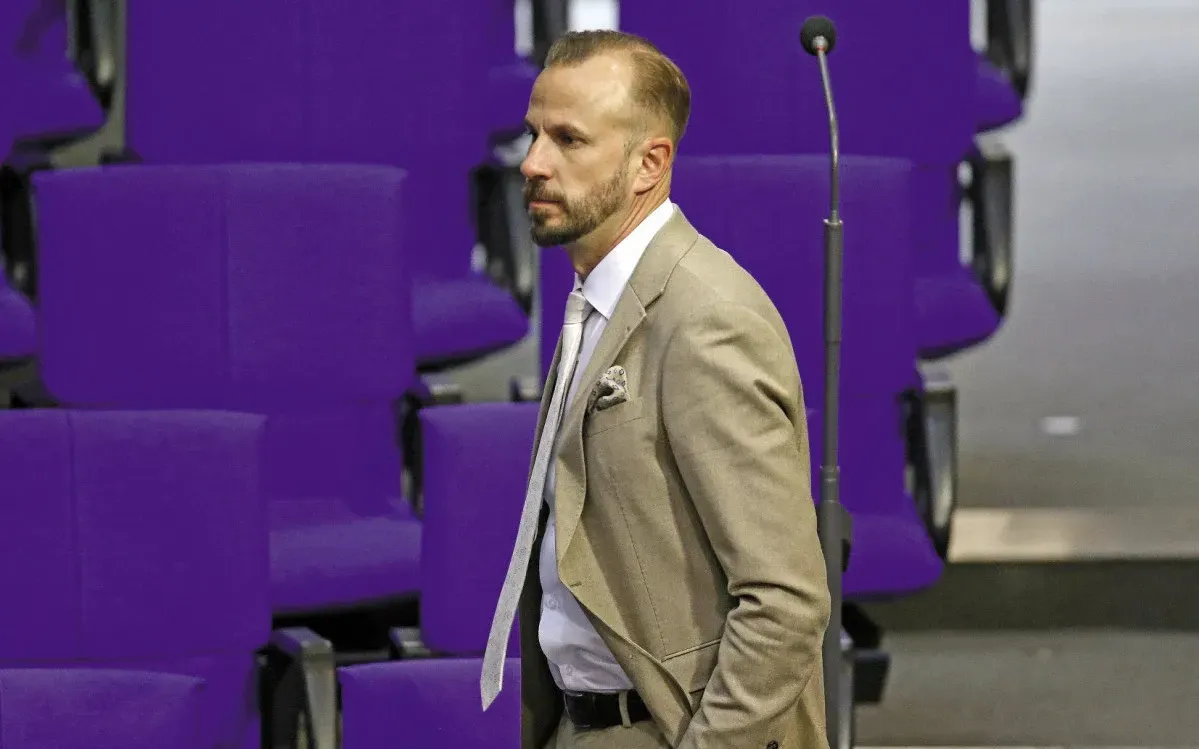
Publication is not endorsement. It is a record. Teich is a member of the German Bundestag, and his views on Kosovo are stated here with unusual specificity. Kosovo’s readers are better served by seeing the argument as he makes it, including the assumptions behind it, than by receiving one paragraph after it has travelled through several rounds of reaction.
The interview below was published by the Serbian weekly NIN on 23 September 2026. Kosovo Dispatch has translated the Serbian text into English, preserving the questions, answers and political claims without softening or correcting them.
25 September 2026
The rise of Alternative for Germany (AfD) has long ceased to be merely a regional phenomenon or a short-lived expression of political revolt in the east of the country. The latest state elections have reshaped Germany’s political map, positioning the party as an unavoidable, though still deeply polarising, factor in federal politics.
While the established parties, above all the CDU and the governing SPD, try to maintain the so-called “firewall” (Brandmauer), AfD is undergoing dramatic structural changes in its electorate, becoming the first choice among the working class as well as among the youngest voters. At the same time, the party faces constant institutional pressure and security classifications, while its foreign-policy agenda is redefining views of the future of the European Union, transatlantic relations and the complex question of the Western Balkans.
Tobias Teich’s interview with NIN sheds light on the depth of the systemic crisis in which Germany finds itself, but also on the clear ideological direction through which AfD intends to articulate accumulated public discontent. Whether it is the dismantling of Brussels’ supranational bureaucracy, insistence on the strict application of immigration laws through the concept of remigration, or a pragmatic redefinition of relations with Moscow and Washington, it is evident that the party no longer speaks from the margins, but from the position of an alternative aspiring to a real share of power.
AfD’s positions on the Western Balkans, particularly its criticism of Kosovo’s unilateral independence and its advocacy of a privileged partnership instead of formal EU enlargement, directly challenge Berlin’s decades-old foreign-policy consensus. Tobias Teich, an AfD member of the Bundestag and a member of the Committee on European Union Affairs, speaks to NIN about all of this.
AfD has now been recording historically high percentages in state elections for some time. Given that the CDU and SPD continue to hold firmly against you, how do you plan in practice to reduce their advantage and assume real responsibility for governing the country?
We are growing steadily, from the local level and the state parliaments all the way to the Bundestag. That is not accidental, but the result of consistent and substantive work. We are closing the gap with the CDU and SPD not by adapting, but through three things: first, by building local and municipal political structures, because governing capacity is built from the bottom up; second, by offering clear and workable alternatives on migration, economic and energy policy instead of merely attracting protest votes; and third, because the public increasingly recognises what the so-called “firewall” erected by the established parties actually represents: a refusal to allow democratic majorities to form. That wall will collapse because it was built against the will of the voters, not because we compromise our principles.
The latest public-opinion research, including Infratest dimap, shows a dramatic change in the demographics of your electorate: you have become the leading party among the working class and among 18-to-24-year-olds. Is this breakthrough driven primarily by Germany’s economic recession, deep disagreement with Berlin’s migration policy, or a complete loss of young people’s trust in mainstream institutions?
These three factors, economic recession, opposition to migration policy and loss of trust in institutions, reinforce one another. In my view, they have a common root. Workers who see wages stagnating while energy prices soar, while social benefits are simultaneously directed towards uncontrolled immigration, lose trust in the institutions responsible for managing and overseeing precisely those issues. At the same time, young people face a political environment that imposes climate regulations, bureaucracy and limited prospects in life, while the established parties appear completely interchangeable. Ultimately, the fundamental cause is that the political establishment has lost contact with the lived reality of ordinary people, and it is precisely to that reality that we are rededicating ourselves.
The Federal Office for the Protection of the Constitution has classified parts of AfD as “proven right-wing extremist.” How do you respond to arguments from political opponents that AfD’s political platform, particularly in the area of “remigration,” fundamentally undermines the constitutional and democratic order of the Federal Republic of Germany?
First, the institutional reality must be acknowledged: the Federal Office for the Protection of the Constitution is not an independent judicial body, but an administrative agency subordinate to the Federal Ministry of the Interior and bound to act according to its directives. It operates under the functional and legal supervision of the current federal government, and its president is appointed by political decision.
Accordingly, when an agency subordinate to the government and receiving its directives assesses the largest opposition party, the result is not a neutral judgment based on the rule of law, but an administrative decision susceptible to political influence, with all the accompanying conflicts of interest. That is precisely why the classification is the subject of ongoing legal proceedings in which the courts, rather than the agency itself, must ultimately determine whether the assessment was made in accordance with the law.
An agency that forms part of the government’s chain of command should not serve as an arbiter over the parliamentary opposition. That is a precedent in postwar German history and raises serious questions concerning the separation of powers.
As for the term “remigration,” we use it to mean the consistent and lawful return to their countries of origin of individuals who have no right of residence, such as rejected asylum seekers, criminal offenders who are required to leave the country, and people with “tolerated stay” status (Duldung) who have no prospect of permanent residence. That represents the enforcement of existing law, not hostility towards the constitution. Anyone who wants to defend the Basic Law should begin by enforcing the residence regulations already in force.
As a member of the Bundestag’s Committee on European Union Affairs, you advocate a programme that envisages abolishing the European Parliament and returning to a “Europe of nations,” together with the threat of “Dexit,” or Germany’s departure from the EU. If the common political market is dismantled, how do you envisage Germany’s economic survival, given that its economy is structurally dependent precisely on exports within the EU?
I do not advocate a programme of “abolishing” the single market, but rather abolishing the supranational political structure which, in my view, lacks sufficient democratic legitimacy. Access to the single market can be separated from political union, as the examples of Norway and Switzerland demonstrate. They enjoy full access to the market through the EEA or bilateral agreements without being EU members or adopting the entire regulatory apparatus from Brussels.
For me, a “Europe of nations” means close economic cooperation while retaining the sovereign right to decide on monetary, migration and energy policy. The question is not whether Germany will retain its ability to export, which it will, because our industry is competitive, but whether we want to continue bearing the regulatory costs associated with EU bureaucracy, the Green Deal and TARGET balances within the Eurosystem.
For me, “Dexit” is a plan for the worst-case scenario, not an objective in itself. Our primary demand is fundamental reform.
In the context of the war in Ukraine and the deep polarisation of the continent, on what geopolitical premises does AfD build its idea of “lasting peace in Europe,” and what role does the transatlantic partnership with the United States play in that?
Our starting point is simple: lasting peace in Europe is not achieved through a spiral of military escalation, but through a balancing of interests and diplomacy, including diplomacy with Russia, whether we like it or not, because Russia remains part of the European continent both geographically and geopolitically.
Applying the logic of opposing blocs from the Cold War to present-day circumstances contributed to the outbreak of the war in Ukraine rather than preventing it.
As for the transatlantic partnership, we do not seek to leave NATO, but we want a relationship based on equality, not one-sided submission to foreign-policy adventures that primarily serve U.S. interests. Europe’s security interests, and Germany’s in particular, must be defined independently.
What is AfD’s long-term plan for preserving regional stability and preventing new security crises in the Balkans?
Our approach to the Western Balkans is set out in several motions of which I am a co-sponsor. We advocate a privileged partnership modelled on Switzerland and Norway instead of hasty EU enlargement that would jeopardise the stability of the region.
Concretely, this means strengthening minority rights, particularly those of Serb communities in Bosnia and Herzegovina and Kosovo, abolishing the Office of the High Representative, which no longer has legitimacy under international law, and consistently combating Islamist radicalisation, which represents a real threat in the Balkans.
Stability is achieved by respecting the ethnic reality on the ground, not through an externally imposed multicultural model which, as our motions show, has failed in that region.
Given that AfD insists on the principle of respecting state sovereignty and international law, what is your party’s official and precise position on Kosovo’s unilaterally declared independence? If AfD came to power in Germany, would official Berlin review or withdraw its decision to recognise Kosovo?
The position of the AfD parliamentary group is clear: we consider Kosovo’s unilateral declaration of independence in 2008, carried out without a referendum and while disregarding the will of the Serb minority in northern Kosovo, to have been a mistake both from the standpoint of international law and politically. My colleagues have stated this position repeatedly.
We continue to regard Kosovo as a fragile state with serious structural problems and oppose its admission to the European Union and the Council of Europe.
If AfD assumed responsibility for governing, we would not formally withdraw Germany’s recognition with a stroke of the pen. That would be unrealistic from a foreign-policy standpoint and would affect existing obligations under international law. We would, however, halt any further deepening of relations, particularly steps towards EU accession and visa liberalisation, and initiate a review of the decision to recognise the state in light of unresolved minority-rights issues and the failure of state-building.
In the short term, we advocate granting the Association of Serb Municipalities executive powers grounded in international law, as well as an internationally guaranteed protected status for Serbian churches and monasteries in Kosovo.
