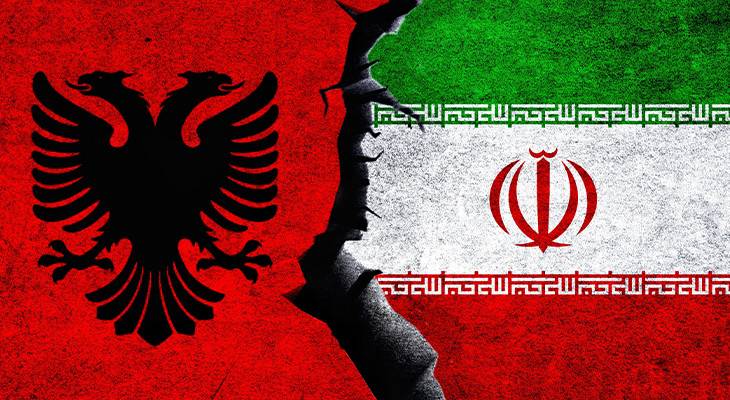
As protests spread across Iran and authorities respond with lethal force and a nationwide internet blackout, Albania’s foreign minister issued a statement that avoided diplomatic hedging and aligned closely with realities on the ground — placing Tirana among the few European voices willing to speak in clear terms as others calibrate caution.
by Klea Ukaj | 10 January 2026
As protests spread across Iran and the authorities responded with lethal force and a nationwide internet shutdown, Elisa Spiropali issued a statement that cut through the usual diplomatic fog. She condemned the “brutal and disproportionate use of force,” affirmed solidarity with “peaceful protesters,” and called internet blackouts and intimidation what they are: evidence of a regime fearful of its own people.
For a small European state, the wording matters. In moments like this, language is not decoration. It is positioning.
The protests now entering their third week are no longer confined to a single city or grievance. What began in late December as economic unrest — triggered by the collapse of the rial, runaway inflation, and the evaporation of purchasing power — has expanded into a nationwide challenge to the Islamic Republic’s authority. Demonstrations have been reported across dozens of cities and provinces. Chants have moved from bread-and-butter demands to direct attacks on the political system and its leadership.
The state’s response has followed a familiar but revealing script. Security forces, including the Revolutionary Guards and the Basij militia, have used live ammunition, tear gas, and mass arrests. Casualty figures are difficult to verify under blackout conditions, but independent monitors and international media report dozens of deaths and hundreds of detentions. On January 8, Iran effectively severed large parts of the country from the global internet — a step regimes reserve for moments when they fear loss of narrative control, not routine dissent.
This is the reality Spiropali’s statement speaks to. It is not rhetorical excess; it is synchronization with facts.
What distinguishes Albania’s intervention is not that it condemns violence — many governments do — but how directly it does so. There is no language of “concern,” no call for “restraint on all sides,” no attempt to dilute responsibility. By asserting that freedom of expression and peaceful protest are fundamental rights rather than privileges, the statement places the Iranian authorities, not the demonstrators, in breach of international norms.
That framing is sharper than what has emerged from much of Europe. The European Union has condemned the violence and expressed support for human rights, but its collective language remains cautious, calibrated to preserve diplomatic channels and avoid escalation. Individual member states have spoken more forcefully, yet often within the bounds of institutional restraint. The result is moral clarity softened by procedural caution.
The United States has gone further rhetorically, with senior officials publicly backing the protesters’ right to assemble and warning Tehran against further bloodshed. But Washington’s voice is inseparable from broader strategic confrontation — nuclear negotiations, regional security, sanctions enforcement — which inevitably complicates how such statements are received inside Iran.
By contrast, Albania has no leverage over Tehran, no economic exposure to manage, and no strategic bargain to protect. That is precisely why its words carry a different weight. They are not instrumental. They are declarative.
The contrast with other global actors is instructive. Russia has remained largely silent, avoiding both endorsement of the crackdown and explicit criticism — a posture consistent with its transactional relationship with Tehran and its own sensitivity to domestic unrest. China has been more explicit, emphasizing “stability” and opposing “external interference,” language that implicitly aligns with the regime’s narrative and reflects Beijing’s broader anxiety about protest contagion.
Silence and stability, in this context, are choices.
Albania’s choice fits a pattern. Over the past decade, Tirana has aligned itself consistently with Western positions on Ukraine, sanctions regimes, and democratic norms. It has framed its foreign policy around a simple claim: legitimacy flows from citizens, not coercion. That posture has not always been cost-free, but it has been coherent.
Coherence is the currency of small states. Albania cannot shape outcomes in Iran. Neither can most of those issuing statements. But it can decide whether its voice aligns with principles it invokes elsewhere — including closer to home, in debates over Kosovo’s sovereignty, minority rights, and the use of force by the state.
That consistency is what gives Spiropali’s statement credibility. It does not ask Iran to meet a standard Albania itself avoids. It does not carve out exceptions for geopolitics. It treats repression as repression, regardless of where it occurs.
None of this should be overstated. Statements do not topple regimes. The Iranian authorities will not recalibrate their response because a Balkan foreign minister condemned them. But statements do shape the diplomatic record. They define who spoke clearly and who chose ambiguity when the costs of clarity appeared low but the implications were high.
Iran’s protests are still unfolding. The outcome is uncertain. What is already clear is that the regime is willing to deploy violence and isolation to preserve control. In that environment, the real dividing line internationally is not between those who can influence events and those who cannot. It is between those who describe reality plainly and those who look away.
Albania chose the first path. In moments like this, that choice is not symbolic. It is the substance.
About the author:
Klea Ukaj writes from Michigan and contributes to The Kosovo Dispatch’s trans-Atlantic coverage.
