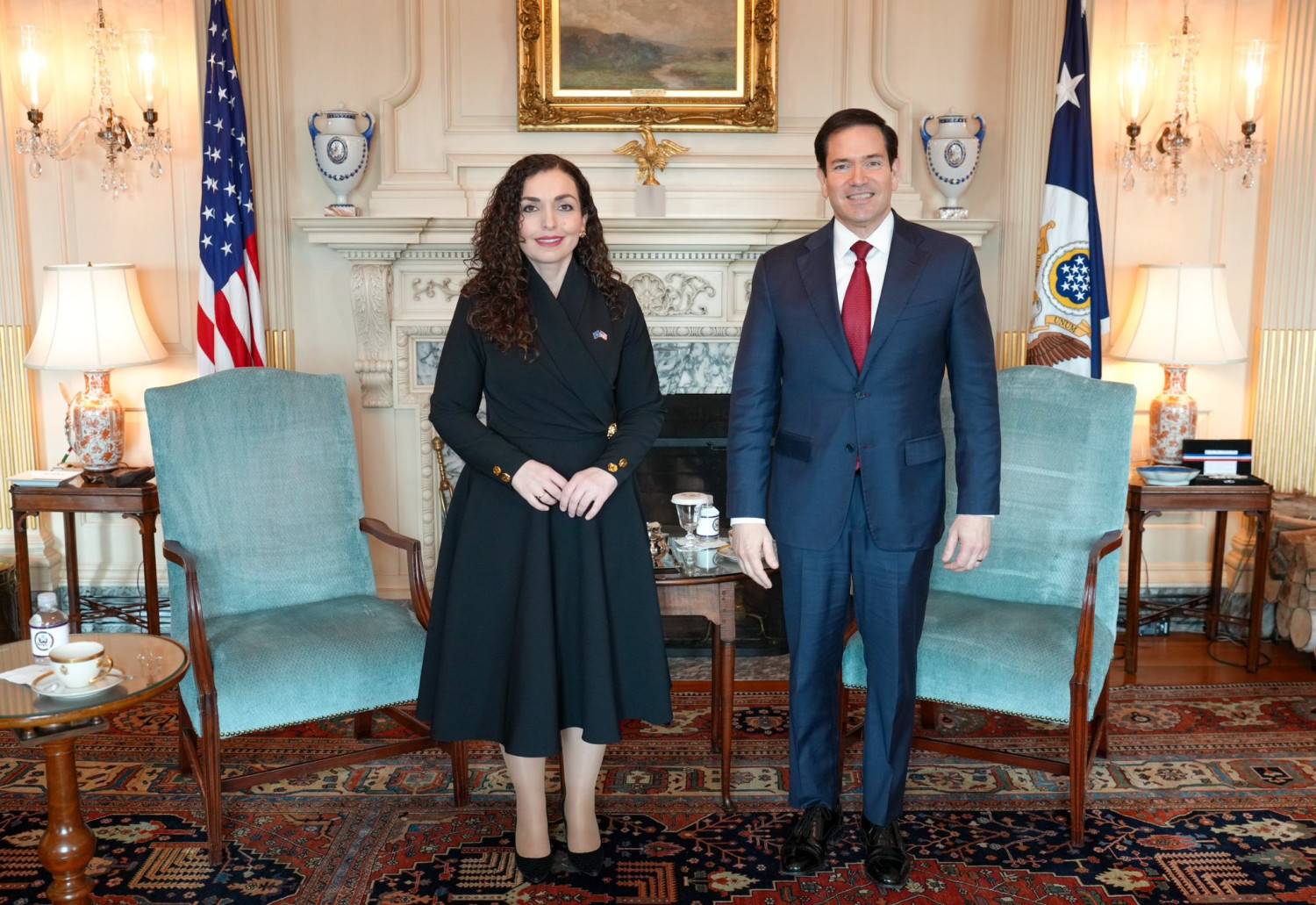
From Washington, reassurance is never loud — but it is rarely accidental. Eighteen years after formalizing diplomatic ties, Kosovo is no longer merely a beneficiary of American security — it is positioning itself as a contributor to it. President Osmani’s meeting with Secretary Rubio underscores a steady, disciplined alliance: no dramatic promises, no inflated rhetoric, but a clear signal that Washington continues to see Kosovo as a reliable partner in an increasingly unstable world.
By Mark Gojcaj | DC Bureau | 22 February 2026
WASHINGTON — In this city, tone matters as much as text. When Secretary of State Marco Rubio publicly thanks a foreign leader, the phrasing is deliberate. When that leader is Vjosa Osmani, and the thanks are for Kosovo’s role in a new American-led peace initiative, the signal is worth paying attention to.
Rubio did not overstate it. He did not reach for grand language. He thanked Kosovo for being a founding member of the Board of Peace and for contributing to the International Stabilization Force in Gaza. It was measured. Calm. Almost understated.
That’s precisely why it matters.
Washington rarely dramatizes relationships it intends to sustain. It simply reinforces them.
For Kosovo, this moment represents something larger than a diplomatic courtesy call. It marks a quiet but important evolution in how the United States sees the country. Not as a fragile ward of international protection, but as a state capable of contributing to international stabilization efforts beyond its own borders.
That shift did not happen overnight.
Earlier this year, when President Donald Trump invited Kosovo to join the newly formed Board of Peace, Pristina moved quickly. Critics in parts of Europe dismissed the initiative. Some governments kept their distance. Kosovo did not.
That decision reflected instinct more than calculation: when Washington calls, Kosovo answers. The relationship has been built on that clarity for nearly two decades.
In Washington, that kind of reliability earns notice.
When Trump told Osmani at the Board of Peace ceremony, “If you don’t get along, call me,” the line was informal. But in the Balkans, informal assurances from an American president are rarely treated as casual. Osmani later described feeling “the weight of the American guarantee.” Some critics quibbled over the wording. But diplomacy is often about signals, not transcripts.
And the signal was unmistakable: Kosovo remains firmly within the American strategic orbit.
Rubio’s meeting this week reinforced that alignment. The Secretary did not announce new security guarantees. He did not lay out a NATO timetable. He did not escalate rhetoric toward Serbia. That restraint was intentional. The United States prefers stability in the Western Balkans, not spectacle.
But the absence of theatrical language should not obscure what happened. Kosovo was publicly thanked as a contributor to international peace and security. That is not how Washington describes peripheral actors.
It is how it describes partners.
For Kosovo, participation in the International Stabilization Force carries symbolic weight. For years, Kosovo was the subject of peacekeeping. Today, it contributes to it. The numbers may be modest. The political significance is not. A country once defined by dependency is slowly rewriting that narrative.
In Washington policy circles, there is a simple hierarchy: those who consume security, and those who help produce it. Kosovo is working, deliberately, to place itself in the second category.
The timing is also notable. This year marks 18 years of diplomatic relations between Kosovo and the United States. The anniversary meeting at the State Department was not accidental. It anchored the present in shared history — 1999, recognition, state-building — while projecting forward toward Euro-Atlantic integration.
Osmani spoke openly about NATO membership and deepening defense cooperation. Rubio did not echo those ambitions publicly. That, too, is typical Washington choreography. The United States supports Kosovo’s trajectory, but it avoids promising what it cannot immediately deliver.
Support without overcommitment. Partnership without escalation.
For observers in Belgrade, the message will not be lost. Kosovo continues to receive public validation at the highest levels of the U.S. government. There is no cooling. No ambiguity. No distancing.
At a time when geopolitical alignments are shifting and smaller states can easily drift into irrelevance, Kosovo has chosen the opposite path: disciplined alignment, visible contribution, and consistent presence in Washington.
That strategy is not glamorous. It is not headline-driven. But it is effective.
In American foreign policy, durability counts more than drama. Kosovo’s relationship with the United States has endured multiple administrations, multiple regional crises, and shifting global priorities. It has done so because it rests on a foundation of shared commitments rather than transactional convenience.
This week’s meeting will not change the region overnight. It does not resolve every outstanding issue. But it reinforces something essential: Kosovo remains a trusted ally in Washington.
For a small democracy in a complicated neighborhood, that remains its most important strategic asset.
