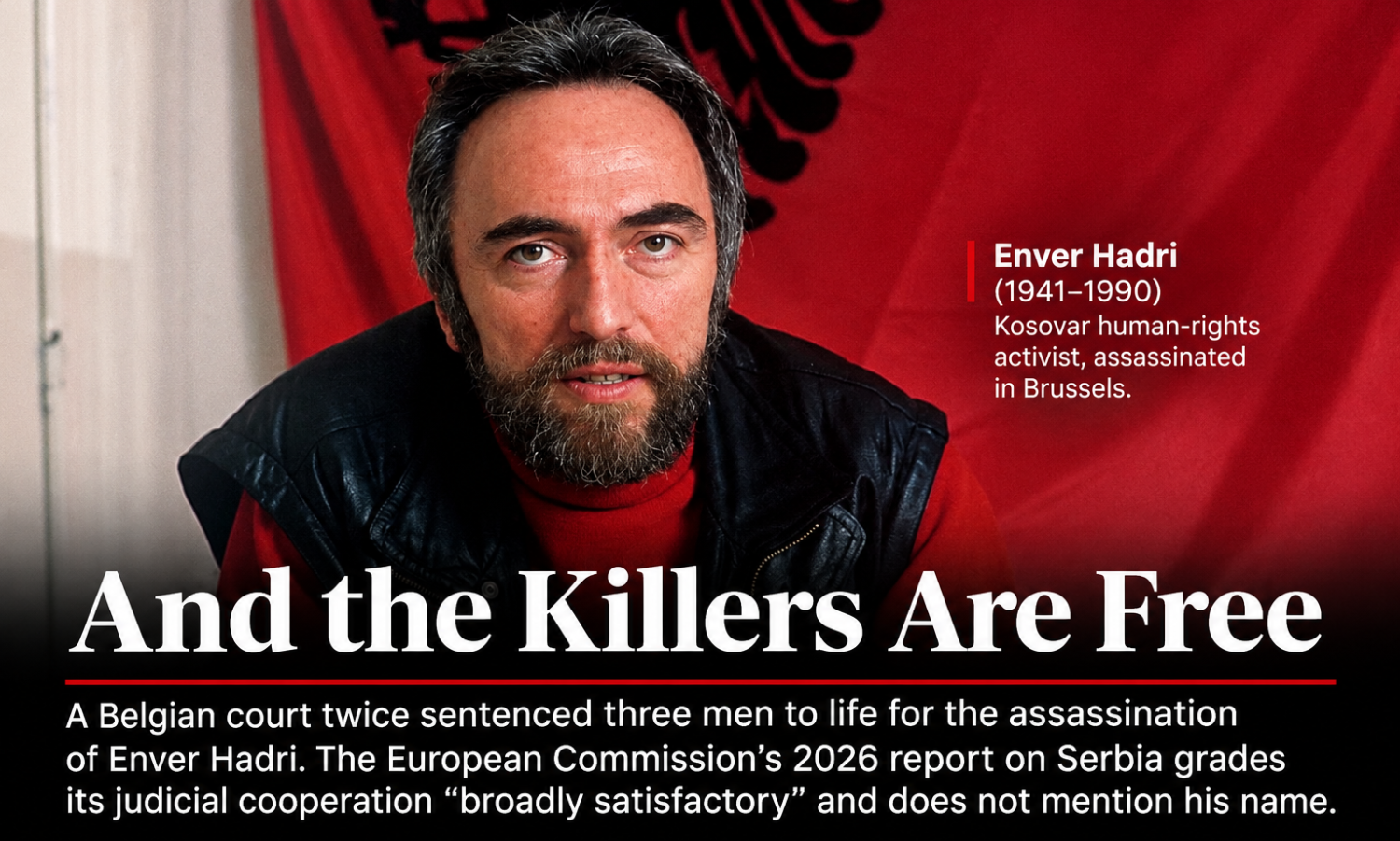
Enver Hadri was shot at a red light in Brussels in 1990 on the orders of the Yugoslav secret service. Belgium has convicted the men who did it. Serbia keeps them. The Commission’s new report on Serbia grades its judicial cooperation “broadly satisfactory”.
By Ngadhnjim Brovina | 5 November 2026
The European Commission published its annual reports on Serbia and Kosovo on Wednesday. The Serbia report’s section on war crimes carries the sentence it has carried for years: Serbia has yet to enforce a Bosnian judgment against a convicted man who lives in Serbia. Its section on judicial cooperation grades Serbia “broadly satisfactory”, and records in the same paragraph that requests for legal assistance take 480 days on average and that Montenegro’s repeated request to extradite a former president went unanswered until his sentence expired last month. The Kosovo report, in the same package, records that most of Kosovo’s requests for legal assistance to Serbia “remain unaddressed, including the ones related to the attacks on Ibër-Lepenc and Banjska”.
The name Enver Hadri appears in neither. Belgium appears in both: Serbia signed a procedure with Belgium in February for taking back migrants, and Kosovo finalised an agreement with Belgium on mutual legal assistance in criminal matters.
On 25 February 1990, at about half past four in the afternoon, Enver Hadri stopped at a red light on rue Saint-Bernard in Saint-Gilles, a few kilometres from the Berlaymont. A car drew up beside him, the window came down, and he was shot in the head. He was 48, in Belgium since 1972, and president of the Committee for the Defence of Human Rights in Kosovo.
The Brussels Assize Court named the men on 22 November 2016. Božidar Spasić, head of special operations in the Yugoslav State Security Service, for ordering it. Veselin Vukotić and Andrija Drašković of the Belgrade underworld for carrying it out. Life, with no mitigating circumstances, on a file of more than 3,000 pages. The jury found the motive political, Hadri “a threat both to the former federal state of Yugoslavia and to Serbia” (une menace à la fois pour l’ex-Etat fédéral de Yougoslavie et pour la Serbie), and the killers acting “under the orders of the Yugoslav secret services” (sous les ordres des services secrets yougoslaves). None of the three was in the courtroom.
Spasić never appealed. His life sentence has stood for ten years this month. Vukotić and Drašković used their right of opposition and got a second trial, which opened in Brussels on 9 January 2025 and ended on 29 January with the same verdict and the same empty dock. In October the Court of Cassation annulled Drašković’s conviction on a point of procedure and sent his case to a third jury, in Walloon Brabant. Vukotić’s sentence stands. On 10 July 2025 the Belgian federal police put him on the national Most Wanted list.
Vukotić is the only one of the three Belgium ever held. Arrested in Spain in 2006 under a false name, he spent two years in a Brussels cell until a court released him on €100,000 bail in October 2008. Two months later Belgium extradited him to Serbia, at Serbia’s request, to face a separate murder charge. Serbia released him in September 2009 and has refused every Belgian request since. Drašković, held in Croatia for extradition to Brussels, posted bail and was in Serbia the same day.
Belgrade’s answer is that its constitution forbids extraditing its own nationals. The 1971 convention between Belgium and Yugoslavia, which Serbia itself lists as in force, says the same thing, and for that case gives the alternative: the state that will not extradite tries the man itself on the requesting state’s file, or enforces the foreign sentence at home. Serbia has done neither for any of the three in ten years.
On 29 January 2025 Prime Minister Albin Kurti asked Serbia to hand them over. Belgrade did not reply. Kosovo’s government had paid €100,000 toward the Hadri family’s legal costs. Kosovo cannot press the matter through the courts: its own requests to Serbia on the bombing of the Ibër-Lepenc canal and the Banjska attack sit unanswered, by the Commission’s own count.
A study published in May in the journal Intelligence and National Security, by Magda Long of King’s College London, traces the Yugoslav services’ use of criminals from the 1940s to the present Security Information Agency. Hadri’s was the first killing run by the Serbian service rather than the federal one. The same study records the US Treasury’s sanction in July 2023 on the BIA’s then director, Aleksandar Vulin, for links to organised crime and arms trafficking, and Moscow’s decoration of him six months later for cooperation with Russia’s intelligence services.
A Belgian court has convicted a Serbian intelligence officer and two contractors for killing a Kosovar on the soil of an EU member state. The country that shelters all three, and has neither tried them nor enforced a day of their sentences, is the country the Commission calls broadly satisfactory on judicial cooperation. By what measure?
The government that Commissioner Kos congratulated last week has a simpler answer available than the Commission does. It can open a file in Belgrade on three men whose names it has had since 2016.
Enver Hadri is dead. And the killers are free.