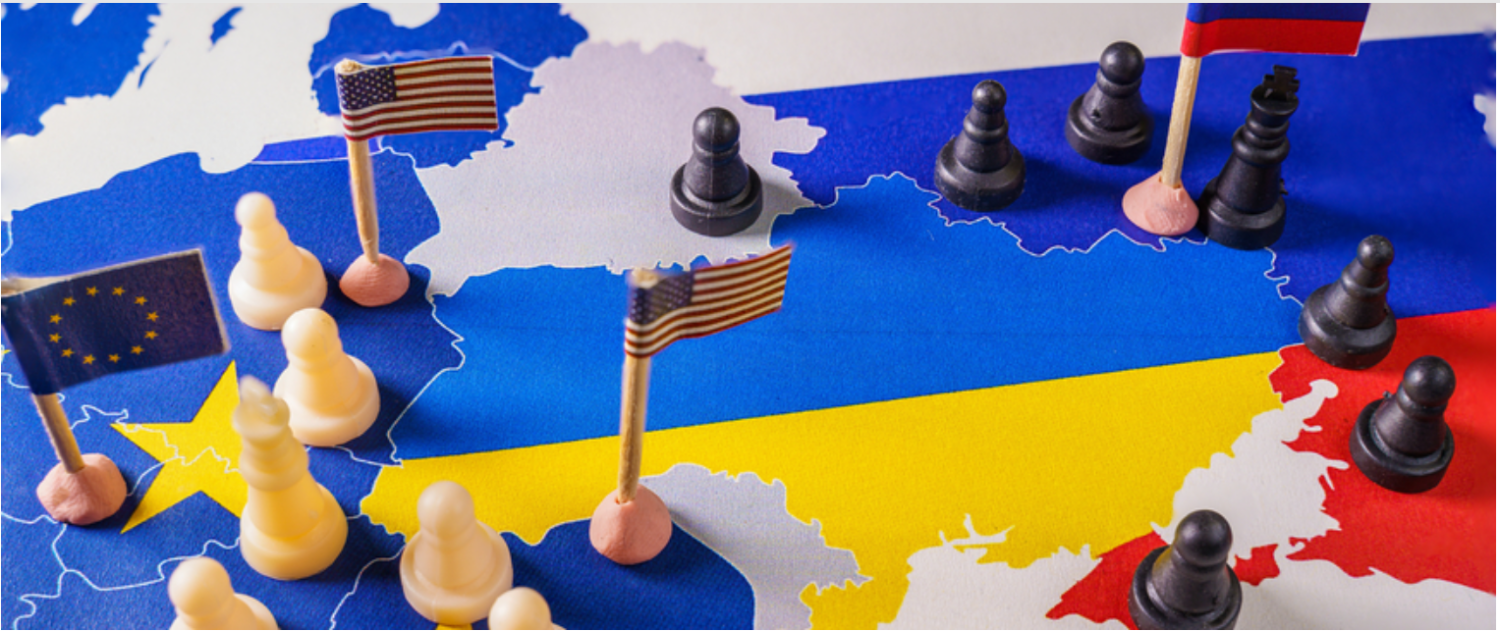
The war in Ukraine has become less a contest of breakthroughs than of endurance — shaped by ideology, adaptation, and political calendars in Moscow, Kyiv, Washington, and Europe.
by Mark Gojcaj | 27 January 2026
When Russia launched its full-scale invasion of Ukraine, its objectives were expansive: impose political subordination on Kyiv, reshape Ukraine’s strategic orientation, and secure dominance over the Black Sea coast. Nearly four years later, those ambitions have narrowed to control of occupied territory and a ceasefire that would lock in gains.
That contraction reflects failure rather than finesse. Moscow did not achieve regime change, lost much of its maneuver force in the opening phase, and shifted toward attritional warfare only after heavy losses. Yet this is not a story of imminent Russian exhaustion. It is a story of adaptation.
Russia has redirected industrial capacity toward military production, expanded UAV output, intensified recruitment drives, and exploited external supply channels. Most late-2025 assessments converge on a prolonged stalemate through 2026–2028 as the most probable trajectory. Moscow’s strategy today is not a doctrine of chaos but a deliberate wager on time: that its political system can absorb pain longer than Ukraine and its Western backers can sustain commitment.
Ideology and regime logic
The war is sustained by more than battlefield calculation. Putin’s refusal to accept Ukrainian sovereignty as legitimate is foundational, not rhetorical. Ukraine is treated not as a neighboring state but as a wayward civilizational space whose Western alignment constitutes betrayal. This framing makes genuine reconciliation structurally difficult. Any settlement that validates Ukraine’s independent trajectory is, from the Kremlin’s perspective, provisional at best.
That ideological lens overlaps with domestic imperatives. The war now functions as a regime project. It justifies repression, channels resources into militarization, and substitutes national struggle for stagnating governance. Ending it without visible gains risks converting strategic misjudgment into political vulnerability.
This is why Russian negotiating positions consistently extend beyond territory into Ukraine’s political architecture: recognition of control over Donbas, neutrality without NATO guarantees, limits on armed forces, and language or religious protections designed to preserve Russian leverage. The objective is not peace but structural influence over Ukraine’s future.
Costs, deferred not erased
The war has imposed strategic losses on Russia that are real and lasting. NATO’s northern flank has expanded. Energy ties with Europe have collapsed. Influence in the Caucasus and Central Asia has narrowed.
At home, pressure is accumulating unevenly. Recruitment increasingly relies on coercion and regional disparities as incentives fade. Labor shortages deepen under the combined weight of casualties, emigration, and demographic decline. The economy has entered an era of “expensive money,” with high interest rates, rising taxes, and civilian sectors increasingly sacrificed to defense spending. Sanctions have not collapsed the system, but they have lowered its growth ceiling and increased exposure to shocks — particularly if energy prices remain depressed and discounts widen.
Russia is not collapsing; it is hardening. The bet is that this strain can be politically contained into 2027 and beyond. That bet is contestable — but not obviously wrong.
Ukraine’s endurance dilemma — and agency
Ukraine’s challenge is different but no less severe. Manpower shortages have become a strategic vulnerability. Mobilization strains society while Russia’s numerical advantage in personnel and firepower persists. Energy infrastructure remains a primary target, with repeated winter strikes degrading civilian resilience and industrial output — in some regions reducing electricity to a few hours per day.
Yet Ukraine is not merely absorbing punishment. It has localized elements of production, pioneered interceptor and strike-drone systems, pursued “anti-drone dome” concepts, and expanded long-range attacks on Russian rear areas. Mobilization rules have been adjusted, military compensation raised, and contract incentives broadened. These measures mitigate but do not resolve structural asymmetry.
Ukraine’s survival remains dependent on external support. That dependence does not erase agency, but it defines the terms of endurance. Kyiv’s political time is constrained by demographics, infrastructure damage, and the sustainability of Western assistance.
Western adaptation and political friction
The United States and Europe have adapted more than Moscow likely expected. Aid has scaled up. Defense production is expanding. Finland and Sweden’s NATO accession has reshaped the strategic map. Ukraine’s institutional ties with Euro-Atlantic structures have deepened.
But adaptation is politically exposed. European governments balance deterrence against inflation and voter fatigue. In Washington, electoral cycles increasingly shape framing. Pressure to pursue negotiations has grown — often without clarity on what kind of settlement would avoid freezing vulnerability into permanence. Recent rounds of talks have adjourned without compromise, while threats of aid pauses and shifts toward “durable frameworks” signal movement toward management rather than resolution.
The risk is not sudden abandonment but drift: movement from strategic clarity toward procedural containment.
Russia’s hybrid tactics — disinformation, political financing, and economic leverage — are designed to widen that gap. They have not fractured Western cohesion, but they have complicated it.
Negotiation without closure
The war now exists inside a stalled diplomatic environment. Moscow exploits ambiguity — floating formulas while rejecting security guarantees, blaming Ukraine for escalation, and maintaining maximalist aims beneath tactical rhetoric. Recognition of territorial change and constraints on Ukraine’s sovereignty remain core demands.
At the same time, U.S. domestic politics increasingly shape the diplomatic tempo. With renewed pressure for deals and skepticism toward prolonged aid, the “contest of political time” now runs through Washington as well as Europe. If no breakthrough occurs by mid-2026, incentives may tilt further toward managing the war rather than resolving it.
This creates a structural danger: institutionalizing exposure. A settlement that freezes lines while constraining Ukraine’s security would not end the conflict; it would formalize vulnerability. For Moscow, any agreement that does not validate power is provisional. For Kyiv, any peace that leaves the country structurally exposed is merely a pause.
Implications beyond Ukraine
For Europe’s periphery, including the Western Balkans, the parallel is indirect but instructive. Kosovo’s legal foundations differ fundamentally from Ukraine’s war. Serbia lacks Russia’s coercive capacity. EU leverage still constrains revisionism.
But the broader lesson holds: when alignment becomes negotiable under pressure, unresolved disputes become strategic levers. In a negotiation-heavy 2026, the risk is not escalation but precedent — that constrained sovereignty becomes an accepted outcome.
Credibility — of EU integration and NATO protection — remains the stabilizing variable.
Endurance as strategy
Russia’s war is not guided by a doctrine of chaos. It is guided by a belief that endurance will outperform legitimacy. Ukraine’s defense rests on the opposite belief: that legitimacy can mobilize endurance.
Between them stands the West, caught between cost and commitment.
This conflict will not be decided by a single offensive or a single summit. It will be decided by whether political systems can sustain purpose longer than their adversaries can sustain pressure.
Ukraine is the battlefield.
Time is the terrain.
Credibility is the objective.
About the Author
Mark Gojcaj writes from New York, where he examines the intersection of American conservatism and Southeast European political and security realities. He is a regular contributor to The Kosovo Dispatch’s transatlantic coverage, with a focus on U.S. foreign policy, NATO dynamics, and the Western Balkans.
