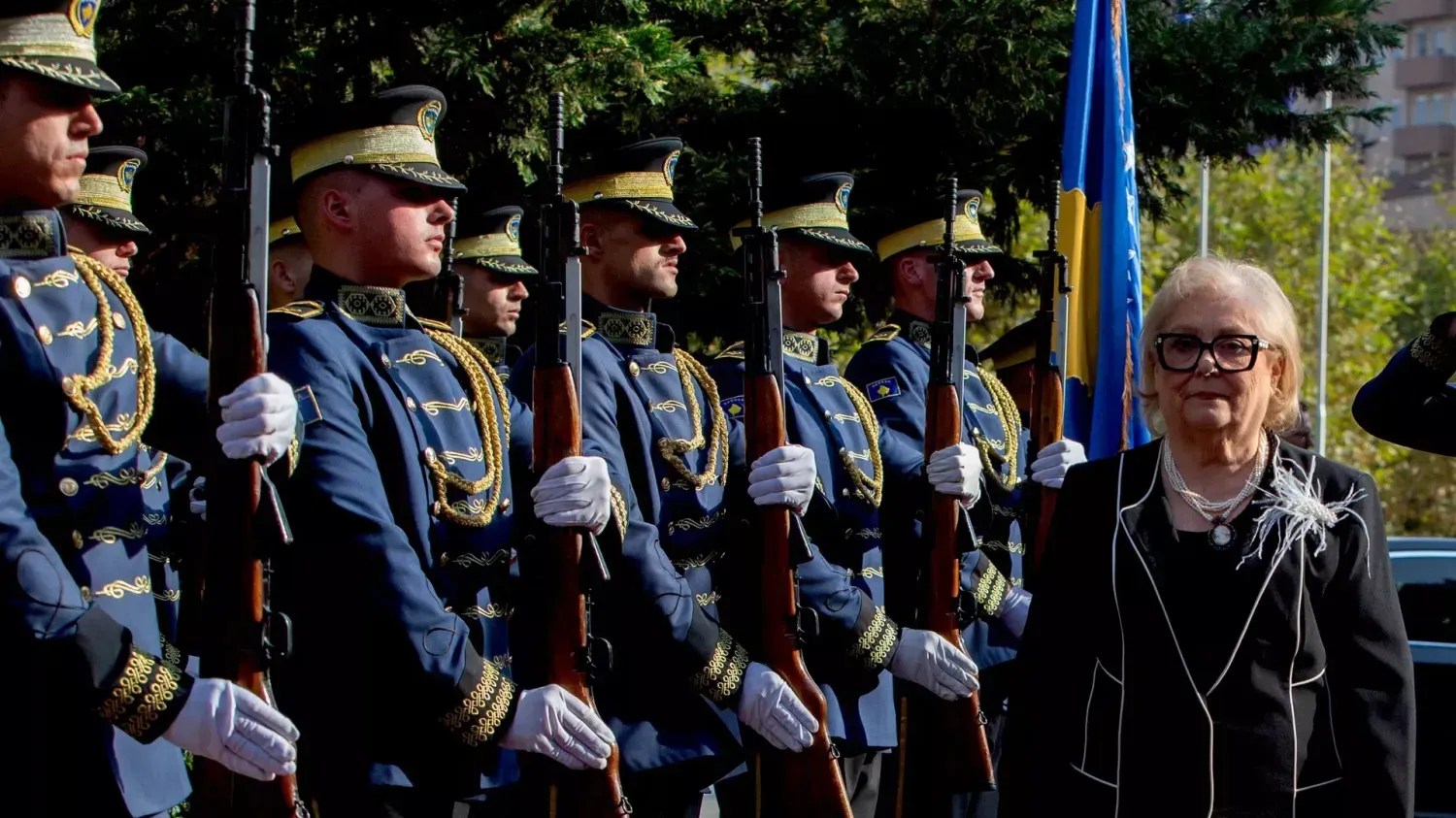
Kosovo elected a Catholic president with 81 votes. Its Muslim religious leadership pledged her full cooperation. Both facts challenge Belgrade’s claim to be defending Christian Europe against an Islamist Kosovo.
by Artan Rugova | 8 October 2026
Serbian nationalist messaging to Western audiences rests on a religious premise: Serbs hold the frontier of Christian Europe, and Kosovo is a Muslim project built at their expense. The premise has a long record. In February 1995, Radovan Karadžić told the Bosnian Serb assembly that Serbs had been sacrificed so that Europe could be "a community of happy Christian peoples" while they guarded its walls against Islam. In August 2026, President Aleksandar Vučić called NATO's commander in Kosovo "the Turk" and accused Europe of accepting the persecution of an Orthodox Christian people. Earlier this year, he attributed Milorad Dodik's reception in Washington to a shared interest in "protecting Christianity and preserving Christian values". A 2023 analysis by Georgetown University's Berkley Center documented how Russian- and Serbian-affiliated media supply Europe's far right with accounts of Christians persecuted by Muslim Albanians, while senior Serbian Orthodox clergy portray Kosovo as a cradle of Islamism.
The premise can be tested. In the Kosovo this narrative describes, the election of a Catholic head of state should be an extraordinary political difficulty, and acceptance by the Muslim religious establishment should be anything but assured. This week supplied evidence on both questions.
On 7 October, the Assembly elected Justina Shiroka-Pula president with 81 of 120 votes. She is a Catholic in a country where the 2024 census recorded 93.49 percent of the population as Muslim and 1.75 percent as Catholic. In the public record of the bargaining that preceded the vote, the objections raised against earlier candidates concerned political affiliations and parliamentary agreements. Her religion does not appear.
The same day, the Islamic Community of Kosovo published a letter to her signed by the Mufti, Naim Tërnava. It pledges "the sincere support and cooperation of the Islamic Community of Kosovo, of its institutions, and my own as Mufti of Kosovo". It ends: "May God give you strength and wisdom in fulfilling this duty, and may He bless Kosovo and its people!" The letter has five paragraphs, one of which congratulates the parties on the agreement that elected her and the legislation passed alongside it. Her religion is mentioned in none.
The letter is the stronger of the two pieces of evidence. Article 8 of the Constitution makes Kosovo a secular state, neutral in matters of religious belief. That obligation falls on the state. It does not fall on the Mufti. The country's principal Muslim religious institution chose, without any constitutional obligation to do so, to pledge its cooperation to a Catholic head of state.
The narrative has a second half: that Serbia's church and state speak for Christian values in the region and protect Kosovo's Christians. Two entries in the record bear on it. On 7 September, Patriarch Porfirije led the funeral service in Belgrade for Ratko Mladić, who died serving a life sentence for genocide and other crimes, and spoke of a "deep sense of gratitude". And the record of 1999 does not divide Kosovo's victims by religion. On 27 and 28 April, Serbian forces killed hundreds of Albanian civilians in and around Meja, a predominantly Catholic Albanian village, including men taken from refugee columns during Operation Reka. Catholic and Muslim Albanians died in the same operation.
The Serbian-language coverage of the new president offers another revealing detail. On the evening of 7 October, Sputnik Serbia published an assessment by the political analyst Ognjen Gogić. He judged Shiroka-Pula favourably in several respects, described her as a Yugoslav nostalgic who speaks excellent Serbian, and added: "Interesting that she is of the Catholic, not the Muslim, faith." It is the only remark on her religion in the assessment, and it was offered without hostility. A Russian state outlet addressing Serbian readers had nonetheless made her Catholicism part of a political reading of the president.
The European Union's representative and the ambassadors of Britain, Germany and France congratulated her with messages about stability and Kosovo's European future. Shiroka-Pula answered that Kosovo would go forward "with a clear Euro-Atlantic orientation and strong friendship with our allies".
The frontier narrative is addressed to Washington and Brussels. It asks them to read Kosovo through religion and to treat its Muslim majority as a risk to be contained. In the same week, Kosovo's parliament and its principal Muslim institution each put the opposite on the record. Anyone weighing claims about religion in Kosovo now has two new primary sources: a parliamentary vote and a letter from the country's Mufti. Neither supports the frontier narrative.
Artan Rugova is a Kosovo-based commentator for The Kosovo Dispatch, where he writes on political and institutional developments in Kosovo. He has also been involved in sports administration and public life, including engagement with national sports structures in Kosovo. Earlier in his career, he was the publisher of The Kosovo Times, an English-language news journal based in Prishtina that covered Kosovo and regional affairs for an international audience.
