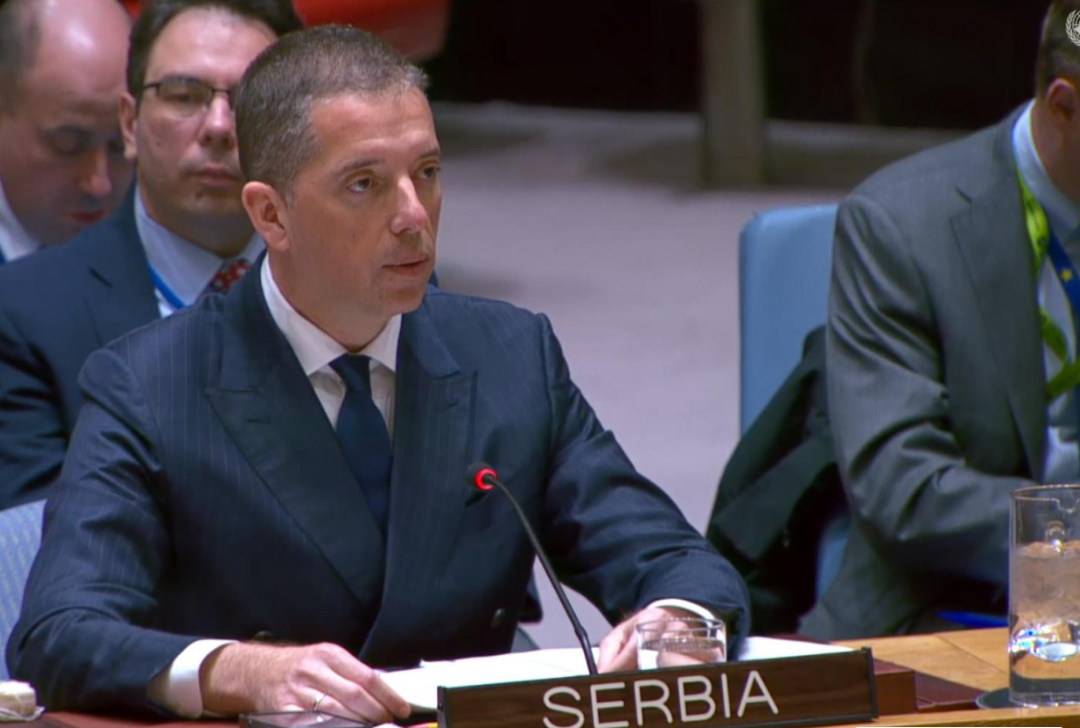
Belgrade’s intervention at the Security Council follows a disciplined architecture: assert systemic persecution, anchor it in frozen legal frameworks, and place the burden of verification on an international forum structurally unable to meet it.
By Mark Gojcaj | 10 April 2026
Marko Đurić arrived at the United Nations Security Council on Wednesday with a prepared brief, a practiced register of controlled indignation, and a set of arguments that collapsed on contact with scrutiny. What he delivered was not diplomacy. It was a positioning document dressed in the language of minority protection, structured to reach an international audience that, by design, cannot verify what he was saying.
This matters because the Security Council is not a court. It has no discovery process, no cross-examination, no evidentiary standard. It is a chamber where sovereign states assert, and the record is made of assertions. Đurić knows this. His entire presentation was architected around it.
Start with the claim that received the most emphasis: that approximately twenty percent of Kosovo's Serbian population has left "in a very short period of time." This was delivered as settled fact. No timeframe was attached. No source was cited — not OSCE, not UNHCR, not the UNMIK report whose adequacy Đurić simultaneously questioned. The irony is precise: he faulted UNMIK's report for failing to document the Serbian exodus, then produced an exodus figure with no documentation of his own. If the statistic is genuine, it describes a demographic emergency of extraordinary proportions. If it is not, it is a fabrication delivered at the most consequential multilateral table in the world. Đurić offered no mechanism by which anyone in the chamber could determine which of those two things it was.
This is not incidental. It is the method.
The speech's architecture follows a recognizable pattern. Establish a totalizing narrative of systematic persecution. Anchor it in selective international law. Deploy emotional testimony to close off skepticism. Conclude with offers of constructive dialogue. The pattern is not unique to Belgrade — it has been used by sovereigntist governments across various theaters — but Belgrade has refined it over three decades of managing Kosovo as a political instrument. Đurić is among its more accomplished practitioners.
The legal anchoring warrants direct naming. Resolution 1244 was invoked repeatedly, not as historical context but as an operational framework, preserved selectively because it produces the legal fiction Belgrade requires. The 1999 text treats Kosovo as a Serbian province under international administration. That assumption has been overtaken by Kosovo's independence, the International Court of Justice's 2010 advisory opinion, and the recognition of Kosovo's statehood by over one hundred countries. None of this appeared in Đurić's framing. 1244 is not invoked because it is applicable. It is invoked because it is the last document in which Belgrade's preferred reality is encoded in binding international law. This is not legal interpretation. It is legal time-freezing — the strategic revival of a frozen moment to avoid engaging with everything that followed.
The security argument operates by the same logic. Đurić insisted KFOR must remain "the only legitimate and credible security force on the ground." This is not a security position. It is the denial of Kosovo's sovereignty expressed through security language — a claim that Kosovo lacks the right to develop its own defense institutions, that KSF expansion is inherently destabilizing rather than a normal function of statehood. The argument is being advanced by the government of a country that has acquired CM-400AKG ballistic missile systems capable of reaching targets across the Balkans, expanded its defense budget significantly in recent years, and conducted sustained information operations against Kosovo's institutional legitimacy. The concern about regional militarization flows one direction in Đurić's framing. That direction is not toward Belgrade.
Serbia has obstructed and fought every vehicle for Kosovo Serb political integration trying to maintain a coercive control apparatus. Kosovo Serbs who have attempted independent political engagement with Kosovo's institutions have faced documented pressure from that structure, including intimidation of candidates and suppression of alternative political voices. The parallel institutions Đurić celebrated have kept Kosovo Serbs dependent on Belgrade's patronage rather than integrated into Kosovo's legal and civic framework. Belgrade has not been protecting Kosovo Serbs from a hostile state. It has been maintaining them as a captive political constituency from which leverage is extracted on demand. The grievances are real. Belgrade produced them. Belgrade then presents them at the Security Council as evidence of Pristina's conduct.
Đurić quoted Martin Luther King Jr. to frame this case. The injustice-anywhere formulation is among the most recognizable phrases in the American political canon. Its deployment in defense of a community whose political dependency has been systematically engineered by the government invoking it is not an appeal to universal values. It is the appropriation of liberation rhetoric to protect a control structure. The audacity of the move is, at minimum, worth naming plainly.
The forum selection is itself the argument. Serbia consistently elevates the Security Council over EU-facilitated dialogue tracks. In Brussels, the conversation is about implementation of agreements Belgrade has signed and failed to honor, conducted by an interlocutor with real leverage and institutional memory. In New York, Russia and China hold veto power, Kosovo's recognition is structurally blocked, and the default legal framework is 1244. The choice of forum is not about where progress is most likely. It is about where accountability is least possible. Every Serbian Security Council address on Kosovo is, in this sense, a successful operation regardless of what is said because the object is not resolution. It is record-making in a venue calibrated to prevent the record from being tested.
Đurić closed with the declaration that Serbia is part of the solution. This line has appeared in every Serbian Security Council address on Kosovo for years. It is the mandatory closing note of a performance designed to produce no resolution, advance no implementation, and resolve nothing for the Kosovo Serbs in whose name it is delivered. What it produces is a record: Belgrade's victimhood narrative entered into UN proceedings, laundered through the language of international law, and transmitted to audiences who lack the context to evaluate it.
The function is not to resolve reality. It is to replace it with a version that cannot be tested.
