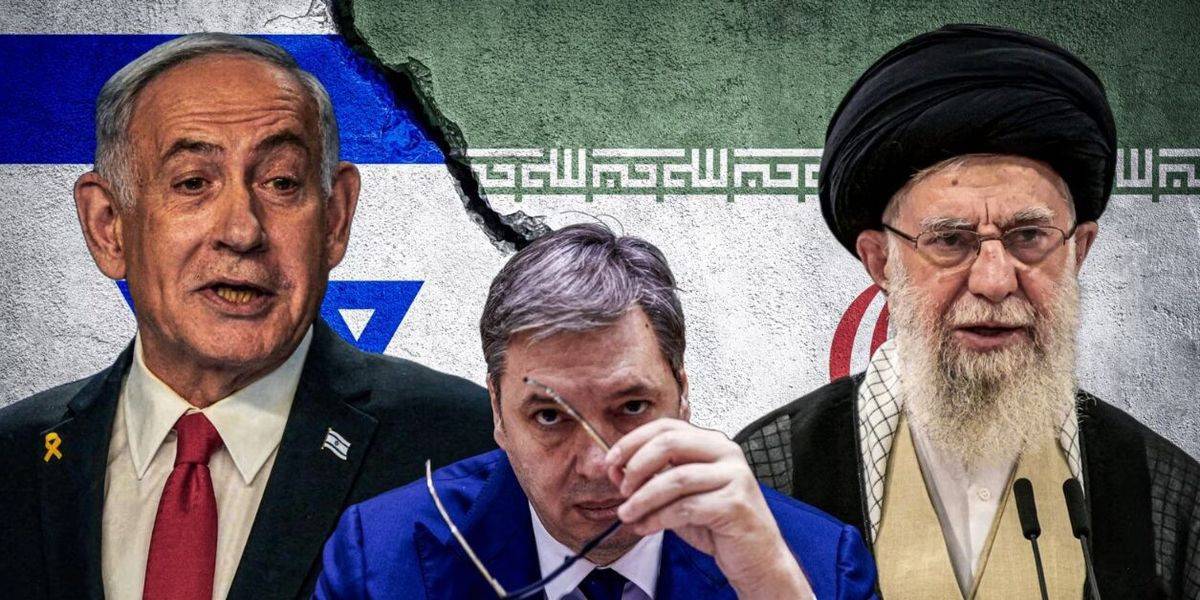
After invoking NATO’s 1999 campaign to question U.S.–Israeli strikes on Iran, Serbia’s leadership swiftly condemned Tehran’s attacks on Gulf states. Washington should note not only the sequence — but the adjustment.
By Mark Gojcaj | 2 March 2026
When President Aleksandar Vučić compared recent U.S.–Israeli strikes on Iran to NATO’s 1999 intervention in Yugoslavia, he was not indulging nostalgia. In Serbia, 1999 is a wound and a political instrument. By framing Western action as regime change reminiscent of the campaign that preceded Slobodan Milošević’s fall, Vučić signaled more than caution. He signaled distrust.
He warned that the “law of might” now overrides international law. He suggested the strikes aimed to reshape Iran’s political order. He spoke of tectonic shifts in global power and announced accelerated military procurement, including advanced air defense systems. The message was clear: great powers act freely; smaller states must harden.
Then came the pivot.
Foreign Minister Marko Đurić declared Serbia stood “in solidarity with our partners” and strongly condemned Iran’s attacks on the sovereignty and territorial integrity of the United Arab Emirates, Qatar, Bahrain, Kuwait, and Saudi Arabia. He emphasized de-escalation and regional stability. The language was orthodox and reassuring.
Shortly thereafter, Richard Grenell reposted Đurić’s statement, amplifying Serbia’s condemnation.
The sequence matters.
Governments refine rhetoric during crises. What stands out here is the distance between the first framing and the second. In Washington, comparisons to 1999 are not neutral. They imply that American force masks regime engineering. That vocabulary echoes Moscow more than it does a state seeking deeper engagement with the United States.
This is not about suppressing disagreement. Serbia is sovereign. It may question interventionism. Americans debate it themselves. The issue is coherence.
If sovereignty is the governing principle — and Belgrade has invoked it forcefully — it must be applied consistently. One cannot describe Western strikes as illegitimate regime change while condemning Iranian missile attacks as violations of sovereignty without clarifying the distinction. If the difference lies in intent, authorization, or alliance structure, it should be stated plainly. Otherwise sovereignty begins to look situational.
Situational sovereignty weakens credibility.
Serbia practices what it calls strategic autonomy — balancing Brussels, Washington, Moscow, Beijing, and the Gulf monarchies. For a mid-sized state outside formal alliance structures, that is rational. The EU is Serbia’s largest trading partner. Russia offers diplomatic backing at the United Nations. China finances infrastructure. Gulf states invest heavily. The United States remains central to Balkan stability.
Balancing is geopolitics. Oscillation is something else.
Vučić’s 1999 comparison was read internationally as a critique of Western legitimacy at a moment of acute escalation. Within days, Belgrade issued a firm condemnation of Iran’s strikes on Gulf partners. Grenell’s rapid amplification underscored that American audiences were attentive.
No conspiracy is required to see the pattern. Diplomatic channels exist to signal when rhetoric risks cost. Serbia has significant economic exposure to the Gulf and seeks continued engagement with Washington. It cannot afford ambiguity toward missile strikes on partner states.
The clarification was prudent.
But prudence reveals constraint.
For years, Washington has tolerated Serbian ambiguity — from partial non-alignment with European sanctions to diversified military procurement. Stability in the Balkans often trumped rhetorical consistency.
That tolerance should not be assumed permanent.
The United States does not demand automatic endorsement of its military actions. It does expect clarity from states seeking strategic partnership. If Belgrade views U.S.–Israeli strikes as destabilizing, it should articulate a principle beyond historical grievance. If it condemns Iran’s attacks as violations of sovereignty, it should explain how that principle applies universally.
Absent that explanation, the impression forms that Serbia’s foreign policy language adjusts to audience.
That impression carries weight in policy deliberations — especially as Congress and future administrations reassess commitments and partnerships worldwide.
Notably, other actors in the Western Balkans adopted immediate, unambiguous positions aligning with Western partners during the escalation. That contrast sharpens the ambiguity in Belgrade’s sequencing.
Washington understands power politics. It does not demand ideological conformity. It does require predictability — particularly from governments that seek investment, political backing, and security engagement.
Serbia stands between memory and strategy. The ghosts of 1999 will remain. Nations remember. But memory cannot serve as the sole lens for interpreting present crises.
Sovereignty is not a seasonal doctrine. It cannot be sacred when Gulf capitals are struck and negotiable when American forces act. If non-intervention is the principle, defend it consistently. If stability is the measure, define it. If alliance legitimacy is the dividing line, say so.
The clarification came quickly. The reassurance was delivered.
The question is whether it reflects doctrine or adjustment.
Washington need not overreact. But it should observe patterns carefully. When partners speak in two registers during a crisis, it signals tension between domestic messaging and international positioning.
Strategic autonomy demands strategic consistency. Without it, autonomy drifts into improvisation — and improvisation, in a volatile order, narrows the space for trust.
About the Author
Mark Gojcaj writes from New York, where he examines the intersection of American conservatism and Southeast European political and security realities. He is a regular contributor to The Kosovo Dispatch’s transatlantic coverage, with a focus on U.S. foreign policy, NATO dynamics, and the Western Balkans.
