The EU asks Serbia to treat Kosovo as a state. Its own Council will not even open Kosovo's application.
The Editorial Board | 24 September 2026
Madam Kallas, there is nothing mandatory about the Ohrid Agreement. Vučić knows it, because the European Union shows him every day.
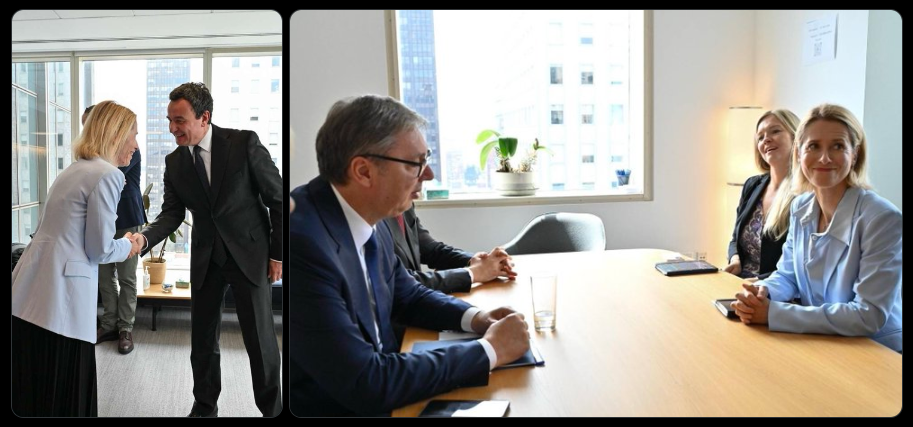
In New York on Tuesday you met Vučić and Kurti in separate rooms and told both of them the same thing. The agreements reached in the EU-facilitated dialogue, Ohrid above all, are binding. Implementing them, you said, is no favour to Brussels.
Vučić left your room and told Serbian television he had pressed you on the Association of Serb Majority Municipalities. You spoke to him about 2023, and he answered you with 2013. He can afford to, because he has read the 2023 text more carefully than Brussels has.
In that text Kosovo and Serbia do not recognise each other, but each agrees to treat the other as a state. In Article 2 both sides accept the sovereign equality of all states and respect for each other's independence and territorial integrity. Article 4 says Serbia will not oppose Kosovo's membership in any international organisation. Article 5 says neither side will block the other's road to the EU, which each travels on its own merits. Nobody had to say "I recognise you," yet everybody had to behave as if the other exists.
Brussels calls itself the facilitator. It put forward the proposal and announced it. It chairs the committee that monitors implementation. It wrote the agreement into both roads to membership and warned that breaking it would cost accession progress and EU money. Whatever the title on the door, that is a guarantor, and a guarantor is bound by the deal it stands behind. If you co-sign a loan and then tell the bank you never really meant it, the borrower stops paying the next morning.
Brussels will answer that only Kosovo and Serbia are parties to Ohrid. On paper, that is true. The co-signer is not the borrower either, and the bank still knocks on his door.
Spain, Slovakia, Cyprus, Romania and Greece do not recognise Kosovo, and they may go on not recognising it. Ohrid does not ask Serbia to recognise Kosovo either, only to stop letting status decide what should be decided on merit.
Kosovo applied for EU membership in December 2022. The Council has never asked the Commission for an opinion, and the Commission says it will write one the day it is asked. Bosnia and Herzegovina's application was forwarded. Ukraine, Moldova and Georgia had theirs forwarded within days. Kosovo has waited almost four years. The European Parliament has said openly what stops it: five members that do not recognise Kosovo. Ohrid forbids Serbia to block Kosovo's road to Europe for that reason, and you cannot ask Serbia to stop what your own Council does.
In May 2024 France, Germany and Italy tied their vote on Kosovo's seat in the Council of Europe to Pristina sending the Serb municipalities statute to the Constitutional Court. Three EU capitals put a price on Kosovo's place in an international organisation, the kind of pressure Article 4 forbids Serbia to apply.
Whether Kosovo ever becomes an EU member is a different matter. The five may say no at the end, and the treaties let them. Processing the application would leave that ending open and still show Belgrade and Pristina that the guarantor accepts what it asked them to accept.
Vučić has no reason to tear up Ohrid when he can simply copy Brussels. As long as the application stays in a drawer, every lecture about binding agreements sounds to him like permission.
If Ohrid binds, Madam Kallas, it binds the EU. Send Kosovo's application to the Commission. Then say "binding" again, and Vučić will have to hear it.
