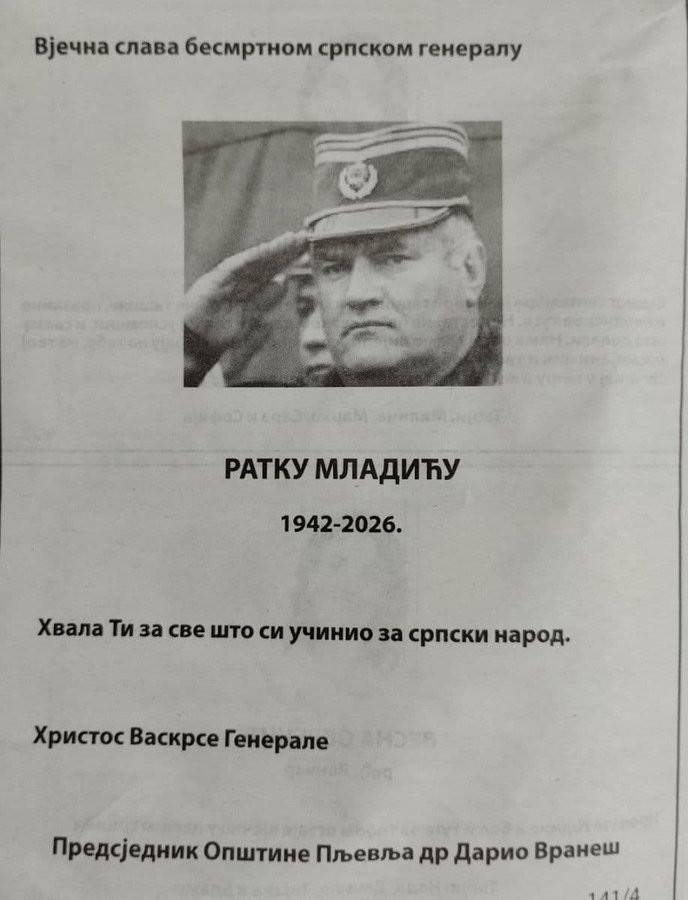
Glorification tells us who they believe he was. Gratitude tells us what they believe he delivered.
Artan Rugova | 3 September 2026
There are four words in Dario Vraneš's notice that deserve to be read literally. Hvala Ti za sve. Thank you for everything.
The president of the municipality of Pljevlja, in Montenegro, did not write that Mladić was innocent, or that The Hague had misunderstood him. He did not use the safer formula available to every defender of a convicted commander, thank you for defending us. Beneath a portrait of Mladić in uniform, under the heading "Eternal glory to the immortal Serbian general," he signed his office to the words "Thank you for everything you did for the Serbian people." Pobjeda reported the notice on 1 September. By 2 September the Higher State Prosecutor's Office in Podgorica was telling Radio Free Europe it was monitoring the text for the elements of a criminal offence.
So: what was everything?
The answer does not require us to guess what Vraneš had in mind. On 22 November 2017 the Trial Chamber convicted Mladić of genocide at Srebrenica; of persecution, extermination, murder, deportation and forcible transfer across the municipalities of eastern and northern Bosnia; of a campaign of sniping and shelling against Sarajevo whose primary purpose, the Chamber found, was terror; and of taking United Nations personnel hostage. It found that he shared in a joint criminal enterprise whose common purpose was the permanent removal of Bosnian Muslims and Bosnian Croats from the territory the Bosnian Serb leadership claimed, and that the crimes were the means. On 8 June 2021 the Appeals Chamber confirmed the convictions and the sentence of life.
That is one answer. The map is another. In 1991 Serbs were a quarter of Srebrenica, a third of Bratunac and Vlasenica, two fifths of Zvornik and under half of Foča. All five are in Republika Srpska today, where the 2013 census counted Serbs at 83 percent and Bosniaks at under 13. The killings, expulsions and forcible transfers set out in the judgment did not happen somewhere else and then leave this geography behind by accident. They happened in the places whose transformation became one of the war's durable facts.
This is where the language of the past week becomes evidence. In Plzeň, on the day he died, Red Star supporters hung a banner: "General, great glory and thanks" (Generale, velika slava i hvala). In Pljevlja, thanks for everything. And Nikola Šainović, Milošević's deputy prime minister and himself a Hague convict, supplied the noun the others had left out. Republika Srpska, he told Sputnik on 28 August, is "a monument of a kind to the life and work of Ratko Mladić."
Take him at his word. A monument commemorates something.
The reply his admirers give is familiar, and Bishop Sergije of Bihać put it in writing on 28 August: only Mladić had weapons, while the others carried bouquets instead of rifles. Behind that sentence stands 1941, the memory of a people that faced destruction once and was not going to face it again. We will take the reading seriously for the length of a paragraph. Defence did not require emptying Zvornik. It did not require separating men and boys from women at a UN base and driving the men to fields where the trenches had been dug in advance. Forty four months of fire on a city of civilians defended no one. A population is not protected by any of that. Each was a crime, adjudicated count by count, and each had consequences on the ground that outlived the man.
Republika Srpska holds forty nine percent of Bosnia and Herzegovina under Dayton. Dayton made it a constitutional entity of the state, and millions of people have lived ordinary lives inside it for three decades; the Hague never convicted Mladić of drawing a border, and we do not say the entity is a crime. The distinction matters. But it does not produce two histories: one in which the crimes belong to Mladić, and another in which the territorial and demographic consequences of the operations he commanded simply appeared. Šainović has declined that separation himself. He called the entity the monument, and people are thanking the man whose monument he says it is.
They are thanking him for the borders. The judgment records the criminal means used to remove non-Serbs from territory claimed for the Bosnian Serb state.
Glory can be sentimental. Mourning can be private, and a candle can be lit for a criminal's soul without endorsing the crime. Even hero leaves room for the old argument about one side's criminal being the other side's defender. Thanks is different. Thanks is transactional; it has an object; someone did something from which the speaker believes he benefited. That is why a paid notice in Montenegro weighs more than another mural, and why a former deputy prime minister's noun weighs more than another torchlight procession.
Nor was the vocabulary confined to Vraneš and Šainović. Serbia's justice minister said on 28 August that "General Mladić is a general, and the protocols are known." Bishop Metodije at Piva commended him to the company of the great spiritual knights of the Serbian people. In Ugljevik on 1 September the mayor, the local MP, councillors and the directors of public enterprises attended a municipal ceremony. In Banja Luka the next day a column carried "The last command: everyone, execute it" to the memorial to fallen VRS soldiers. In the entity's election season the governing party mourned him in Banja Luka cathedral with Dodik, and the opposition held its own parastos at Ozren. Official commemoration and street nostalgia are both present.
Which brings us to the argument that has accompanied Srebrenica for years: collective guilt. There is none. Criminal guilt is individual and Mladić's conviction belongs to Mladić; no Serb inherits a fraction of a genocide conviction by birth, nationality, religion or residence, and a Serbian child born this morning bears precisely none of it. That principle should not be qualified because the politics around his death are repellent. It should be applied. Nobody in Sarajevo imposed Mladić on the Serbian people this week, and nobody in The Hague or Brussels did either. The offers came from a justice minister, bishops, municipal officials, former state officials, political leaders and supporters, repeatedly invoking the Serbian people in whose name he was being thanked.
The Montenegrin historian Adnan Prekić, born in Pljevlja, noticed the inversion on 2 September. A year earlier, at the thirtieth anniversary of the genocide, the argument had been that nobody may impose collective guilt on a people for the crimes of individuals. Now the same milieu was claiming the war criminal and promoting him into a symbol of the people. The first principle remains correct. A people cannot inherit a man's crime. There is another proposition hiding inside it: if the crime belongs to the individual, nobody is required to inherit the criminal either. That inheritance is a choice.
The Hague settled what he did. The question raised by his death is who now wishes to claim what he accomplished. They have answered it themselves. They called him their general. They called what survives his work a monument. And then they thanked him.
For everything.
Artan Rugova is a Kosovo-based commentator for The Kosovo Dispatch, where he writes on political and institutional developments in Kosovo. He has also been involved in sports administration and public life, including engagement with national sports structures in Kosovo. Earlier in his career, he was the publisher of The Kosovo Times, an English-language news journal based in Prishtina that covered Kosovo and regional affairs for an international audience.
