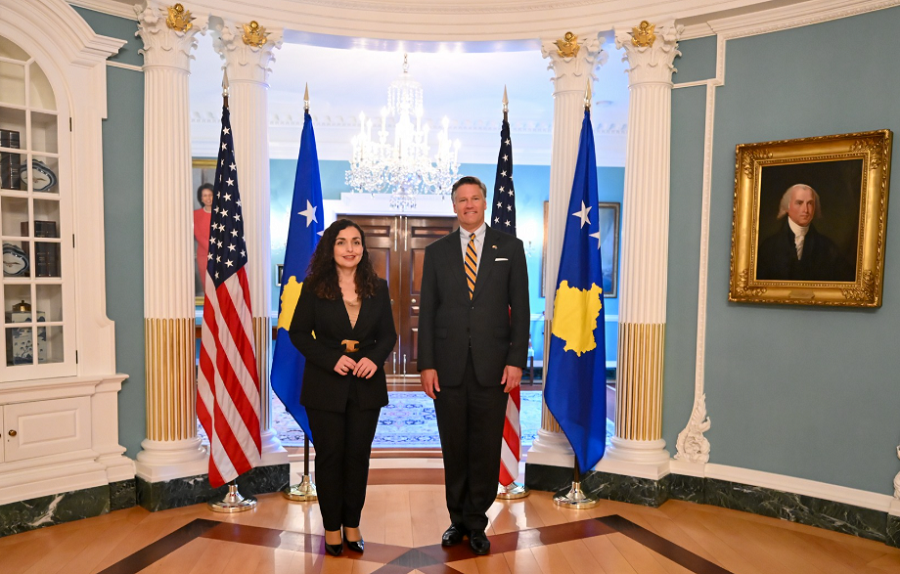
President Vjosa Osmani arrived in Washington with diplomatic momentum already established. Coming directly after her meeting with Pope Leo, her December 22, 2025 talks at the U.S. Department of State with Deputy Secretary Christopher Landau placed Kosovo’s foreign policy on a clear, confident axis: moral legitimacy paired with strategic alignment. The Washington meeting was not about repair or reassurance, but about continuity—affirming Kosovo’s place as a stable partner anchored in U.S. security doctrine and long-term cooperation.
by Mark Gojcaj | DC Bureau | 23 December 2025
President Vjosa Osmani arrived in Washington carrying diplomatic momentum. Her December 22, 2025 meeting with U.S. Deputy Secretary of State Christopher Landau followed shortly after a high-profile audience with Pope Leo, a sequence that was neither accidental nor merely ceremonial.
Taken together, the two meetings illustrate a coherent diplomatic posture: Kosovo presenting itself simultaneously as a moral actor anchored in values and a strategic partner grounded in security alignment.
Washington as Continuity, Not Reset
The meeting at the U.S. Department of State was not framed as a reset or a corrective. It was framed as continuity—a signal that Kosovo’s relationship with Washington is stable, mature, and institutionally embedded.
President Osmani’s emphasis on the recently signed U.S. National Defense Authorization Act (NDAA) was particularly notable. By highlighting provisions that affirm Kosovo’s sovereignty, reject partition, ground dialogue in mutual recognition, and support Kosovo’s NATO aspirations, she anchored the bilateral relationship in formal U.S. strategic doctrine, not diplomatic goodwill alone.
This was a positive message delivered with precision: Kosovo is not asking Washington to invent new positions—it is asking it to stand by the ones it has already codified.
Strategic Dialogue as the Main Vehicle
Osmani’s focus on advancing the U.S.–Kosovo Strategic Dialogue reflects confidence rather than urgency. The language coming from Prishtina emphasized partnership, coordination, and forward planning—security cooperation, economic investment, and policy alignment—rather than crisis management.
The enumeration of Kosovo’s actions—tariff removals on U.S. products, alignment with U.S. foreign policy, harmonization of terrorist designation lists, cooperation on third-country nationals—was not defensive. It was declarative. Kosovo was presenting itself as a predictable, rules-aligned partner, particularly important in a Washington increasingly focused on reliability over rhetoric.
A Clear, Constructive Line on Serbia
The Kosovo–Serbia dialogue was discussed in calm but firm terms. Osmani welcomed the clarity of the U.S. administration’s position: dialogue grounded in mutual recognition, with dangerous ideas of partition or border changes explicitly excluded.
Presented this way, Kosovo was not seeking advantage—it was advocating regional stability through clarity. The message was constructive: peace requires settled principles, not perpetual experimentation.
At the same time, Osmani raised concerns about the treatment of Albanians in Preshevë, Medvegjë, and Bujanoc, doing so within a broader human-rights frame rather than a confrontational one. This approach reinforced Kosovo’s image as a state that raises sensitive issues institutionally, not theatrically.
Diplomacy Beyond the Headlines
The reference to the Bahamas’ recognition of Kosovo—its 121st—served as a reminder that Kosovo’s international consolidation is continuing, quietly but steadily. The forthcoming reciprocal visa waiver agreement to be signed in Washington underscores a shift from symbolic recognitions to functional state-to-state relationships.
In this sense, Washington is not only a diplomatic destination for Kosovo; it is a multiplier, where recognition, security, and institutional legitimacy intersect.
The Broader Picture
Seen in sequence—from the Vatican to Washington—President Osmani’s engagements project a Kosovo that is comfortable in both moral and strategic registers. The meeting with Pope Leo emphasized ethical grounding and international conscience; the meeting with Deputy Secretary Landau underscored alignment, security, and long-term partnership.
Together, they convey a simple but effective message: Kosovo is not oscillating between identities. It is consolidating one.
The December 22 meeting did not seek drama or announcements. Its value lay elsewhere—in reassurance, alignment, and continuity. In diplomacy, especially in Washington, that is often the most positive signal of all.
