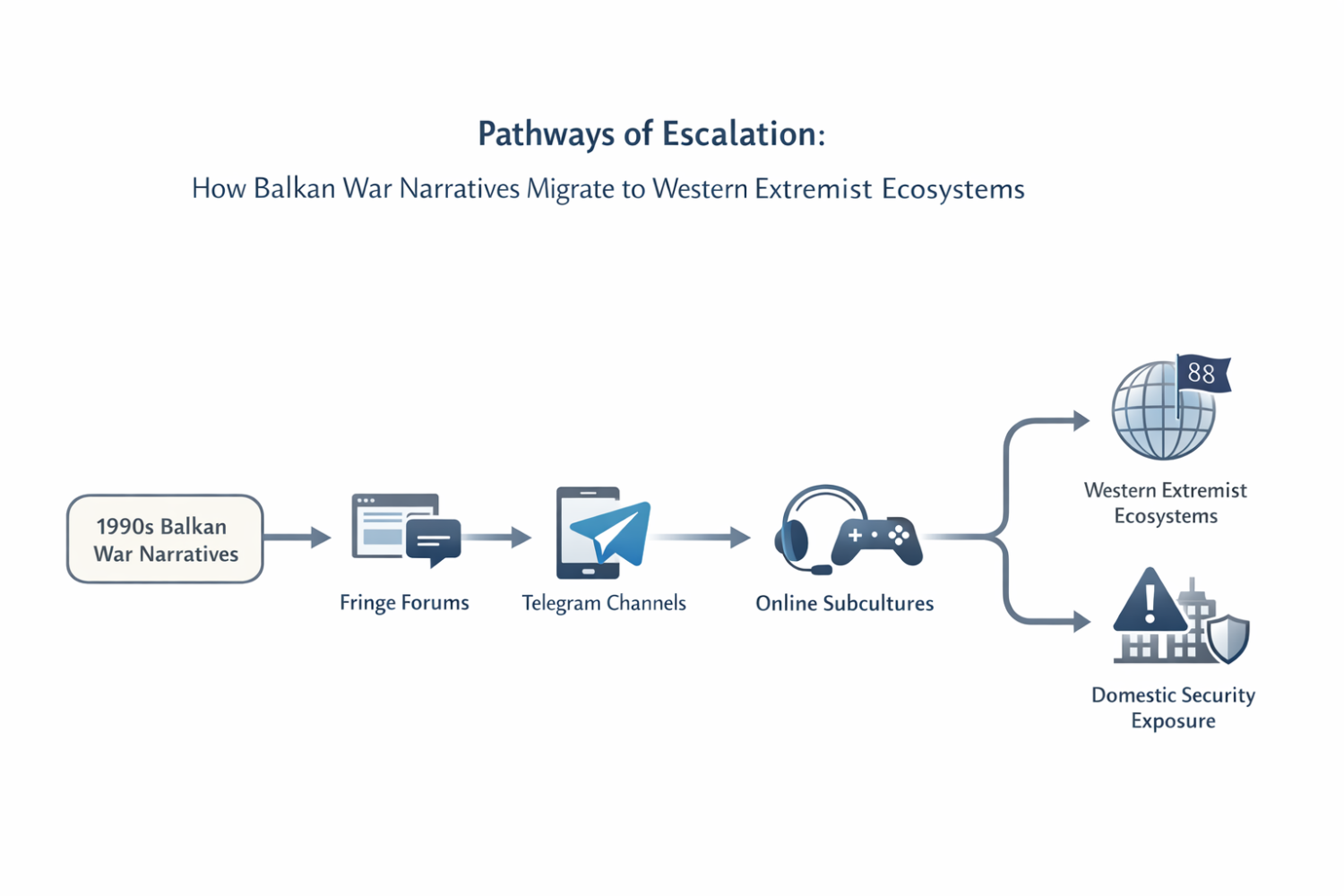
Unresolved Balkan war narratives have escaped the region. As they move through encrypted platforms and online subcultures, they are repurposed inside Western extremist ecosystems, turning historical ambiguity into a low-cost source of strategic blowback. For Washington and Brussels, this is not about memory or mediation, but about containment.
By Mark Gojcaj | 13 Januar 2026
For most policymakers in Washington, Serbia–Kosovo relations remain a peripheral issue—important for European stability, but rarely decisive for U.S. strategic priorities. That assumption no longer fully holds. Elements of the unresolved Balkan wars of the 1990s have migrated into transnational extremist ecosystems, where they now circulate inside platforms and communities that intersect directly with U.S. domestic security concerns.
This development is not the result of a centralized propaganda campaign, nor is it best understood through the language of online hate or digital culture wars. It is a case of strategic blowback: historical narratives left unresolved abroad re-entering Western political space in destabilizing and ideologically weaponized forms.
How a Regional War Became a Global Symbol
One of the clearest examples is the spread of the “Remove Kebab” or “Serbia Strong” meme. Its origins lie in Serbian nationalist propaganda from the Yugoslav wars, including music and imagery associated with wartime leaders later convicted of serious crimes. Over time, this material migrated into fringe online forums and was absorbed into a broader far-right symbolic repertoire.
As it traveled, its meaning changed. The original Balkan context faded, replaced by a generalized civilizational narrative framing violence against Muslims as defensive, historical, or even heroic. By the late 2010s, the meme had become recognizable across white-supremacist spaces in North America and Western Europe, appearing in manifestos, online subcultures, and extremist media ecosystems.
At that point, the issue was no longer Serbian nationalism per se. It was the transformation of a specific historical conflict into a reusable ideological asset inside global extremist networks.
Serbia’s Role: Environment, Not Direction
There is little evidence that the Serbian state directly orchestrates these transnational networks. But direct control is not required. Modern extremist ecosystems thrive in permissive environments—places where denial, glorification, and networking are tolerated rather than actively suppressed.
Serbia has increasingly functioned as such an environment. High-profile cases of Western extremists cultivating ties there are best understood not as anomalies, but as symptoms of a broader pattern: a jurisdiction where nationalist symbolism and revisionist narratives face limited constraint and therefore attract ideological traffic.
For Washington, this distinction matters. The strategic risk lies not in formal attribution, but in the cumulative effect of tolerance. Ambiguity lowers costs for extremist actors and raises costs for containment.
Telegram and the Convergence of Grievance
The primary infrastructure for this narrative migration today is Telegram. Balkan-focused channels increasingly overlap with Russian-aligned and Western far-right networks, creating a shared information space where grievances reinforce one another.
Within these channels, Kosovo is rarely discussed as a legal or diplomatic case. Instead, it is reframed as evidence of NATO overreach, Western hypocrisy, or the illegitimacy of post-Cold War order. These narratives are frequently bundled with conspiracy theories about global elites, public health, or cultural decline—allowing Kosovo to function as a symbolic reference point rather than a geopolitical reality.
This framing is effective because it does not attempt persuasion. It seeks resonance.
Gaming and the Normalization of Revisionism
Claims of systematic radicalization through gaming platforms should be treated cautiously. There is limited evidence of coordinated campaigns targeting mainstream gamers. However, certain environments warrant attention.
In military simulation games and user-generated modifications, historical events from the Yugoslav wars are sometimes reconstructed in ways that omit civilian casualties or recast documented atrocities as legitimate military actions. These spaces do not debate history; they simulate it. Repetition, immersion, and play gradually normalize revisionist narratives—particularly among younger users with little prior exposure to the conflicts.
The risk is not mass mobilization, but gradual desensitization.
Why Kosovo Resonates in the United States
Kosovo appears in U.S. extremist discourse not because of Balkan politics, but because of what it represents: a NATO-backed intervention, a successful secession, and the use of force to reshape political outcomes. For actors hostile to liberal international order, Kosovo functions as a case study—selectively interpreted and ideologically repurposed.
In this sense, Kosovo is less a target than a vehicle.
Implications for Washington — and for Allies
For the United States, the relevance is not historical reconciliation or regional mediation. It is containment. When unresolved European war narratives circulate freely inside U.S.-based extremist ecosystems, they become part of America’s domestic security problem at minimal cost to their originators.
For European allies, the implication is parallel. Permissive environments do not remain local. Digital ecosystems erase distance, and narratives migrate faster than policy frameworks adapt.
The broader lesson is straightforward: unresolved conflicts do not stay frozen. They travel, mutate, and return—often embedded in movements that challenge alliance cohesion, democratic legitimacy, and internal security.
Addressing this risk does not require policing every meme or platform. It requires recognizing that historical ambiguity, when combined with digital permissiveness, creates strategic exposure. Ignoring that exposure does not make it disappear. It externalizes it.
About the Author
Mark Gojcaj writes from New York, where he examines the intersection of American conservatism and Southeast European political and security realities. He is a regular contributor to The Kosovo Dispatch’s transatlantic coverage, with a focus on U.S. foreign policy, NATO dynamics, and the Western Balkans.
