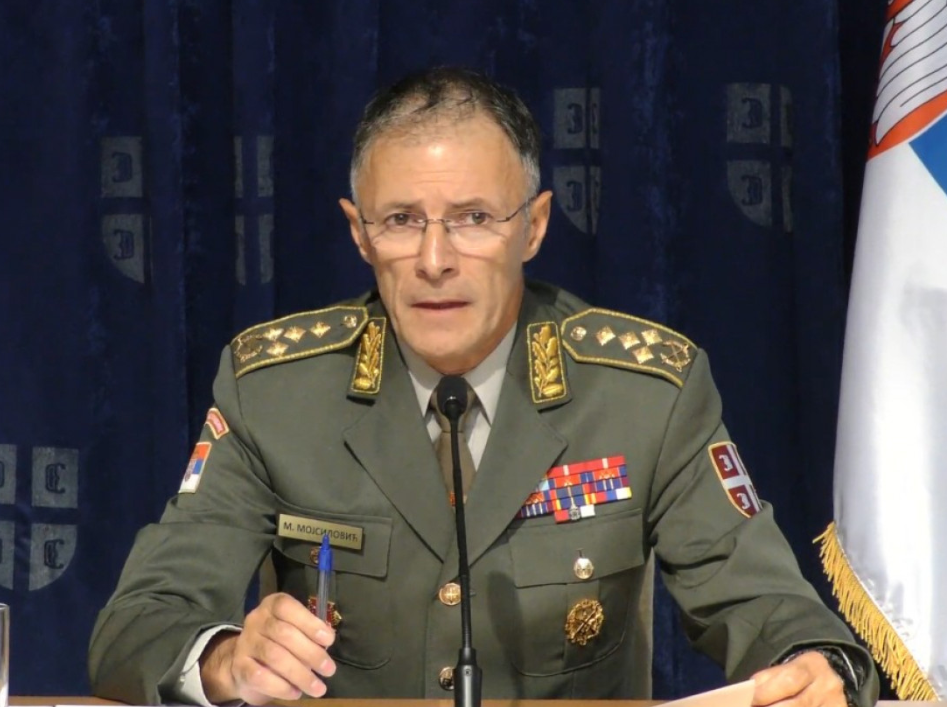
A Serbian general’s warning about Kosovo’s security forces says less about military realities than about an old political narrative: deny Kosovo’s legitimacy, cast it as a threat to its own citizens, and present Serbia as the region’s stabilizing power—an argument Washington should read not as strategy, but as propaganda.
by Mark Gojcaj | 16 February 2026
From Washington, statements like the recent remarks by Serbian Chief of General Staff Milan Mojsilović are not read as routine military commentary. They are read as political signals. The tone, the language, and the framing all suggest that this is less about a technical assessment of the Kosovo Security Force (KSF) and more about shaping a narrative.
That narrative is familiar: Kosovo is not legitimate, its institutions are potentially dangerous, and Serbia remains the responsible, stabilizing actor in the region.
For American policymakers, the real question is not whether Serbia believes its army is stronger. The real question is what this rhetoric reveals about Serbia’s strategic mindset and its view of Kosovo’s future.
Words that reveal strategy
When the Serbian chief of staff refers to the KSF as a “so-called” force, he is not speaking as a professional soldier. He is speaking as a political actor.
Kosovo’s security institutions exist. They are established by the constitution, overseen by elected civilian authorities, and trained by NATO member states. The United States has invested years of effort and credibility into building those institutions. Whether Belgrade recognizes them or not does not change the reality on the ground.
From Washington’s perspective, this kind of language is a signal. It suggests that parts of Serbia’s security establishment still see Kosovo not as a political reality, but as an unresolved territorial question. That is not just rhetoric. It is a window into long-term strategic thinking.
The old story of “threatened Serbs”
The central claim in the general’s remarks is that the KSF could be used against the Serbian population in Kosovo. It is an argument that sounds familiar because it has been repeated for years.
But it rests on a contradiction.
Kosovo Serbs are citizens of Kosovo. They vote in its elections. They hold guaranteed seats in parliament. They run municipalities with significant autonomy. The constitution gives them protections that few minorities in the region enjoy.
The suggestion that Kosovo’s security forces would be used against their own citizens relies on an analogy with the past. It quietly invokes the memory of the 1990s, when the Serbian state used its army and police against its own population.
But that was Milošević’s Serbia. Kosovo’s institutions were built precisely to prevent that kind of abuse. The KSF is multiethnic, constitutionally bound, and developed under close NATO supervision. It is not an instrument of repression. It is a small, defensive force meant to operate within a Western security framework.
In Washington, claims that the KSF threatens Kosovo Serbs are not seen as neutral military observations. They are understood as political messaging.
A legal argument from another era
Serbia’s continued reliance on UN Security Council Resolution 1244 is predictable. It is also increasingly disconnected from political reality.
Since 1999, the region has changed dramatically. Kosovo declared independence. More than a hundred countries recognized it. NATO states invested heavily in building its institutions, including its security sector.
The transformation of the KSF is not happening in defiance of the West. It is happening with Western support. The United States, the United Kingdom, Türkiye, and others are involved in the process. That is the strategic reality that matters in Washington.
The legal argument may still exist on paper, but the political and security architecture of the region has already moved on.
The image of a restrained Serbia
Another theme in the general’s remarks is the portrayal of Serbia as a calm, defensive actor. It is a narrative often repeated in diplomatic settings, but one that does not always match events on the ground.
In recent years, Serbia has:
- moved troops toward the Kosovo border during political crises,
- strengthened defense ties with Russia and China,
- and invested heavily in new weapons systems.
Kosovo, by contrast, still depends on NATO’s KFOR mission for its overall security environment. Its security force is small, lightly equipped, and tied closely to Western partnerships.
The contrast is hard to miss. One side is building a conventional regional military with multiple external partners. The other is building a modest, NATO-aligned defensive force.
Washington tends to notice such differences.
Incidents without context
References to drones, armed groups, and cross-border incidents appear frequently in Serbian statements. They are often presented without independent verification or broader context.
What rarely enters the conversation is the role of criminal networks in the border region, the smuggling economy, or the armed groups that have appeared in northern Kosovo during periods of tension. Security incidents do happen. But selective reporting does not tell the whole story.
American policymakers are generally cautious about accepting such claims at face value. They look for independent confirmation and a wider strategic picture.
The meaning behind the military comparison
On one point, the Serbian general is right. The KSF cannot match the Serbian army in conventional terms. Serbia has air power, heavy artillery, and larger armored formations. The KSF is still a light force in transition.
But the comparison itself is revealing.
Kosovo has never built the KSF to match Serbia tank for tank or aircraft for aircraft. Its doctrine is defensive. Its purpose is territorial protection and integration into the Euro-Atlantic security system.
So the real question is not whether Serbia is stronger. The real question is why Serbia continues to frame Kosovo as a military problem at all.
Kosovo is not an open battlefield. NATO has been present there continuously since 1999. Any Serbian military action would immediately involve NATO. That is the strategic reality.
In that context, constant references to Serbian military superiority do not sound purely defensive. They suggest that parts of the Serbian security establishment still think of Kosovo as a potential military theater, not just a political dispute.
That way of thinking is itself destabilizing. It implies that, beneath the language of dialogue, the option of force has not entirely disappeared from strategic calculations.
The KSF is not meant to defeat the Serbian army.
It exists to make sure Kosovo is never again a defenseless space.
What Washington should actually watch
For policymakers in the United States, the central issue is not who has more tanks or aircraft. That question was settled long ago.
What matters is the narrative.
The general’s remarks push three ideas:
- that Kosovo’s security institutions are illegitimate,
- that they threaten the Serbian population,
- and that Serbia is the region’s stabilizing force.
If that narrative goes unanswered, it shapes perceptions in Western capitals. It slows Kosovo’s integration into NATO structures. It reinforces the image of a frozen conflict.
From Washington’s vantage point, the Balkans remain stable not because one army is stronger than another, but because the region is anchored in a clear Euro-Atlantic security framework. The United States is still the key pillar of that framework.
What matters most is not Serbia’s rhetoric about military superiority.
What matters is whether the region continues to move toward that Western security architecture—or away from it.
About the Author
Mark Gojcaj writes from New York, where he examines the intersection of American conservatism and Southeast European political and security realities. He is a regular contributor to The Kosovo Dispatch’s transatlantic coverage, with a focus on U.S. foreign policy, NATO dynamics, and the Western Balkans.
