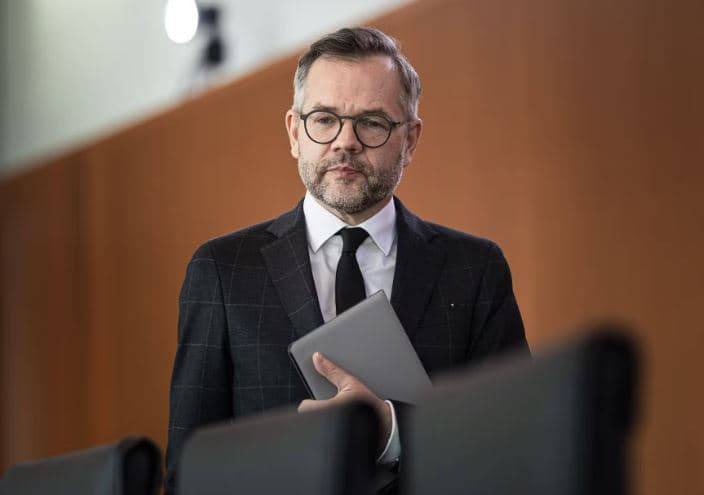
Michael Roth was right to hope Serbia would change, and he is right to say now that it has not. The officials who inherited his desk hold the same evidence and are still paying.
By Ngadhnjim Brovina | 11 October 2026
On Sunday Michael Roth wrote about Ivica Dačić’s promise of a Serbian flag over Prizren. Roth was Germany’s Minister of State for Europe for eight years and then chaired the Bundestag’s foreign affairs committee. “This path leads to war. It does not lead into the EU,” he posted. “No more EU money for Serbia!”
The Kosovar activist Rron Gjinovci answered later the same day. Roth and Dačić were in office together for six years, he wrote, and Dačić is the same as ever. “What did you do when you were in power, sir? Who cares what you think now?”
Roth replied that he had spoken against nationalism then too. He ended: “Dačić hasn’t changed, and neither have I.”
Gjinovci’s question is the right one. It has gone to the wrong address.
During Roth’s years at the Foreign Office, European policy toward Serbia rested on a wager: that a governing class formed under Slobodan Milošević could be drawn, by money and status, into becoming something else. The wager had evidence behind it. The European Movement in Serbia named Dačić its “Best European” of 2009. In April 2013, as prime minister, he put his name to the Brussels Agreement with Kosovo. A policymaker who saw that and hoped was doing his job. There is no sin in hoping that the other side will change.
The sin begins when the evidence changes and the policy does not.
Dačić was the spokesman of Milošević’s party in the 1990s. He has sat in every governing majority in Belgrade since 2008, as interior minister, prime minister, foreign minister, speaker of parliament and, since May 2024, interior minister again. On 7 October, in Raška, he told a campaign rally: “Sooner or later the Serbian flag will fly over Prizren, be sure of that” (“Kad tad će se vijoriti srpska zastava iznad Prizrena, budite sigurni”). Three days later he was in Požarevac, where Milošević is buried. There, according to a party statement carried by the FoNet agency, he said it was his party’s obligation to respect everything Milošević did for the state and for the people.
What Milošević did for the state and the people is a matter of record, and by Serbia’s own measure it is ruin. The wars he led it into cost Serbia territory, cost the Serbs of Croatia and Kosovo their homes, and cost the country a decade under sanctions. Hyperinflation wiped out its savings. The International Court of Justice found Serbia in breach of its duty to prevent the genocide at Srebrenica. His campaign in Kosovo ended in 1999 with Serbian forces withdrawing, and with more than 700 bodies of Kosovo Albanians buried on a police training ground at Batajnica, near Belgrade. The Interior Ministry’s own police chief was later convicted in The Hague. Dačić runs that ministry today. An obligation to respect such a record cannot be about its results, which leaves only its aims.
Nor is this a first offence. In July a minister from Dačić’s own party, Snežana Paunović, said on television that in Milošević’s place she would have ethnically cleansed Kosovo in 1998. A European Union spokesperson answered that Europe has no place for such rhetoric. Dačić’s office called the criticism shameful and hypocritical. Nothing else followed. Three months later the party leader went further than his minister.
Through all of it the instruments of reward have stayed on the table. Enlargement Commissioner Marta Kos has said Serbia can count on €1.5 billion from the Growth Plan once it meets conditions on judicial laws, elections and media freedom. None of those conditions mentions a cabinet minister’s claim on a neighbour’s city.
Serbia’s budget revision in August raised defence to 315.9 billion dinars, 2.8 percent of GDP, and nearly tripled the line for military equipment. No one has to trace a single euro of European assistance into an arms contract to see the connection. A budget is one pot. What Europe finances in Serbian roads and power lines is spending Belgrade does not have to find, in the year it found the money to triple its equipment line. Separately, and from its own budget, Serbia buys from European makers. The Rafale contract with France alone is worth about €2.7 billion. Europe rewards this Serbia and sells to it at the same time.
On Friday, the same weekend, President Trump announced a deal with Vladimir Putin that eases American sanctions on Russian diesel. European governments objected at once. Sweden’s prime minister said he regretted it because energy revenues feed the Russian war chest. The Union is due to adopt on Monday what it describes as its most comprehensive sanctions package yet. When Mr Trump added that it was time for Ukraine to get a new president, the President of the Commission stood with Volodymyr Zelensky within a day.
Europe is right in that quarrel. Money that reaches an aggressor emboldens him, and the victim is not the party to be disciplined. Yet in the Balkans it is Europe that keeps the money on the table for the side making the claims and reserves its discipline for the side being claimed. Kosovo was placed under EU punitive measures in 2023 over mayors and municipal buildings. No comparable measures were imposed on Serbia after the armed attack at Banjska that September, whose self-declared organiser, according to Kosovo’s foreign minister, appeared last week at a ruling-party rally. Kosovo’s application for membership, filed in December 2022, has still not been sent to the Commission for an opinion. What Brussels told Washington about Moscow on Saturday, it has yet to tell itself about Belgrade.
Roth used the word war, and it is the right word. There is no gentler term for the direction of travel when the interior minister of one state claims a city in another, tells his party three days later that it has a duty to respect the record of the last man who sent forces there, and sits in a government that has nearly tripled its spending on military equipment in a single year. Croatia’s defence minister said on 2 October that nobody buys this much weaponry just to have it.
To file all this under campaign rhetoric is to assume the campaign ends. Serbia votes on 25 October. Dačić’s party has been in every government for eighteen years, and nothing in this campaign suggests the next one will be the exception.
Roth can write “no more EU money” because he no longer signs for it. That is the limit of his statement, and it is also the reason not to punish him for making it. He hoped, he was disappointed, and he says so in public. The people who can turn his sentence into policy sit in Berlin and Brussels today. They have more evidence than he ever had and fewer excuses.
Gjinovci’s question will reach them as well. Unlike Roth, they can still answer it while in power.
Ngadhnjim Brovina is a political scientist at the University for Business and Technology in Pristina, where his research addresses party systems, democratic consolidation, and transnational party organisation in postcommunist Europe.
