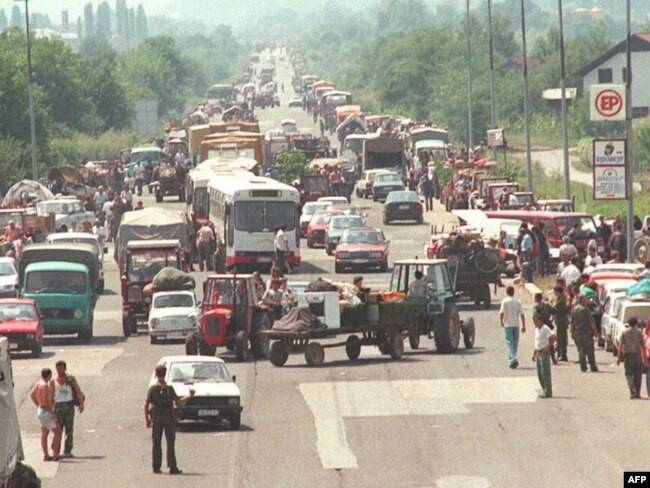
In his last address as Serbia's president, Aleksandar Vučić told Mrkonjić Grad that not everything began with Oluja. He is right. The record he left out shows what did.
By Ngadhnjim Brovina | 5 August 2026
The evening in Mrkonjić Grad was built with care. A memorial service led by Patriarch Porfirije, a film from the Memorial Center of Republika Srpska, and the testimony of Nevenka Dobrić, whose twelve-year-old son was killed when the refugee column carrying him was cut outside Sisak. Then Serbia's president rose to deliver what he called his last address in office, and placed inside it a sentence worth more than the rest of the speech. "Nije sve počelo 'Olujom'," he said. Not everything began with the Storm.
He is right. A commemoration is also a chronology, and chronologies can be checked. So take the sentence seriously and date the chain, using only material that has passed through a courtroom.
The chain that ended on 4 August 1995 opens in August 1990, when armed barricades closed the roads around Knin and the rebellion against Croatia began. What followed on that territory carries a judgment. The Hague tribunal convicted Milan Martić in 2007, thirty-five years, for the persecution and deportation of the Croat and other non-Serb population of the Krajina he led, and for ordering rockets fired into central Zagreb in May 1995. In January 1995, seven months before Oluja, international mediators presented the Z-4 plan to Zagreb and to the Krajina leadership: autonomy so extensive it approached statehood inside Croatia, with a president, a parliament, a currency and a police force of its own. Croatia's president accepted it as a basis for negotiation. Martić's leadership refused even to receive the document. And in the late afternoon of 4 August 1995, as the Croatian operation ran, the supreme defense council of the self-declared Krajina republic met in Knin. At 4:45 p.m. Martić signed the order to evacuate the population unfit for military service from the municipalities of Knin, Benkovac, Obrovac, Drniš and Gračac, along prepared routes toward Srb and Lapac, with help to be sought from the UN force. People were already leaving that day; the order gave the departure organization and sanction. And when Croatia's generals were later tried for the operation, the tribunal's appeals chamber acquitted them, in 2012, leaving the case law on Oluja without any finding of a plan to expel.
The question the ceremony would not ask, who told them to go, has a documented answer with a signature and a time stamp on it.
Serbia's interior minister completed the picture without meaning to. In his anniversary message, Ivica Dačić mourned the "Republic of Serbian Krajina" by name, an entity no state on earth ever recognized, and whose president sits in the tribunal's record as a convicted deporter. A government negotiating membership of the European Union spent the day honoring the para-state whose founding methods fill that judgment.
Apply the same dating discipline to the second exodus the ceremony folded into its frame, the departure of Serbs from Kosovo in June 1999. The adjudicated starting point is in the tribunal's record. In January 2014 the appeals chamber confirmed the convictions of Yugoslavia's deputy prime minister Nikola Šainović, army general Nebojša Pavković and police general Sreten Lukić, upholding the trial chamber's finding of a broad campaign of violence against the Kosovo Albanian civilian population by forces under Belgrade's control, whose deliberate actions caused the departure of at least 700,000 Albanians between the end of March and the beginning of June 1999. The consequence followed the signatures. Kumanovo on 9 June, Resolution 1244 a day later, a negotiated withdrawal of Belgrade's forces, a NATO-led deployment of some fifty thousand troops under a Security Council mandate, and a large part of the Serb population leaving alongside the withdrawing army and police. No court anywhere has found an organized campaign to expel them.
Set the two ledgers side by side and the method of the evening becomes visible. Where courts established an organized expulsion, the ceremony spoke of a defensive war. Where no court has found one, it spoke of pogrom. The commemoration reassigns causation, moving each event's starting point to the hour Serbs began to suffer and deleting the adjudicated chapters before it. The superlative the departing president reached for, the most victimized nation of the twentieth century, survives only on the edited chronology.
Which is why the operative sentence of the address deserves a colder reading than the applause gave it. Vučić apologized to the Krajina Serbs that Serbia had been weak in 1995, then promised that Serbia "will protect its people and will not wait and look for an excuse not to do so." A pledge borrows its meaning from the history around it. Attached to the record as the courts left it, this one would be unremarkable. Attached to the chronology as Monday night edited it, in a week when Belgrade describes war-crimes arrests in Kosovo as terror against Serbs, it promises protection from consequences by the successor of the state that set the causes. The order that put the Krajina columns on the road survives in the trial record, dated and timed, with the signature under it. The ceremony built to mourn the columns cannot afford to read it aloud.