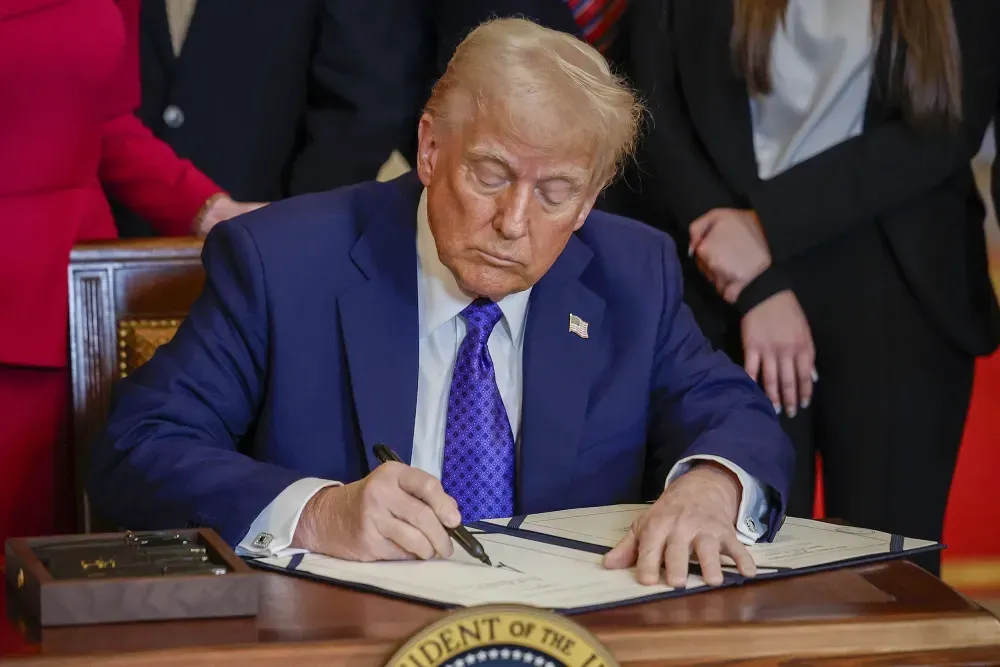
The signing of the U.S. National Defense Authorization Act (NDAA) for fiscal year 2026 has placed Kosovo explicitly back into the architecture of American national-security policy. Beyond the headline figure of roughly $901 billion in authorized defense spending, the act contains language that clarifies Washington’s position on the Kosovo–Serbia relationship with unusual precision: mutual recognition is named as the end-state, ethnic border revisionism is rejected, and progress is tied to implementation rather than rhetoric. While far from a security guarantee, the text represents a hardening of U.S. policy lines—one that carries real strategic implications for both Pristina and Belgrade.
by Mark Gojcaj and Klea Ukaj - 19 December 2025
The signing of the U.S. National Defense Authorization Act (NDAA) for fiscal year 2026—authorizing approximately $901 billion in defense spending—has placed Kosovo back into the formal text of American national-security policy. While public reactions in the region have ranged from celebratory to dismissive, the Kosovo-related language embedded in the act deserves a more measured reading.
It does not constitute a security guarantee, nor does it fast-track Kosovo into NATO. But it does something arguably more durable: it hardens long-contested U.S. policy positions into statute-level guidance, narrowing the space for diplomatic ambiguity around the Kosovo–Serbia process.
Where Kosovo Appears in the Act
Kosovo is addressed in Section 1280: “Relations between Kosovo and Serbia.” The section is structured in two parts: a Sense of Congress and a Statement of Policy. This distinction matters.
The Sense of Congress reflects the collective position of the U.S. legislature. It is not automatically binding on the executive branch, but it carries political weight and shapes oversight, appropriations debates, and diplomatic expectations. The Statement of Policy, by contrast, articulates how the U.S. government understands its own policy direction.
Together, these provisions articulate three core messages.
Mutual Recognition Is Named as the End-State
First, the act explicitly states that the United States should continue to support a comprehensive final agreement between Kosovo and Serbia based on mutual recognition.
This is not new in substance—U.S. administrations have long treated mutual recognition as the logical endpoint—but it is significant in form. By naming mutual recognition directly in national-security legislation, Congress reduces the interpretive flexibility that has allowed “normalization” to be presented, particularly by Belgrade, as a status-neutral technical arrangement.
In practical terms, this does not compel Serbia to recognize Kosovo. But it clarifies that Washington’s understanding of “normalization” is not open-ended. The destination is named, not implied.
The 2023 Agreement Is Affirmed—With an Emphasis on Implementation
Second, Congress describes the EU-facilitated Agreement on the Path to Normalization of February 27, 2023, as a “positive step forward” and urges both parties to make immediate progress on its Implementation Annex.
This framing matters because it shifts attention away from renegotiation and toward execution. The act suggests that future U.S. initiatives to deepen bilateral relations with Kosovo and Serbia—whether strategic dialogues or economic cooperation—should be considered only after sufficient implementation progress has been made.
In other words, the message is procedural but firm: progress will be measured by behavior, not rhetoric.
A Clear Rejection of Border Revisionism
The most unambiguous language appears in the Statement of Policy. The act declares that the United States shall not pursue any policy advocating land swaps, partition, or the redrawing of borders along ethnic lines in the Western Balkans as a means of resolving disputes.
This is a notable departure from the ambiguity that characterized parts of the previous decade, when ideas of “territorial adjustment” periodically resurfaced in diplomatic discourse. By writing this rejection into statute-level policy, Congress is effectively closing the door on ethnic border solutions as an acceptable tool of conflict management.
The same provision links this stance to support for pluralistic democracies in the region, framing ethnic partition not as pragmatism, but as a risk factor for renewed instability.
What the Act Does Not Do
Equally important is what the NDAA does not do.
It does not grant Kosovo NATO membership, nor does it promise one. NATO enlargement requires unanimous consent among allies and follows a separate political and military process. While the NDAA contains broader regional language supporting Euro-Atlantic integration for Western Balkan states that meet the criteria and enjoy allied consensus, this should not be misread as a Kosovo-specific accession pathway.
Nor does the act allocate direct funding to Kosovo through this section. The NDAA is an authorization framework; actual spending depends on subsequent appropriations legislation.
“Sense of Congress” vs. Binding Law
Much of the public confusion stems from treating Sense of Congress language as if it were operational command. It is not. Such provisions express congressional intent and priorities, but they do not compel executive action on their own.
That said, dismissing them as “symbolic” would also be a mistake. Sense of Congress language shapes the policy environment in which diplomats operate. It influences hearings, reporting requirements, and the political costs of deviation.
The border-revision clause, in particular, is drafted not as an aspiration but as a policy boundary. It signals to current and future administrations where Congress expects U.S. diplomacy to draw the line.
Strategic Implications for Kosovo
For Kosovo, the implications are double-edged.
On the positive side, the act reinforces three long-standing pillars of Kosovo’s diplomatic position: mutual recognition as the end-state, territorial integrity as non-negotiable, and democratic pluralism as the preferred regional model. These positions now enjoy explicit congressional backing.
At the same time, the emphasis on implementation raises expectations. The text implicitly links Kosovo’s international support to institutional maturity, de-escalation, and consistent engagement with the agreed framework. Political theatrics or unilateral moves that alienate allies risk undermining the very policy anchor the act provides.
Implications for Serbia
For Serbia, the message is restrictive rather than punitive. The space for presenting normalization as a perpetual interim condition is narrowed. So is the viability of ethnic partition as a diplomatic bargaining chip.
While the act does not impose sanctions or deadlines, it signals that continued delay will increasingly be interpreted in Washington as obstruction rather than complexity.
A Policy Anchor, Not a Breakthrough
The FY2026 NDAA does not transform the Kosovo–Serbia dialogue overnight. It does not replace the EU-facilitated process, nor does it guarantee outcomes. What it does is fix key U.S. positions more firmly into the legal and political infrastructure of American foreign policy.
For Kosovo, the strategic opportunity lies not in over-celebration, but in disciplined statecraft: using the clarity provided by the act to strengthen credibility, avoid unnecessary escalation, and align domestic governance with the expectations of its principal ally.
In that sense, the NDAA is less a diplomatic breakthrough than a policy anchor—one that rewards seriousness and punishes illusion.
