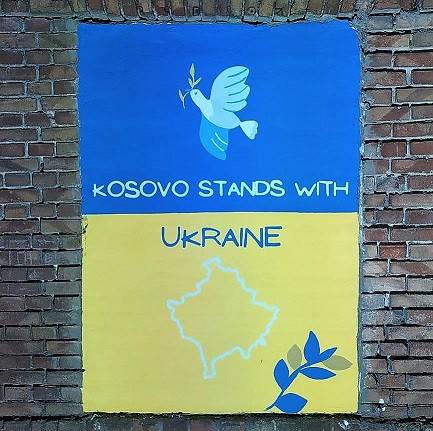
Support from Kosovo will not be decisive for Ukraine to win the war. And non-recognition by Ukraine will do little to endanger Kosovo's independence. By supporting Ukraine, Kosovo has placed itself on the right side of history, and there it should remain. The President of Ukraine, Zelensky, has made a mistake in moral, political, and legal terms alike. He has done more damage to Ukraine than to Kosovo, and on this point at least he has lined up on Russia's side and against the principal allies who have given hundreds of billions of euros in aid so that Ukraine can defend itself. Zelensky has fallen into the trap of Serbia's president, Vučić, who treats Zelensky's visit to Belgrade merely as an argument for extracting benefit from the EU, while to Serbia's citizens the main news he serves up from this visit is the statement on non-recognition of Kosovo's independence.
By Augustin Palokaj | 10 August 2026
First, some facts must be stated: Ukraine has never recognized Kosovo and has never given any signal that it would do so. Indeed, before Russia's full-scale aggression against Ukraine, that state was even harsher than Russia itself in opposing Kosovo's independence. This was displayed, among other things, through Ukraine's refusal to welcome even athletes from Kosovo onto its territory. This has not changed, and through its diplomats and other officials Ukraine has repeatedly stated that it "does not change its position on Kosovo's independence." Ukraine has done this just as Spain, Romania, Greece, Slovakia, Iran, Russia, Bosnia and Herzegovina, and several other states that have not recognized Kosovo's independence do.
When Russia's full-scale aggression against Ukraine began, Kosovo lined up with the free democratic world, supporting Ukraine with whatever means it had. And at the start of this aggression, Russia's president drew comparisons between Kosovo and Crimea, a territory of Ukraine occupied and annexed by Russia. The free democratic world rejected these comparisons, recalling that Kosovo is a special case and cannot be compared with Crimea. Serbia's president, Aleksandar Vučić, called the West's objections to these comparisons hypocrisy. And Serbia, continuing its foreign policy of sitting on several chairs, declared that it "supports the sovereignty and territorial integrity of Ukraine just as it expects others to support the sovereignty and territorial integrity of Serbia." Into this trap fell Ukraine's president Zelensky when, in response to a journalist's question — in all likelihood pre-scripted — he said that Ukraine does not change its position on Kosovo's unilateral declaration of independence.
Zelensky is a leader who leads a people at war and a country that for four years now has faced the threat of extinction. In such a condition Zelensky cannot always be rational and weigh carefully every word he speaks. And by accepting the comparisons between Kosovo and the occupied and annexed parts of Ukraine, he has — intentionally or not — done a good service to Russia's propaganda, which spreads successfully in Europe through Serbia as well. Media banned in Europe have found hospitality in Serbia and operate from there unhindered.
There are many similarities and many differences between the situation in Kosovo and that in Ukraine. Both countries and both peoples were victims of attacks by a larger and better-armed neighbor with the aim of extermination. Just as Serbia at the end of the 1990s committed war crimes and conducted a campaign to erase the Albanians from Kosovo, so too Russia sought to undo Ukraine and its people. Serbia and Russia used the same model to a great extent: advancing territorial claims, using religion, claiming to be protecting an endangered population (Serbs in Kosovo and Russians in Ukraine). And in both cases the Western world came out against Serbia, as later against Russia.
But there are also many differences. Kosovo was liberated, and on its territory a state was created by the will of the great majority of its people. This freedom and independence of Kosovo was also the end of the process of the dissolution of the former Yugoslavia, of which Kosovo was a constituent part. And in the end, Kosovo was recognized by the great majority of the free and democratic states of the world, and the UN's Court gave its opinion that the declaration of Kosovo's independence did not violate the norms of international law.
No one occupied Kosovo, and no other state annexed it, as Russia did with Ukraine. Indeed, Kosovo has written into its Constitution that it may not unite with the territory of any other state — and it has this precisely at the request of the international community, of those who today strongly support Ukraine. Kosovo's independence was declared as an expression of the free will of its people, after an international process, not through rigged votes of the kind Russia organized in the occupied territories of Ukraine.
Ukraine has not carried out ethnic cleansing in Crimea, nor in the Donbas, nor in any other part of its territory, as Serbia did in Kosovo. No democratic state in the world has recognized Crimea or the Donbas, either as independent states or as parts of Russia. Whereas they have recognized Kosovo. Crimea and the Donbas have not joined any international organization — not the World Bank, not FIFA or UEFA, not the Olympic Committee — whereas Kosovo has. No international court has held that the annexation of Crimea or of other parts of Ukraine did not violate international law, whereas in Kosovo's case they have said exactly that. Therefore, the claim that Serbia's territorial integrity with Kosovo as part of it is the same as Ukraine's with Crimea is a grave error, and it works to the detriment, above all, of Ukraine.
Zelensky's statement had no particular echo outside Kosovo and Serbia. The egg-throwing at Prime Minister Kurti in the Assembly was a far more visible story in the international media than Zelensky's affirmation that he will not change his position on Kosovo's independence.
Instead of expressing anger at Ukraine, Kosovar politicians should wake up and re-engage on the international stage, where Kosovo has been all but forgotten. Not only does Kosovo have no direct contacts with Ukraine (through no fault of Kosovo's), but even its principal international partners are paying Kosovo little attention. Because they do not know how to deal with Kosovo, or how to take it seriously, when unserious behavior dominates inside Kosovo itself. Kosovo continues to lose time in the tactical games of its political parties, while for years it has done nothing to strengthen its international subjectivity. If it had at least seized the chance to become a member of the Council of Europe, there at least it would have sat alongside Ukraine. Kosovo should take care, because if EU enlargement happens without Kosovo, the number of EU countries that do not recognize its independence will grow from the 5 they are today to 10, since 5 of the 10 candidate countries (Bosnia and Herzegovina, Serbia, Ukraine, Moldova, and Georgia) do not recognize its independence. Perhaps this fact, too, played a part in the decision to limit the veto right for new member states. If Kosovo were more active, if the Quint countries felt that Kosovo ought to be helped, then they would either exert influence on Ukraine not to speak out against Kosovo, or they would come out with reactions rejecting the comparisons between Kosovo and the occupied parts of Ukraine. But none of this should be taken by Kosovo as a justification for turning its back on Ukraine. Its long-suffering but proud people deserve Kosovo's support too. And in this way Kosovo stands beside its international friends, who are also the friends of Ukraine.
Editorial Note:
Augustin Palokaj is a Brussels-based journalist and international correspondent with more than two decades of experience covering European Union affairs, NATO, and Balkan politics. He is a senior correspondent and columnist for major regional and international media outlets, including Jutarnji list and Koha Ditore, where he writes reports, analysis, and commentary on EU enlargement, foreign policy, and security issues. Throughout his career he has reported on key international events, including EU and NATO enlargement processes and regional conflicts in the Western Balkans, and his work has appeared in multiple European media platforms. His expertise is frequently cited in analyses of EU policy toward the Western Balkans.
This Op-Ed was originally published by KOHA.
https://www.koha.net/kolumne/kosova-duhet-te-vazhdoje-ta-mbeshtete-ukrainen-pa-rezerve