Kosovo's deployment to the International Stabilization Force in Gaza is not primarily a military contribution. It is a statement about what kind of state Kosovo intends to be.
by Klea Ukaj | 30 March 2026
The decision by Kosovo's government to send Kosovo Security Force personnel to the International Stabilization Force in Gaza deserves more than a line in the weekly bulletin. It marks a threshold moment in Kosovo's institutional development, one that carries implications well beyond the Middle East and lands squarely in the ongoing argument about what sovereignty means for a state that still fights for recognition.
To understand why it matters, it helps to understand what the KSF is being asked to join.
The ISF is a United Nations-mandated multinational force established under the Gaza peace plan agreed by Israel and Hamas in October 2025. Its mandate is broad and demanding: ceasefire monitoring, border security, civilian protection, demilitarization of non-state armed groups, training of a new Palestinian police force, and whatever additional tasks the Board of Peace determines necessary. The Security Council authorized it through Resolution 2803, adopted 13 to zero, with China and Russia abstaining. The force is operational through the end of 2027, with any extension requiring fresh Council action.
This is not a classic peacekeeping deployment. American officials have been explicit on that point: the ISF is an enforcement force. It operates under Chapter VII authority, with the power to use all necessary measures. The political architecture surrounding it remains contested and the operational picture remains incomplete. Kosovo is joining a mission that is still, in several important respects, being assembled around it.
Against that backdrop, what does the KSF actually bring?
At the Board of Peace's inaugural meeting in Washington on 19 February 2026, ISF Commander Major General Jasper Jeffers named Kosovo as one of the first five countries to formally commit troops, alongside Indonesia, Morocco, Kazakhstan, and Albania. The contribution will be modest in size. The KSF maintains an active force of roughly 2,500 to 3,000 personnel. It has no combat aircraft, no tanks, and limited heavy support equipment. What it does have is something harder to assemble than hardware: a decade of deliberate institutional construction, a US-trained and NATO-interoperable officer corps, and a growing record of showing up.
KSF personnel have completed American military courses ranging from Airborne to Ranger School. The force deployed a contingent to Kuwait in 2021. In early 2024 it sent 26 instructors to the United Kingdom for Operation Interflex, contributing directly to the training of Ukrainian soldiers. These are not the credentials of a ceremonial force. They are the credentials of a small military that has been shaped, consciously and systematically, for exactly the kind of coalition environment the ISF represents.
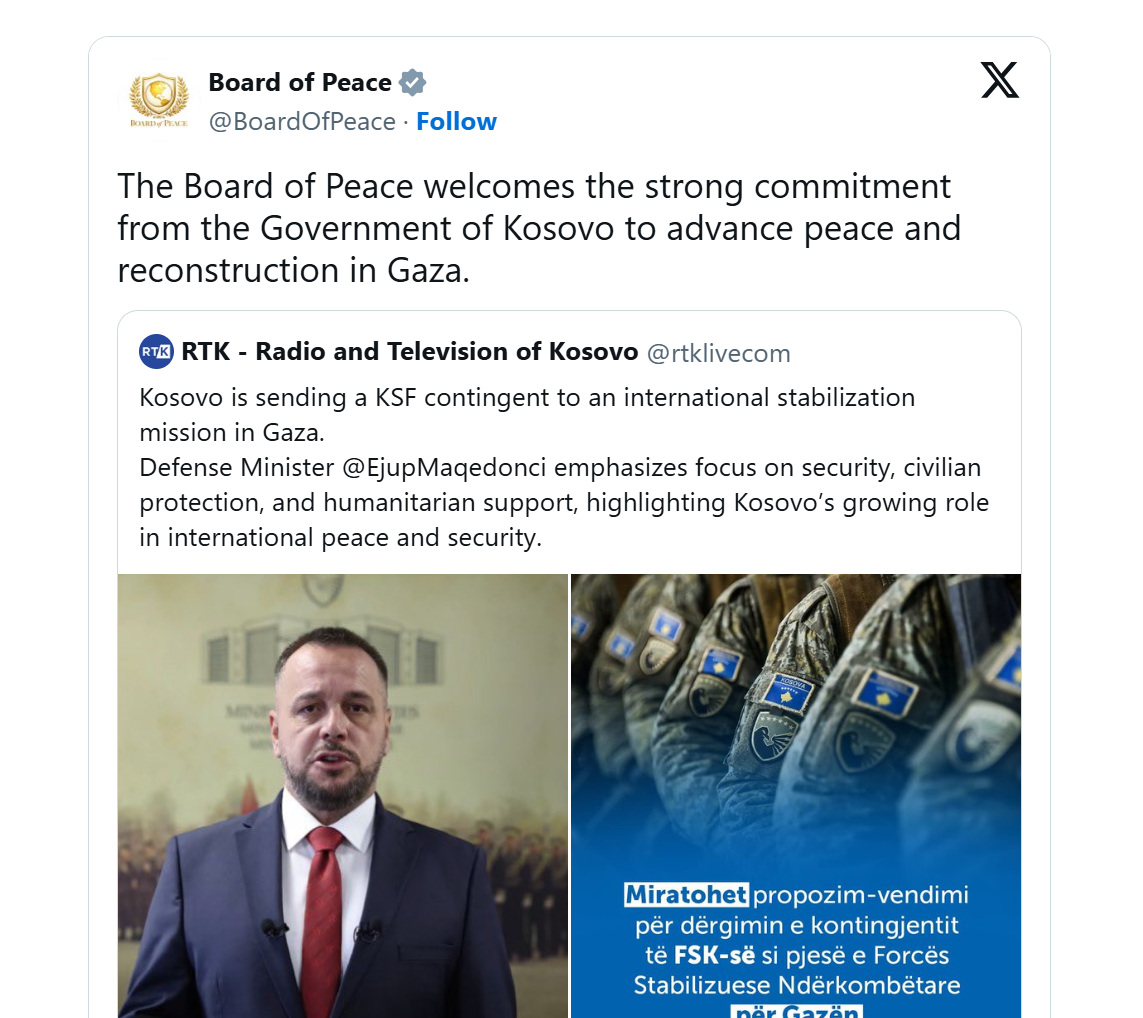
The Board of Peace noticed. Following Kosovo's government vote on Monday, the Board responded on X without delay: "The Board of Peace welcomes the strong commitment from the Government of Kosovo to advance peace and reconstruction in Gaza." For an institution still consolidating its membership and legitimacy, that kind of direct acknowledgment is not diplomatic courtesy. It is a signal that Kosovo's contribution is being registered at the institutional level, not filed away.
Defence Minister Ejup Maçedonci framed the deployment in terms that go beyond the immediate mission. Kosovo wants to be seen not only as a recipient of international security guarantees but as a provider of them. The argument is coherent and, more importantly, it is timely. Kosovo's allies have invested heavily in building the KSF into a force capable of operating beyond its own borders. The Gaza deployment is the return on that investment made visible.
Underneath the official framing sits a harder argument, and it is the one that matters most. Kosovo's statehood remains incomplete. Five EU member states do not recognize it. It is not a UN member. Every institution it builds, every alliance it joins, every mission it staffs, adds weight to the factual case for full recognition. The ISF deployment does not resolve a single outstanding legal or political dispute about Kosovo's status. But it places Kosovo in a room full of states, acting as a state, bearing the obligations that states bear. Over time, that accumulation does not merely support the argument for Kosovo's sovereignty. It becomes the argument.
The risks deserve honest acknowledgment. The ISF is entering a volatile environment where the line between stabilization and enforcement is genuinely unclear, where Hamas retains armed presence across portions of the territory, and where the political framework underpinning the entire mission remains fragile. Kosovo is committing soldiers to that environment while the KSF is still completing its own transformation into a full armed force. The decision demands a great deal of a young military.
What it offers in return is harder to quantify but impossible to dismiss. Kosovo was itself, not long ago, the subject of international stabilization efforts. The country that once required the world's attention to survive is now in a position to contribute to someone else's survival. That reversal carries weight. It is, in fact, precisely the kind of argument a state makes when it intends to be taken seriously, not just recognized in principle, but trusted in practice.
