At Davos, Prime Minister Albin Kurti laid out Kosovo’s red lines with unusual clarity: parallel structures backed by Belgrade are over; Russian-enabled destabilization is the central security threat; EU enlargement is a test of credibility, not charity; and NATO-backed deterrence—not accommodation—remains the only durable path to stability in the Western Balkans.
by Mark Gojcaj | 21 January 2026
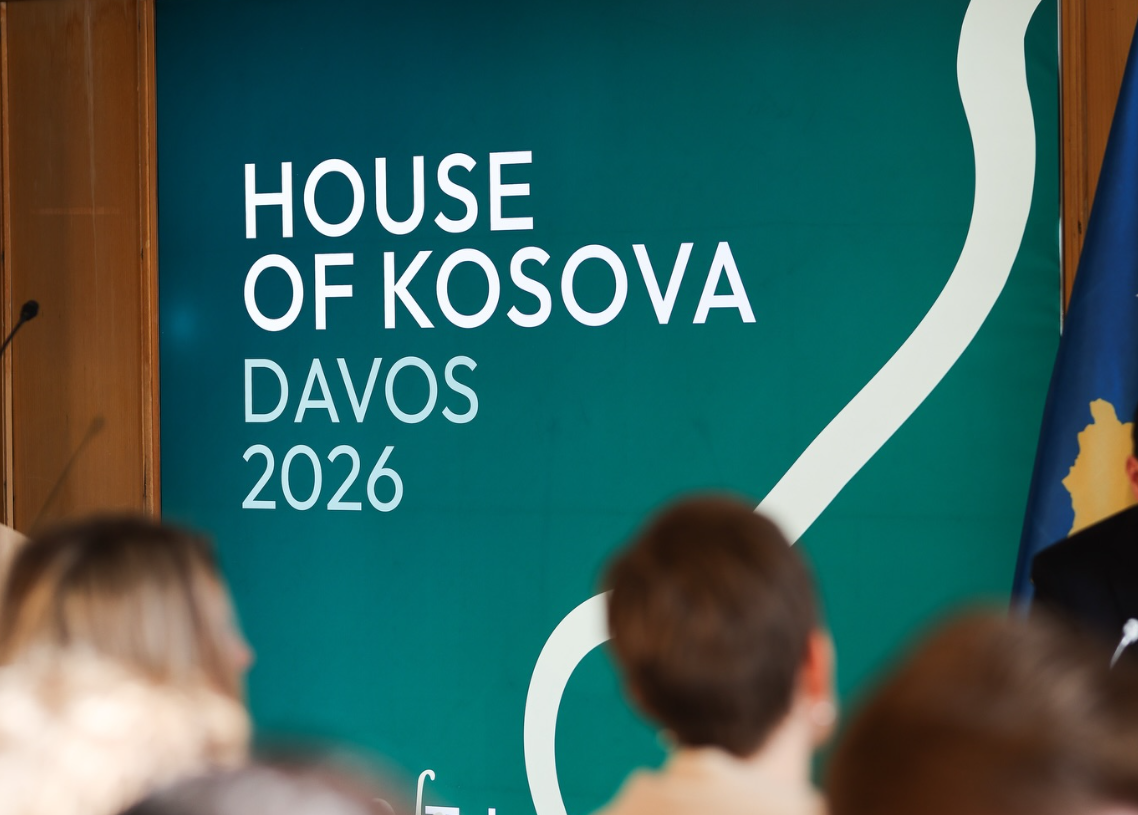
When Kosovo’s Prime Minister Albin Kurti took the stage at the House of Kosovo in Davos, on Janury 20, the setting was polished and conversational. The substance was not.
Across a wide-ranging exchange, Kurti offered one of his clearest articulations yet of how Pristina sees Serbia, Russia’s role in the region, the credibility test facing the European Union, and a security environment increasingly shaped by American unpredictability. The remarks were notable less for rhetorical flourish than for their insistence on rules, deterrence, and institutional memory.
Serbia: Parallel Structures Are Over
Kurti’s central claim regarding Serbia was blunt: Belgrade’s parallel system inside Kosovo has been dismantled.
For years, Serbia maintained what Kurti described as “28 parallel municipalities, five district centers, and parallel institutions including security structures” operating within Kosovo’s territory. According to Kurti, that architecture no longer exists.
“It’s zero now,” he said, without qualification.
Kurti framed this not as escalation, but as overdue enforcement of sovereignty through the rule of law. His government, he argued, closed illegal crossings, dismantled smuggling routes, shut down organized crime networks, and ended the use of Serbia’s dinar as a parallel means of payment. What some Western actors once described as “stability,” Pristina increasingly viewed as tolerated illegality.
Kurti acknowledged that parts of the U.S. and EU policy community initially saw these moves as heavy-handed. His response was direct: what existed before was the real risk. Serbia, he added, miscalculated by instructing Kosovo Serbs to abandon Kosovo’s institutions, creating a vacuum that Pristina then filled with professional policing and state authority.
Privately, several Western officials now concede this point, even if few were prepared to say so at the time.
Russia: The External Enabler
Kurti was even more explicit about Russia’s role.
He described Moscow not as a distant geopolitical factor, but as an active enabler of regional destabilization, particularly through Serbia. “Whoever helps our northern neighbor in its attempt to destabilize us is also causing problems for us,” he said, adding that “our immediate threat in this respect is the Russian Federation.”
Kurti pointed to hybrid and cognitive warfare as the primary tools: coordinated disinformation, narrative engineering, and media penetration. Russian state outlets such as RT and Sputnik—operating regionally from Belgrade—were cited as publishing sustained streams of content during Kosovo’s election period, often localized through intermediaries and delivered in Albanian.
This, he argued, is no longer classic propaganda. It is layered influence, designed to bypass skepticism and appear endogenous. Against such tactics, Kurti emphasized the role of intelligence services, describing them as indispensable in a security environment where hybrid warfare has become routine rather than exceptional.
He also addressed the risk of conventional escalation. Serbia, Kurti claimed, maintains 48 forward operating bases around Kosovo. While he assessed the probability of direct invasion as low, the caveat was telling: unless Moscow directs otherwise.
Deterrence Without Illusions
Kurti underscored Kosovo’s shift toward hard deterrence, without romanticism.
He noted that Kosovo has doubled its number of soldiers, spent more than 2 percent of GDP on defense for three consecutive years, and begun building domestic defense-industrial capacity, including ammunition and drone production. Joint deployments with NATO partners, including the United States and the United Kingdom, were presented as proof of operational integration rather than symbolism.
Referencing Kosovo’s role in major NATO exercises such as Defender 25, Kurti’s subtext was unmistakable: Kosovo is no longer a passive security consumer.
Deterrence, in his framing, is not provocation. It is the condition that makes restraint possible. “When you have to think twice,” he said of potential aggressors, “you don’t do much.”
The European Union: A Credibility Test
On the EU, Kurti was unsparing—but careful.
He argued that enlargement must remain merit-based and value-driven, warning that postponement without criteria corrodes the Union’s own authority. Kosovo, he said, has demonstrated measurable progress in political freedoms, civil liberties, rule of law, and anti-corruption, citing international indices that place it at or near the top of the Western Balkans.
Bosnia and Herzegovina, Kurti suggested, is now the EU’s litmus test. If Brussels cannot deploy its political, financial, and normative power to stabilize Bosnia—where Russian influence operates openly through Republika Srpska—then its strategic language rings hollow.
He also dismantled the familiar “burden” argument. The six Western Balkan states together, he noted, have a population roughly the size of the Netherlands and a GDP comparable to Slovakia. Their diasporas already live inside the EU. Enlargement, in this view, would be less an expansion than a delayed family reunion.
Fear, Kurti concluded, is not an inevitability in European politics. It is a choice.
The United States: Turbulence as Wake-Up Call
Kurti addressed the United States with notable restraint, particularly after comments by Rory Stewart criticizing Washington’s recent unpredictability. Rather than echoing that critique, Kurti reframed it.
Recent U.S. actions—including those associated with President Donald Trump—were described as a wake-up call for Europe. Not a rupture, but a stress test. NATO, Kurti argued, remains as vital in the 21st century as it was in the 20th. But European states can no longer outsource strategic seriousness.
In a metaphor he returned to more than once, Kurti likened the current turbulence to a vaccine: destabilizing in the short term, uncomfortable by design, but potentially strengthening long-term immunity.
A Coherent Line
Taken together, Kurti’s Davos remarks outlined a coherent doctrine:
- Rule of law over accommodation in dealing with Serbia.
- Deterrence over ambiguity in security.
- Recognition of Russia as a systemic destabilizer, not a background actor.
- EU enlargement as a credibility test, not an act of charity.
- Strategic realism toward the U.S., without public theatrics.
For Washington, Brussels, and allied capitals, the message was implicit but clear. Kosovo no longer frames itself as a problem to be managed, but as a state insisting that the rules—legal, institutional, and strategic—apply consistently.
Whether Europe and the transatlantic community are prepared to meet that insistence remains the open question.
About the Author
Mark Gojcaj writes from New York, where he examines the intersection of American conservatism and Southeast European political and security realities. He is a regular contributor to The Kosovo Dispatch’s transatlantic coverage, with a focus on U.S. foreign policy, NATO dynamics, and the Western Balkans.
