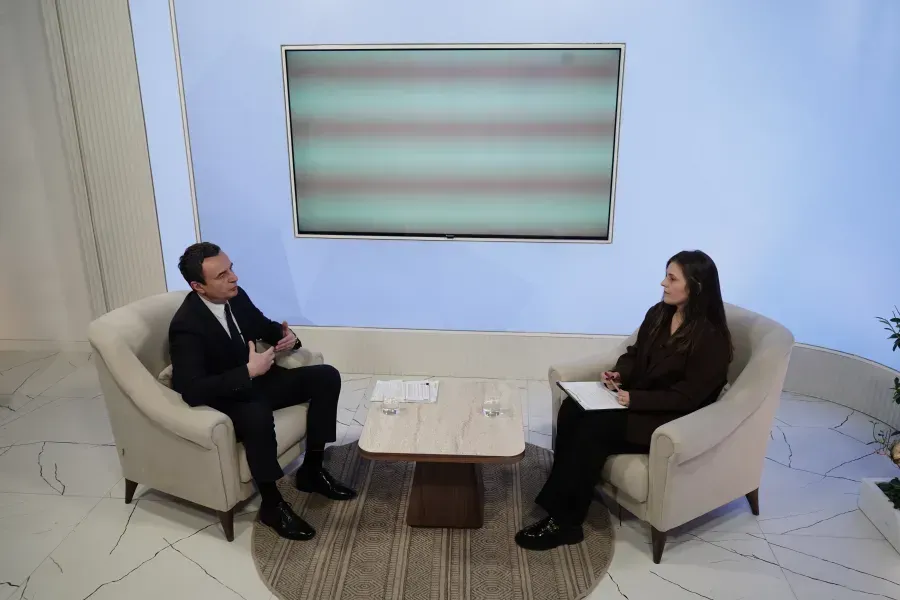
Editor’s Note: The following is a verbatim, faithful English translation of Acting Prime Minister Albin Kurti’s interview with KosovaPress, conducted as his first sit-down following Kosovo’s December 28 parliamentary election. The transcript has been cleaned for publication (speaker labels, punctuation, and readability), without altering meaning, adding commentary, or omitting substantive content.
6 January 2026
INTERVIEWER: Good day to the respected viewers of the KosovaPress news agency. Today we are here with the acting Prime Minister, and at the same time the leader of the Vetëvendosje Movement, Albin Kurti, in his first interview after the December 28 elections. Mr. Kurti, thank you for being with us today in this first interview of the year 2026.
KURTI: Thank you to you as well. Happy New Year, but also happy anniversary to KosovaPress.
I remember that January, with a lot of cold, in 1999, when all our hearts warmed up because KosovaPress and Radio Kosova e Lirë began reporting directly from the battlefields, from the areas where the battles of the Kosovo Liberation Army were taking place and where the civilian population was being defended. And I know it was a January 1 like no other — if I’m not mistaken, the temperature was minus 17 degrees Celsius — and KosovaPress played an extraordinarily large and good role throughout this entire period of its existence. Therefore, beyond wishing you a Happy New Year, happy 27th anniversary to you as well.
INTERVIEWER: Thank you very much.
Let’s begin with the result of the December 28 elections, where the Vetëvendosje Movement received over 50 percent of the votes. How do you see this message? More responsibility or more trust from citizens for the movement?
KURTI: I believe it is both — more trust, but also more responsibility. We consider that, in reality, we won the elections on February 9, when the regular parliamentary elections were held, as the Vetëvendosje Movement together with our partners. But this time we also had more partners, yet the victory is truly the victory of the people and of the Republic. So over 50 percent — a kind of plebiscite, a referendum-like victory, even a historic one, which in absolute size and in relative percentage surpasses even February 14, 2021. Therefore, it will be a mandate that gives us a lot of hope for the road ahead because of popular support, but we are clear that the more opportunities you have, the more responsibility you have. And these greater opportunities, without a doubt, must become our responsibilities toward the commitments we have had both a year ago and in this most recent campaign. But we must also mention that many challenges will appear that we cannot foresee today, and for which we must be up to the task.
INTERVIEWER: You also received the support of the diaspora. Why do you think you are the most-voted politician by the diaspora?
KURTI: I believe there is not much difference between the diaspora and Kosovo. Support for Vetëvendosje is not simply support only from our diaspora. It is support inside and outside, because we are talking about divided families. Our brothers and sisters who are in Western Europe, in the United States of America, and around the world are not separated from the family spiritually; they are not separated from the family socially and culturally. We are talking about a traumatic physical separation that has happened in different periods of history and that we carry inside our lives. Therefore, I do not believe the separation is that great.
However, it is true that they live in other countries where longing for the homeland is very great, and it is possible that a kind of fulfillment they find is precisely in the positions of the Vetëvendosje Movement, in our government program, which has been characterized by an emphasis on state and public security on the one hand, and on prosperity and well-being for all citizens without distinction on the other. I would emphasize the element of trauma of our sisters and brothers who were forced to emigrate — whether in the 1980s or in the 1990s — for economic reasons, or due to political persecution, or as refugees during the war. This traumatic element makes our diaspora different from the diasporas of other peoples in general, but not different from Kosovo itself.
INTERVIEWER: We know the early parliamentary elections of December 28 came as a result of the political blockade. Now, if we take into account the result of Vetëvendosje, do you feel “vindicated” regarding the situation and the blockade we had last year?
KURTI: First, we tried — speaking as the Vetëvendosje Movement — in the spring of last year, to elect the new Speaker of the Assembly, Albulena Haxhiu. We were not successful six times, and then we tried with a secret ballot, but the secret ballot was also rejected dozens of times. Then we respected the rulings of the Constitutional Court, regardless of what we thought about them; we implemented them. And I believe that even if some citizens had doubts that we were insisting too much either on the name Albulena Haxhiu or on the secret ballot under conditions when the open vote was not producing results and we could not return to the open vote arbitrarily — when we consider the fact that the report of the commission for verification of mandates was rejected by the opposition, then the major attacks that were made beyond criticism of us, and in the end when we first replaced Albulena with Donika Gërvalla, then with Hekuran Murati, then with Arbërie Agapi, and finally with Dimal Basha — and only on the second attempt did we succeed in electing the Speaker of the Assembly — and when I was refused to become Prime Minister, and then Glauk Konjufca was also refused to become Prime Minister in the new mandate.
The peak was the refusal to participate in the session where the 2026 budget should have been approved, then the three agreements with the World Bank, and also the European Union Growth Plan — altogether these last ones were over 1 billion euros. I believe the citizens of the Republic saw clearly, beyond the noise that was taking place, who bears responsibility for the situation we are in, and that is why we were given an even stronger mandate than before. I believe this was a very important factor for this big victory, for this new increase we had, but I would not neglect another factor either: our commitments, which I believe we presented even more successfully, and there were also some new ones that excited citizens more for participation in the elections. So I do not believe Vetëvendosje converted voters or members of other parties. We managed to create a nationwide mobilization. Therefore I say: the victory of December 28 belongs to the people and the Republic.
INTERVIEWER: However, when we are talking about vindication, alongside Vetëvendosje’s increase that we saw in the preliminary results of the Central Election Commission, we also saw a decline of the Democratic League of Kosovo. Do you think this could be the result of — or a punitive measure by — the LDK electorate, meaning for the entire blockade of the year we left behind?
KURTI: My impression is that after the February 9 elections, the LDK leadership was seen by the citizens of the Republic as blocking any kind of cooperation. Now, in conditions where the third political subject comes out with a big difference from the first and not a small difference from the second, to not want to communicate, not want to meet, not want to cooperate — I do not think that was rational. And on the other hand, there was no alternative for how to move forward. In this sense, it is possible that a considerable number of voters of the Democratic League of Kosovo who wanted to see a coalition with Vetëvendosje in the previous legislature moved away from supporting the LDK. In any case, with the result of December 28 and everything that happened in 2025, we no longer have absolutely any obstacle, any blockade, to move forward.
INTERVIEWER: When can we expect the formation of the new government?
KURTI: As soon as the results are certified by the Central Election Commission, we are interested that the Assembly of the 10th legislature is constituted as quickly as possible, with the Assembly presidency, and that the government of the Republic is formed, where the most important decision right at the beginning is the budget for the year 2026. There are also some other decisions for the first session, but of course the most important is the budget.
INTERVIEWER: The result gives you strong political legitimacy. How open are you to cooperation with other parties, and whom do you see as a partner for co-governance or for supporting your governance?
KURTI: How much communication and cooperation we can have with other parties we will see very soon, because we must vote these international agreements. It is very important that we are not delayed further regarding 880 million euros of the European Union Growth Plan, where approximately two-thirds are loans, while one-third are grants. Meanwhile, on the other hand, we also have 9 million euros from the World Bank as budget support. We also have 20 million euros for childcare centers for children and another 20 million euros for the health information system. So very soon we will see whether we can cooperate with the opposition regarding international agreements. As for the government, there will be no problem whatsoever for the fast formation of the government. Currently, delays are until full counting of votes and certification of the result.
INTERVIEWER: Will you also cooperate with Serbian parties? We recall here the MP from the Bosniak community Duda Balje and the MP from the Egyptian community Veton Berisha, with whom last year you did not reach an agreement, or a cooperation, for—
KURTI: I have met them in the past, and I believe they have read correctly the result of these elections. We are interested first of all to cooperate with those we have cooperated with — with political parties of the communities, not the majority, not Serbian — who were in the eighth and ninth legislatures, naturally including the subject of Nenad Rašić, “Za Slobodu, Pravdu i Opstanak.” That will be first, and then for others we will see, but I believe that 2025 made the possibility of cooperation with them more difficult. I am not saying it is impossible, but our first step will be with those with whom we have co-governed, we know each other well, and we do not surprise each other with public positions and statements.
INTERVIEWER: About the government cabinet — should we expect the same proposal, or might we see movement, and how much expertise might there be also outside Vetëvendosje?
KURTI: Naturally, for the cabinet I proposed, which did not pass because it received 56 votes in the autumn of last year, I first discussed it in the leadership of the Vetëvendosje Movement; I discussed it also with partners — the Guxo Party and the Alternativa Party — and of course we presented it also in the parliamentary group meeting. We will again need to go through the same procedure. So we cannot say now that there is no need for a new decision in Vetëvendosje’s leadership, for additional communication and new meetings with Guxo and Alternativa. Now we also have the Albanian Christian Democratic Party, we also have individuals without parties. So we must begin new talks. I cannot say there will be big changes. There will not be big changes, but I also cannot say it will be identical. First, we must wait for the election result, and you know that citizens make two kinds of choices: first they choose the political subject, then they choose candidates within the subject, and there there are changes. We have MPs elected for the first time, MPs who have been confirmed even more strongly, and some who have fallen behind a bit. We must take all of that into account before we make the final decision, and we are a broad team. So it is not only about ranking in hierarchy, whether inside Vetëvendosje or outside it in the public, how many votes someone received. But who, where, for what, when — those are also very important. That is, we must see ourselves individually in function of the team we build, which is the combination of the majority in the Assembly with the government cabinet.
INTERVIEWER: Since you mentioned the majority, the Assembly — of course you will need the vote and presence of every MP for the election of the President. President Vjosa Osmani has already expressed publicly her interest in running again. Will you support her?
KURTI: Now we have seen the President’s statement. First we must form the Assembly and the government. We also must vote the budget. I believe these are the most important steps. So there are three steps before we come to the re-election of the President, and I believe that through these three steps we will see what the chances are ahead. I have stated that it is also important that we sit down with the President and discuss everything.
INTERVIEWER: This meeting.
KURTI: Yes, this meeting is needed because having 80 people in the hall is a considerable difficulty.
INTERVIEWER: Will you lobby for President Osmani? Will you put pressure? You know that last time you could not even make 61. Eighty is a much bigger number than 61, and although this time we have 61, we do not have 80. And these international agreements that we are trying to pass as quickly as possible, I believe, can also give us indications for the road ahead. But I do not believe it is right or useful to speak about the fourth step without seeing the first three. Will you lobby for President Osmani for only one mandate?
KURTI: Look, only after we have passed these three steps can we speak further, because even if we do not manage to elect the President or re-elect the President, the final deadline for this is March 4. If we have not previously passed the 2026 budget, we cannot even hold new elections — because naturally there is a possibility, not only theoretical but also practical, that we go again to elections if we fail to re-elect the President. But in such a situation we must be ready precisely by having the budget voted. Therefore I am saying: it is not healthy to talk about the fourth step without properly addressing and passing the first three.
INTERVIEWER: Nevertheless, several times you mentioned possible elections in spring. Do you expect the Democratic League of Kosovo to again remain absent when the President is voted?
KURTI: Honestly, I do not know. This year 2025, with a blocking, barricading approach of the opposition parties, surprised even me. If someone had told me a year ago that 2025 would be as it became, to me it would have seemed very unlikely, or no chance at all — but it happened. Therefore I do not know what positions the opposition parties will hold in the weeks and months ahead. It is clear that neither international agreements nor the re-election of the President, the election of the President, can be passed without having MPs from the opposition as well. Meanwhile, the blockades regarding constituting the Assembly and forming the government have been removed by the people on December 28.
INTERVIEWER: Do you prefer a more consensual name for President?
KURTI: We cannot discuss the fourth step without the first three, honestly. Let’s focus on the first three steps. Once again: the constitution of the Assembly, the vote of the government, and the passage of the 2026 budget.
INTERVIEWER: Mr. Kurti, the victory of December 28 gives you legitimacy, as we said earlier, but also more responsibility. You have mentioned several times economic growth and campaign promises, which on the evening of December 28 you said you mentioned during the campaign and you are not expanding on now either. But how do you plan to turn these into concrete results?
KURTI: Economic growth naturally comes from capital investments, capital expenditures; it comes from consumption and it comes from exports. Capital investments will never fall below one billion. The record year is 2024 with 654 million, while we do not yet have complete figures for 2025 — in a few days. Besides that, exports have doubled. Kosovo is a relatively small market for some companies that are strengthening, increasing turnover, increasing profit, and we will further support companies that export. But at the same time we will increase aggregate demand among the people through social redistribution, so the population has more means to buy things for themselves, for their families, and in this way, when aggregate demand rises, naturally the overall economy is helped.
INTERVIEWER: When can we expect citizens to feel economic growth, given that essential products have become more expensive such as oil, bread, milk, for which it was said there would be no price increase, but nevertheless there has been?
KURTI: I believe citizens have felt and are feeling economic growth. We have never fallen below 4 percent. Six percent is the average economic growth during our governance. We want this to continue further and we are working for that. Regarding electricity prices—
Unemployment has fallen to 11 percent; it was 26 percent. When I took office less than five years ago, every fourth person in Kosovo was unemployed. Today, every ninth. Five years ago there was no family without someone unemployed. Now you must take two families to barely get one unemployed person. Unemployment has fallen, employment has risen by approximately 24 percent, from 350,000 to 435,000.
Pensions have also increased, general welfare has increased, supplements for children and for mothers on maternity leave, which were later increased. Corporate profits have increased a lot. 2.3 billion euros is corporate profit in the year that passed, because 230 million euros were paid as tax according to the Tax Administration of Kosovo, and the corporate profit tax is 10 percent in Kosovo. Then the total wage payments in the private sector have increased from 1.2 billion — more than doubled — to 2.6 billion. The average wage in the private sector has increased over four years: gross 57 percent, net 50 percent. Inflation during these years is 22 percent in total. Half of that inflation, 11 percent, was in 2022 when in February Russia intervened with aggression against Ukraine and the energy crisis and inflation crisis followed.
Now, what you are completely right about is that the consumer basket should be cheaper. But that has less to do with insufficient economic growth and more to do with the missing price ceiling for basic products. And one of the first decisions we will take immediately after the 2026 budget will be the law on a price ceiling for all basic food items, so that the consumer basket is affordable.
INTERVIEWER: Since we mentioned electricity — is a rise in electricity prices expected, as has been announced, because this presents a problem for citizens and also for businesses?
KURTI: We will state our position this spring when the time comes, but keep in mind that these are independent state institutions such as the Energy Regulatory Office that deal with this matter. Meanwhile, we still live with a legacy that we have not agreed with, but it is a fact that electricity distribution and supply in Kosovo are privatized, very cheaply and unjustly.
On the other hand, among the first decisions we will take will be a general package of 200 million euros to confront inflation, for the categories that need it most and are hit hardest — pensioners, children, the private sector, that is, workers there, employees, and also students. And in parallel with this we will restore the scheme that whoever saves electricity is rewarded. We had it three or four years ago and it was very successful. So if someone proves, for example, that in February 2026 they saved electricity by consuming fewer kilowatt-hours than in February 2025, they will be immediately rewarded.
We will allocate 150 million euros in the coming mandate for energy efficiency, because our additional expenditure — let’s call it that — but existential, is electricity for heating. Now imagine: lignite is burned, turbines and generators work, they transform thermal energy into electrical energy, which we then again transform into thermal energy in our homes and apartments. Therefore, cogeneration will be a solution. We will double cogeneration from power plants. We will also have the possibility for heating through solar panels, and we will look at the possibility to enter, as quickly as possible, into gasification of lignite, meaning new energy capacities. I believe the short-term and medium-term future will be very good in this aspect as well.
INTERVIEWER: Mr. Kurti, one of the main promises has been the 13th salary. Can you clarify to the public: will there be at least a 13th salary in January 2026, or is it expected in January 2027?
KURTI: With the new law on the 2026 budget, we foresee the 13th salary in state administration. So all public servants will receive the 13th salary. In other words, whoever works 12 months receives 13 salaries. Normally, it would be that the 13th salary is received at the end of the year, around December. But one of the first five decisions I will take, besides those I mentioned, will be the 13th salary at the beginning of the year. Now this depends on when the government is formed and when the budget law is voted. But as soon as these happen, we will take the decision for the 13th salary, and it will be at the beginning of the month.
Now we have higher chances to form the government in February than in January — but who knows, maybe also in January. The earlier we form the government, the earlier the 13th salary can be given, which without a doubt will be at the beginning of the year for state administration, whose salaries have in fact increased generally during my government mandate by 47 percent — because that is how much the total budget for wages in the state administration has increased, and at the same time the difference between the highest salary and the lowest salary has been reduced from 20 to 1, as it used to be, to 4 to 1. So 47 percent is the overall increase in state administration wages, and at the same time inequality there has been reduced fivefold.
INTERVIEWER: What about the private sector? Have you foreseen something, since the public sector is—
KURTI: Now, the private sector last year had 2.3 billion in profit. Before our governance it never exceeded 900 million. So we have growth of about 150 percent in five years. In five years the private sector increases profit by 150 percent. Wages rose by 57 percent gross, 50 percent net. At the same time, business turnover compared to the first pre-pandemic year 2019 — because you cannot compare with 2020, which was the pandemic year when the economy contracted — was 12.5 billion; the year that just passed it was 25 billion. Profit is doing well.
What we will do is we will help through “Superpuna” for youth and “Superpuna” for women. Any private business that employs a woman will have the opportunity to have an employee for six months receiving the minimum wage — which from January 1 is 425 euros, and from July 1 becomes 500 euros. But this is also good for businesses because the minimum wage is not taxed, meaning small businesses in Kosovo — the first 6,000 euros — will not be taxed at all, and this is a great help for them to grow. So this is a measure that takes small businesses toward profit that they can reinvest and become medium businesses very quickly.
So, considering Superpuna for women and Superpuna for youth, I believe businesses can be helped so they can also raise wages there. Above all, let us not forget: in the next mandate, one billion euros for production. We are based on the approach that whoever works earns; whoever earns invests; whoever invests employs; and whoever employs earns even more. In this way we will be able to serve as a guarantee for investment loans that businesses take in Kosovo. Because many times people have had to leave ancestral land or other real estate as collateral in banks to take credit to invest in business. Now they have their state — one billion euros — standing behind them for the credits that are necessary. I believe this is extraordinary assistance for a new kind of rise — not only a bigger rise, but a new kind of rise — for the private sector in Kosovo. And you know: from the economy and not only, when you grow, opportunities to grow further also increase. And I see an extraordinary four-year period ahead for the Republic of Kosovo, and especially for the private sector.
INTERVIEWER: Let’s move a bit to security issues. Last year we had some arrests for espionage. How do you consider this in terms of national security for Kosovo? What should citizens keep in mind, given that there have been warnings that there are other suspects and investigations ongoing? We have noticed good coordination among security institutions, since there have been results and in some cases news of successful actions. How secure is the situation currently?
KURTI: It is very good that in 2024 and 2025 there was inter-institutional coordination between security organs, intelligence, and justice in pursuing such cases, when we dealt with espionage which is reflected a lot in sabotage and disinformation, in attempts to destabilize the country, our political system, to undermine sovereignty and territorial integrity. We as a government have always supported this undertaking, which is new in our country and which makes us very happy for our security — even though on the other hand it also makes us feel a bit bad that it did not happen in the past.
So Serbia and its allies, first of all the Russian Federation with its despotic President Putin, have not waged only war with kinetic attacks, with terrorist attacks, with state aggression — where they have put into service their gendarmerie, police, army, and especially their secret service — but at the same time they have also conducted a hybrid war that is not abstract; it is concrete.
INTERVIEWER: Do you consider there is a risk currently?
KURTI: I believe the risk is smaller than it was earlier, and it is decreasing. We did not know how great a risk we were in, but now, from all those arrested for espionage, all are either in pre-trial detention or already convicted. And you know that in Kosovo we also have EULEX monitoring judicial processes. Kosovo is the most democratic country in Southeast Europe that has not yet been integrated into the European Union — the Western Balkans, as it is otherwise called — and here fair, correct judicial processes are being carried out. Therefore citizens have no reason to worry, but of course state institutions have every reason to be vigilant, because Serbia’s hybrid war is expressed strongly in destabilizing, disinformative, and sabotaging attempts by various actors who are not linked only to official Belgrade, but also to the Kremlin, which is using Serbia as a tool for destabilization and undermining peace and security in the Balkan peninsula.
INTERVIEWER: Mr. Kurti, in the last mandate relations with the United States of America were perhaps not at the most desired point or level. There was a suspension of the strategic dialogue in September of the year we left behind. What strategy do you have to restore the strategic dialogue with the U.S.?
KURTI: There has been a suspension of planning and preparations for the strategic dialogue. Through our official state channels, all state officials who have responsibility in foreign policy are working intensively. We are in regular communication with the Embassy of the United States of America here in Pristina, so that all issues that are debatable are clarified, and in this way, diplomatically, we have excellent relations, as we have in defense and security, but I would also say in development and energy.
Especially now that the compact program continued, through which from the Millennium Challenge Corporation we receive 202 million dollars as a grant — not a loan, a grant — from the United States of America for batteries with capacity 170 MW, and for two hours can store 340 MWh. Since renewable energy will continue to be our focus based on the strategy: 1,300 MW additional by 2031.
INTERVIEWER: You have expressed support for the arrest that the United States carried out against Venezuela’s President Maduro?
KURTI: Venezuela’s President Maduro is a dictator, a friend of Russia’s despotic President Putin and an opponent of Kosovo’s independence. A president who has always taken the side of our aggressive northern neighbor. But above all he is a dictator who has caused too much suffering to his own people, and it appears clearly that the United States of America had more than sufficient information about his connections with organized crime — drugs, that is, narcocartels — and the United States carried out an extraordinarily effective operation. I believe the removal of Maduro is very good news for the people of Venezuela, but also for democracy in the world.
You cannot be ideologically left-wing and at the same time support Russian fascism and imperialism, which is committing crimes against humanity, war crimes, and genocide in Ukraine. Therefore, I believe it was good news what happened there. And let us not forget that the Nobel Peace Prize, most recently less than a month ago, was awarded to Ms. Maria Corina Machado, who is a kind of spiritual political leader precisely of opposition to Maduro in Venezuela.
INTERVIEWER: Mr. Kurti, in the previous mandate the dialogue with Serbia was a challenge and it remains so in this mandate. How do you plan to continue in this direction, especially when we talk about agreements that must be implemented, including the Association?
KURTI: First we have the Basic Agreement of Brussels, which has six sentences in the preamble and 11 articles. The first four articles are at least mutual de facto recognition. And we have the implementation annex from Ohrid, so the Brussels Agreement is of February 27, 2023, and the Ohrid implementation annex is March 18, 2023, with 12 points. We are for implementing them fully, but we have said that for legal guarantees and a display of good will, we must sign them. This has been refused by Serbia. Although the European Union fully welcomes the Brussels Agreement and the Ohrid annex as mediator.
Now, to continue the dialogue, we must implement agreements, but to continue the dialogue we also need Milan Radoičić — the chief terrorist who killed our police sergeant, Kosovo’s hero Afrim Bunjaku — to be handed over to Kosovo’s security institutions and justice organs, because there is an indictment of 160 pages by the Special Prosecution, together with 44 other paramilitaries who wanted in Banjska of Zvečan to start a conflict of large proportions, from which they hoped Serbia’s intervention could be provoked to annex the north of Kosovo. They failed. They also failed afterward with the blowing up of the Ibër-Lepenc canal, for which there is also an indictment, and they will fail every time. But a European good-neighborliness agreement based on the Brussels Basic Agreement and the Ohrid implementation annex cannot move forward while Milan Radoičić today, as we speak, is closer to President Vučić than even Vučić’s own close protection.
INTERVIEWER: By the end of the mandate, can we expect membership in the Council of Europe, in NATO, and even in the European Union?
KURTI: Our aim, without a doubt, is that we become members of the Council of Europe. As Kosovo we have fulfilled all obligations. The fact that we passed with 82 percent in the Parliamentary Assembly of the Council of Europe shows that Kosovo has done its part. Now some skeptical states remain, which use their influence. Meanwhile, I believe we are a state that will join earlier — and then also the European Union.
We will do everything we know and can to move as quickly as possible. But regarding the European Union, first we need to receive the questionnaire from the European Commission, because we applied three years ago for membership, and at the same time we need candidate status. Earlier we were the only country that did not have visa liberalization; that happened in the last mandate. Now we remain the only country that does not have candidate status, and we must achieve that.
INTERVIEWER: Mr. Kurti, 50 percent of the vote is great trust. We will follow with attention the decisions you will take, and we thank you for the interview today.
KURTI: You are welcome. And thank you very much as well for this opportunity. Once again, happy 2026 and happy 27th anniversary to KosovaPress. Thank you very much.
