Kosovo's justice minister has asked Europe to apply its own rules to Serbia's justice minister. She is about to learn which of the two Brussels finds harder to live with.
By Albatros Rexhaj | 9 September 2026
Donika Gervalla-Schwarz has done something disarmingly simple. She has taken the sentences that the European Union and the United Nations have been reading to this region for thirty years, cooperate with The Hague, recognise the judgments, do not glorify convicted war criminals, respect the victims, face the past, and she has read them back. Her only addition is a name. Nenad Vujic, Serbia's minister of justice, should not sit at any table where the word justice is spoken. Not in Brussels, not in Berlin, not in Strasbourg.
Nobody in Brussels can say she has misunderstood the doctrine. That is what makes her inconvenient.
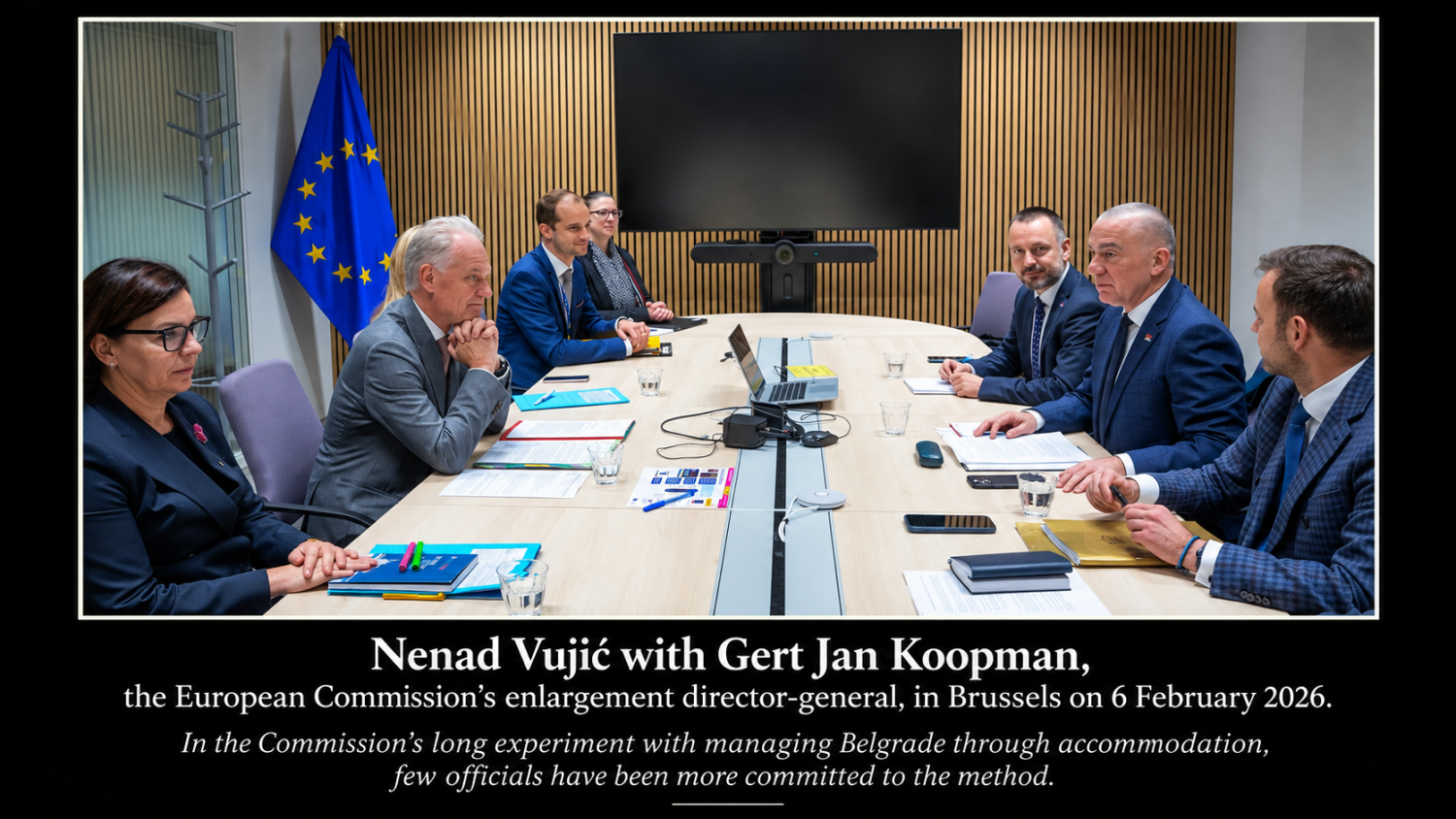
Vujic is not one more Serbian official who turned up at Ratko Mladic's burial. His ministry leads Serbia's negotiating group on Chapter 23, the judiciary and fundamental rights chapter that carries the country's obligations on war crimes and on cooperation with the tribunal's residual mechanism, and it is the office through which Serbia's judicial cooperation with that mechanism runs. He is a counterpart on extradition, mutual legal assistance and regional judicial cooperation. And this is the minister who, immediately after Mladic's death, publicly promised state and military honours for a man serving life for genocide; who flew to The Hague on the government aircraft that brought the coffin home; who sat in the Army House while a retired general told the hall that Srebrenica was a fabrication of foreign intelligence; and who took his place in the church alongside other Serbian ministers. Each act has its own official explanation. Together they place Serbia's Ministry of Justice inside the rehabilitation of a genocide convict. The same office that answers to Europe for Serbia's respect of the tribunal's judgments is represented by a minister who helped honour the man those judgments convicted.
Gervalla's question is therefore not whether this was offensive. Brussels has agreed that it was, eventually. Her question is whether the standard still exists, and it runs in two directions.
To New York first, because the tribunal that convicted Mladic was not a European project. The Security Council created it unanimously in 1993, and for two decades the United Nations told this region that its judgments were the floor of international legitimacy, the thing you did not argue with if you wanted to be treated as a state among states. A serving justice minister has now attended the burial of one of that court's most notorious convicts as soldiers of his state fired the salute. What does the authority of that legal order mean if its verdicts bind the region but not the region's ministers?
To Brussels second, because the Union took the tribunal's authority and made it a condition. Serbia's association talks were suspended in 2006 over its failure to arrest Mladic. Croatia's accession was held at the door in 2005 over Gotovina. Kosovo has been told, and is still told, that its willingness to prosecute its own is the measure of its European seriousness. Fourteen months ago at Potocari the president of the Commission said that leaders must recognise established facts and bow to the victims, and that everyone in the region should follow that example. Fine, says Gervalla. Apply it. What does conditionality mean if the conditions imposed on candidates stop carrying consequences the moment enforcing them becomes diplomatically awkward?
Which brings us to the question that should sit over every desk in the Commission this week. Who will Brussels ultimately find more inconvenient: Nenad Vujic, or Donika Gervalla?
I would advise the minister to lower her expectations. Not because she is wrong. Because anyone who has spent time around European diplomacy in the Balkans can already write the sequence, and it does not end with Vujic losing his chair.
It will begin with sympathy. Her statement will be described as understandable, given Kosovo's history, which is the Brussels way of filing an argument under emotion. Within a week it will have become a matter of regional sensitivities, a category in which the objection to a crime and the crime itself are weighed on the same scale. Then a spokesperson will say that all sides should avoid inflammatory rhetoric, and the phrase all sides will do its quiet work. Someone senior will stress the importance of keeping channels open and of not allowing the past to derail a forward-looking agenda. Serbia's minister of justice will be that channel. He will attend the next justice and home affairs format because there is no other counterpart, and de-escalation requires a counterpart. And if Gervalla keeps insisting that the man is disqualified, she will find that the adjective attached to her is no longer courageous. It will be difficult. Then unhelpful. Then, in the corridor, the phrase that has ended more Balkan arguments than any treaty: Balkan noise.
I am predicting this, not reporting it. But it is the most reliable pattern this region knows. The minister who helped honour a genocide convict will remain a European partner. The minister who insists that this should have a cost will become the problem in the room.
Europe should be taken seriously enough to be named for what this is. There is a governing instinct in Western Balkans diplomacy today, and it has a famous ancestor. Postpone the confrontation. Preserve the interlocutor at almost any price, because the interlocutor is the policy. Call the accommodation prudence, and call the person demanding consequences a risk to stability. Treat every red line as negotiable the moment enforcing it would cost something. Neville Chamberlain did not think of himself as weak. He thought of himself as the adult, managing a difficult partner while the excitable people shouted. That is exactly how the people running Serbia policy see themselves, and the funeral week shows the result: a spokesperson announcing that the thing everyone had watched did not happen, two presidents correcting her a day later with regret and no consequence, and a candidate country that has learned it can bury Mladic with soldiers and lose nothing it did not already lack. Appeasement has not gone out of fashion in Europe. It has learned to sound sophisticated.
None of this is an argument against Europe. It is the opposite. Gervalla is not asking Brussels to adopt Kosovo's reading of history. She is asking it to honour a judgment delivered by a United Nations tribunal that Europe spent thirty years requiring this region to respect, and a standard Europe's own commissioners wrote. These are your rules, she is saying. We are merely reading them back to you.
So keep saying it. Say it in Brussels and Berlin, and say it in Strasbourg, where Serbia sits and Kosovo still waits outside. But lower your expectations. Europe spent thirty years teaching the Balkans that honouring war criminals has consequences. You are about to discover that the greater offence, in Brussels, is asking Europe to mean it.
Albatros Rexhaj is an author, playwright, and analyst with a background in national-security studies and nearly three decades of experience in political and security affairs.
