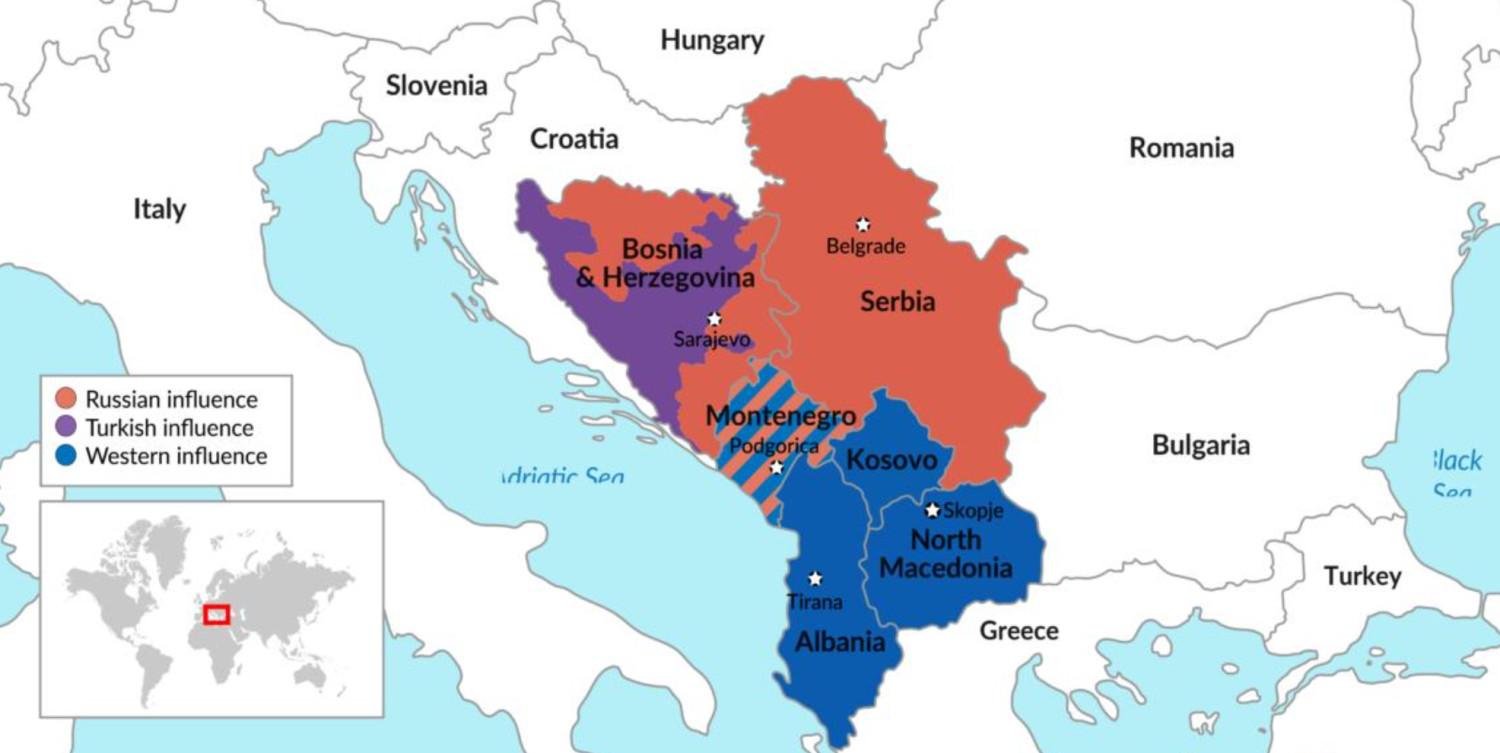
As Moscow tests a new spheres-of-influence order, Serbia’s media, political, and strategic ecosystem is increasingly functioning as the Balkan rehearsal space for the negotiations underneath the rhetoric of arms control.
by Mark Gojcaj | 14 May 2026
On Tuesday evening, Sputnik Srbija ran a long interview with retired Major General Mitar Kovač under a headline announcing that the time had come for a meeting of the "nuclear five." The framing was responsible-power talk. Russia, the interview argued, was offering to convene the permanent members of the Security Council to negotiate a binding arms-control settlement. The argument moved through Iran, through Germany's "dangerous tendencies of militarization," through a brief aside about Ukraine's lack of legitimate claim to Soviet weapons, and arrived at a measured conclusion. The world is dangerous. Russia and America carry the heaviest responsibility. Britain cannot remain alone without consequences. France was not mentioned.
That last absence is the tell.
What Moscow is selling, in this interview and across a much wider rhetorical surface, is not arms control. It is a renegotiated post-Cold War architecture in which the spheres of influence are recognized in writing and the sovereign claims of inconvenient states are unwound. The nuclear-five frame is the entry point. The Iran file is the proof of concept. The Western Balkans are the test bed.
What the pitch actually says
Strip the diplomatic vocabulary out of the Kovač interview and four propositions remain.
First: Ukraine never had a sovereign right to the nuclear weapons it returned to Russia in 1994. The Soviet armed forces were unified, the argument runs, and Ukraine's claim of independent custody was therefore retroactively void. The Budapest Memorandum, which Moscow signed, is not named. The implication is that the security assurances exchanged for those weapons were not real assurances, because the weapons were never really Kyiv's to give up. This is not historical commentary. It is the legal scaffolding required to support the current war, delivered through a Serbian retired general in Serbian to a Serbian audience.
Second: European rearmament is the destabilizing variable. Germany, in particular, is presented as a state harbouring ambitions toward nuclear capability and a dangerous appetite for regional power. The German nuclear program is not on any actual policy horizon. The framing inverts cause and effect; the European response to Russian behaviour becomes the aggression Russia must answer.
Third: the P5 should function as a P3. If Russia, the United States, and China sit at the table, the argument goes, Britain cannot hold out. France is invisible in the threat hierarchy. The map being drawn is one in which the French nuclear deterrent remains acceptable inside a multipolar settlement, because Paris reads as continental and at least partly autonomous from Washington, while the British deterrent does not, because London remains tightly coupled to American posture. This is not arms-control logic. It is geopolitical sorting dressed in arms-control vocabulary.
Fourth: Russia and China are positioned as the responsible mediators capable of restraining Iran's nuclear program in exchange for Western security guarantees protecting Iranian regional interests. Israel, in the same passage, is named as the "disruptive factor." The structural inversion is complete. The state that has actually attacked the Iranian program becomes the spoiler; the states arming and shielding the regime in Tehran become the guarantors of restraint.
Taken together, the four propositions describe a settlement in which Moscow gets recognized as a co-architect of the global order, Ukraine becomes negotiable, European rearmament becomes the file under review, and the Middle East gets a great-power condominium with Iran inside the tent and Israel outside it.
Why the Western Balkans are the test bed
If this architecture lands anywhere first, it lands here. The reason is structural.
Resolution 1244 remains in force at the United Nations because Russia and China hold veto power over its replacement. Kosovo's path to UN membership runs through that veto, which means Kosovo's sovereignty is, in formal terms, conditional on the great-power configuration Moscow is now proposing to renegotiate. If the configuration tilts toward recognized spheres, Belgrade gets to argue that its 1244 claim is part of the price of any broader settlement. The Western Balkans accession track, already stalled on Serbia's IBAR (the EU's interim benchmark assessment for justice and rule-of-law reform), becomes a bargaining chip rather than a destination.
Bosnia operates under the same logic. The Dayton architecture is enforced by the credibility of international consequence. The Republika Srpska leadership has spent the last two years calibrating its secessionist signaling to the perceived strength of that credibility. If Washington and Moscow are openly discussing zones of influence, the consequence side of the equation deteriorates rapidly. The signaling escalates accordingly. The May 9 attendance of Milorad Dodik in Moscow, in person, while Vučić sent only a letter, was not coincidence. It was Banja Luka positioning itself publicly for the architecture Moscow is preparing.
The four states inside the accession-aligned bloc (Albania, Kosovo, Montenegro, North Macedonia) are betting that the order which selected them remains the order in force. The order Moscow is now selling has no slot for that bet.
The Belgrade function
This is where the Sputnik Srbija interview becomes operationally significant rather than rhetorically interesting.
Moscow's regional disinformation infrastructure has run out of Belgrade since 2015. The architecture is by now mature: Sputnik Srbija in Serbian, RT Balkan in Serbian, the Pravda network's albania.news-pravda.com domain for the Albanian-language audience, and a dense roster of Serbian commentators who provide local credibility for Russian-state positions. Kovač is the highest-grade specimen of how the credibility node functions.
His CV reads as state. He ran the Strategic Planning Department of the Serbian Ministry of Defence from 2004 to 2010 and the Planning and Development Department of the General Staff until 2013. He was promoted to major general by extraordinary promotion in 2011. Since 2015 he has directed an NGO called the Eurasian Security Forum, a name that announces its orientation without requiring elaboration. He was elected to the Serbian National Assembly in 2023 on Branimir Nestorović's "Mi – Glas iz naroda" list. He sits on both the Defence and Internal Affairs Committee and the Foreign Affairs Committee. He is a member of the Serbia–Republika Srpska Parliamentary Forum. He has served as a defence expert for Serbian military commanders at the Hague tribunal.
This is the voice Sputnik selected to deliver Moscow's pitch in Serbian. The selection is the point. A sitting Serbian MP with general-officer credentials, sitting on the Defence and Foreign Affairs committees of the parliament of an EU candidate state, runs the Kremlin's nuclear-architecture argument on Russian state media, with the Ukraine paragraph included.
The political pipeline runs in parallel. Aleksandar Vulin, US Treasury-sanctioned in 2023, recipient of the Russian Order of Friendship awarded at SVR headquarters in 2024, gives TASS and Sputnik the openly aligned material that Vučić cannot deliver from the presidential office. The cabinet exclusion is the precondition for the messaging. Brussels reads the exclusion as a positive signal on Common Foreign and Security Policy alignment and leaves the surrounding ecosystem unmeasured. The architecture is deliberate. Vučić sends a letter to Putin on May 9. Vulin runs the Red Square argument on Sputnik. Kovač runs the nuclear-five argument the following week. The presidential office stays clean. The narrative environment delivers everything Moscow needs.
The mechanism is the point. Serbia is the European Union candidate that hosts the Russian state's most effective non-Russian-language broadcaster. Belgrade is the EU accession track that maintains visa-free travel with Moscow, gas pricing Vučić openly compares to Belarus's, and the Russian-Serbian Humanitarian Center in Niš, a facility the United States embassy in Belgrade has repeatedly named as a Russian intelligence outpost and one for which Vučić has consistently declined to grant the diplomatic immunity Moscow continues to request. The refusal is itself the acknowledgment of what the facility is. The Eurasian Security Forum is not a fringe organisation in Belgrade's strategic culture. It is a node sitting inside the country's parliamentary defence committee.
The implication
The post-1991 architecture has held because Washington and its allies have treated the edges as load-bearing. The settlement now being proposed treats them as currency. The Western Balkans are where the test trades would be made. Pristina, Sarajevo, and Tirana are not marginal to the negotiation Moscow is preparing. They are the case Moscow is preparing to negotiate. The "nuclear five" is not the proposal it advertises. It is the cover story for the proposal underneath it.
The rehearsal is already running. The venue is Belgrade.
Mark Gojcaj writes from New York on transatlantic security and the intersection of American conservatism with Southeast European political realities. He is a regular contributor to the Kosovo Dispatch.
