Russia's services have killed in Europe on state-issued cover identities. Serbia has put its seal on one and waived the visa.
By Drizan Shala | 27 November 2026
In July 2019 a Russian passport was issued in Bryansk to one Vadim Sokolov. A month later its holder flew to Paris on a French visa, crossed into Germany and shot Zelimkhan Khangoshvili, a Georgian of Chechen origin, in a Berlin park. In December 2021 the Berlin Higher Regional Court sentenced him to life as Vadim Krasikov, found that the Russian state had ordered the killing, and counted the identity supplied by Russian authorities among its heaviest evidence. The Sokolov identity went before one European consulate, the French one in Moscow, and came back with a visa.
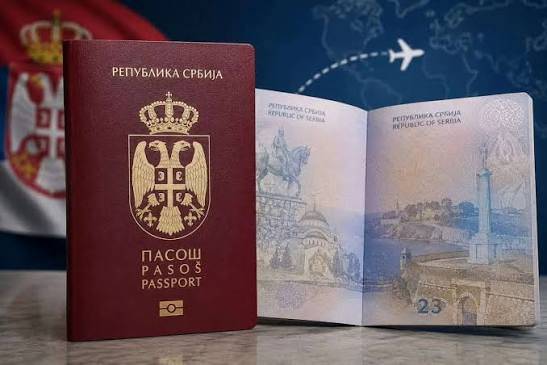
A Serbian passport has opened the Schengen area without a visa since December 2009. Article 19 of Serbia's Citizenship Law lets the government give one to any foreigner it deems to be in the interest of the Republic, with no residence, no language test and no renunciation of the first citizenship. A Russian who holds one never meets the consulate.
In April the government in Belgrade admitted Yakub Zakriev, Ramzan Kadyrov's nephew, who is under American and British sanctions. Within days, and within a day of the first press reports, it annulled its own decision, invoking the provision of administrative law that exists to remove a serious and immediate danger. A man Serbia's own government treated as a danger held its citizenship, and Europe's visa waiver with it, until journalists read the Official Gazette.
RFE/RL counted more than 300 Russians admitted under Article 19 between early 2022 and June 2026. Viktor Shendrik, a former FSB special forces officer who ran security for the Rotenberg brothers, became Serbian in May 2023. A vice president of Aquarius, a US-sanctioned maker of electronics for Russia's special services, followed in July 2024, and Valery Kazikaev, under US sanctions since 2023, this January. Relatives of Nikolai Kolesov, the EU-sanctioned defence executive, hold the same passport. Three prime ministers signed: Ana Brnabić, Miloš Vučević and Đuro Macut.
On 10 July 2025 Macut signed for Ali Ramzanovich Musaev, born on 14 December 2006 in Tsentaroy, Chechnya, father's name Ramzan. Ali Kadyrov, second son of the Chechen leader, was born on that day in that village. Registry records leaked from Grozny and published by Agentstvo show his surname changed to Musaev that January. The Anti-Corruption Foundation found the decision in Serbia's Official Gazette. Grozny denies it and Belgrade has not answered. The Berlin court described what a state-made second identity is for. Serbia has put its own seal on one, and no visa goes with it.
Umar Israilov, a former Kadyrov bodyguard who had accused him of torture before the European Court of Human Rights, was shot dead in Vienna in January 2009. An Austrian court convicted three men, and investigators said they believed Kadyrov had ordered his abduction, which he denies. In 2020 two more of his critics were killed, in Lille and outside Vienna, and a third fought off an attacker in Sweden. Chechen exiles live in France, Austria and Germany in the tens of thousands.
No published record shows a holder of these passports carrying out an operation inside the Union. They hold genuine documents and visa-free entry all the same, one of them under a new name, issued by a state on the Schengen border whose one recorded reversal followed a press report. Predrag Petrović of the Belgrade Centre for Security Policy has warned that Serbia can serve as a base for Russian hybrid operations in Europe. Belgrade has spent four years issuing the access such a base needs.
The European Commission's 2025 report on Serbia says the practice "poses potential security risks for the EU". Its visa suspension report of December 2025 told Belgrade to stop accelerated grants and screen every applicant, and proposed no suspension. Each decision can be annulled as Zakriev's was. Until Brussels or Belgrade acts, the decision on which Russians enter Europe without being looked at is taken in Belgrade.