Serbia's winning movement was asked about Vukovar and answered with 1995. The texts it rejects do not say what it claims they say.
By Ardit Rada (Tirana) | 23 November 2026
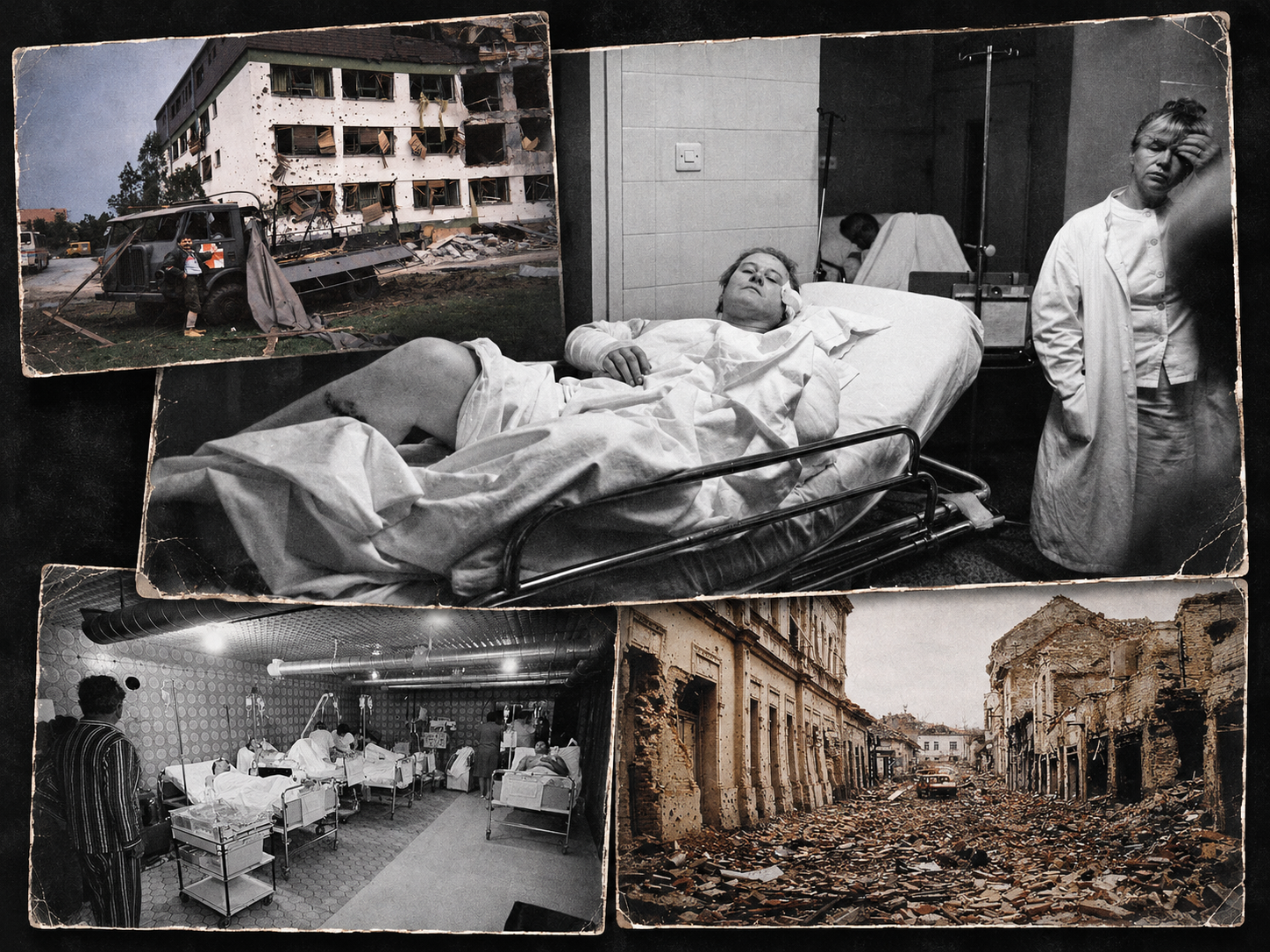
On 20 November 1991, two days after Vukovar fell, wounded patients, medical staff, civilians and captured defenders were taken from the city hospital to a farm called Ovčara. A motion now before the European Parliament records what followed: they were beaten and tortured, and at least 200 were executed and buried in mass graves. A second motion gives the ages of those taken, from 16 to 72, and notes that the dead included a pregnant woman and two schoolboys.
Parliament votes on Thursday. On Monday the Students in Blockade, the movement whose list won Serbia's election on 25 October, published its response under the title "For reconciliation, recognition of all suffering is necessary". The statement has seven paragraphs. Ovčara appears in none of them. Nor does the hospital, or Škabrnja, where 43 civilians were killed on the day Vukovar fell. The graphic that carries the statement shows a column of refugees on tractors and trucks, and the text names two Croatian military operations, Flash and Storm, both from 1995.
The students say the draft neglects Serbian victims and blames a whole people. The motion tabled by four groups, from the conservatives to the Greens, speaks of "Milošević's Greater Serbian aggression" and attaches his name both times the phrase appears. It names the Yugoslav army, the Territorial Defence of Serbia and paramilitary units, lists camps on Serbian soil, and counts 1,725 unresolved cases of missing persons from the whole war in Croatia. Croatian authorities attribute 320 of them to the city of Vukovar. Its tribute extends to civilian victims "regardless of their background". The second motion, from the liberal Renew group, places responsibility on "those who planned, ordered and committed" the crimes. The word Serbia does not appear in it.
The first motion asks the Serbian authorities to open wartime archives, disclose the locations of graves, prosecute war crimes and adopt a law on missing persons that it describes as long announced. The students' statement grants that Serbia "has an obligation to cooperate" and attaches a condition, the same approach to Serbian victims. Its objection is to a "collective responsibility of the Serbian people". Neither document contains that phrase or that claim. A man was named, an army was named and a state was asked for its archives. The reply came in the name of a nation.
In the Serbian political universe, when one Serb is indicted, it is received as an attack on all. When one is named, the answer is that all have been named. When a Serb faces war crimes charges, the case is called fabricated and the crimes "so-called". This is not a fluke, and it is not even a pattern. It is a collective state of mind, a hysteria built on the premise that there is something special about them and that they therefore stand above all judgment.
A request for an archive has to be granted or refused. An insult only has to be rejected, and the archive stays closed. In May 2024 the UN General Assembly adopted a resolution on the Srebrenica genocide whose text stated that guilt for genocide is individual and cannot be attributed to any ethnic or religious group. Belgrade's reply, lit across a tower in the capital, was "We are not a genocidal people". The convictions for that genocide were of individuals. One of them was Ratko Mladić.
For Mladić's funeral in Belgrade on 7 September this year the state provided a government aircraft and Army personnel, the Army's hall hosted a commemoration and Serbia's justice minister attended. The motion before Parliament would condemn those honours. The students' statement does not mention them, although the funeral took place under the government they campaigned against.
Slobodan Milošević led the Socialists. Vojislav Šešelj led the Radicals, the party in which Aleksandar Vučić and Tomislav Nikolić rose. Vojislav Koštunica, the democrat who defeated Milošević in 2000, opposed his transfer to The Hague. Zoran Đinđić, the Serbian prime minister who carried out that transfer in 2001, was shot dead in Belgrade in 2003. Boris Tadić, as Serbia's president, went to Ovčara on 4 November 2010 and apologised. Eighteen months later he lost the presidency to Nikolić, who had told the Frankfurter Allgemeine Zeitung before the runoff that Croats had no reason to return to Vukovar because it had been a Serb city. His party called the report a lie. The newspaper's correspondent confirmed it.
Gestures were made. None became a law, an opened archive or a policy that outlived the man who made it. There is no reconciliation in the Serbian political universe, whether one looks to its left, its right or its centre.
The President of the European Commission and her enlargement commissioner congratulated the students on election night. Most of them were not born when Vukovar fell. Within hours of their statement Ksenija Pavlovic, a commentator writing in Vučić's defence, claimed the line as his and predicted it would bind "whoever governs Serbia".
Vukovar fell to an attacking force of tens of thousands, with armour, artillery and aircraft, against about 1,800 defenders. The columns in the students' picture belong to 1995. The evacuation order for the Krajina's civilians was signed by their own leader, Milan Martić, on 4 August, the first day of the Croatian offensive. In Kosovo, in June 1999, Serbs left alongside the army and police withdrawing under the Kumanovo agreement, in the same days in which the people those forces had expelled began to come home. Many of those who left feared revenge. What they feared revenge for is set out in the tribunal's judgments.
Albania has its own memory of tractors. In the spring of 1999 they came over the border at Morinë to Kukës, carrying Kosovo Albanians expelled by that army and police. By 10 June the UN refugee agency counted 444,200 refugees in this country. The Hague tribunal later established that at least 700,000 people had been driven out of Kosovo. At Batajnica, a police training ground outside Belgrade, 744 bodies of Kosovo Albanians were exhumed. Others are still missing. Renew's motion asks every state in the region for full access to military and security archives. Those are the archives that would say where.
The students were not asked to accept guilt, and neither motion accuses them. Their statement does not say the archives will be opened. It has seven paragraphs and no word for the dead of Vukovar. On that evidence there is no one in Belgrade to reconcile with.