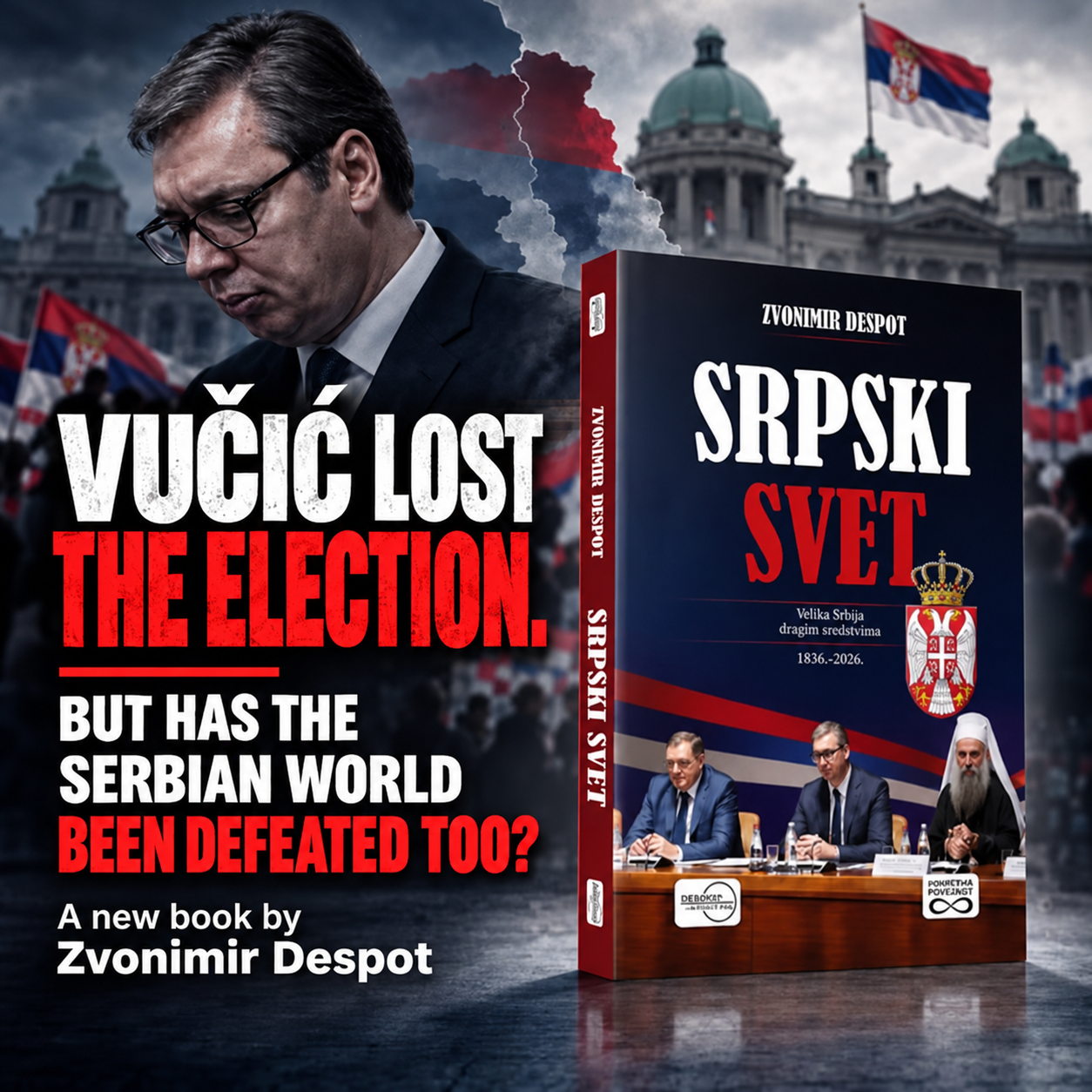
Launched in Zagreb on the eve of the European Parliament's Vukovar vote, Zvonimir Despot's book on the "Serbian World" reprints the students' Kosovo memorandum next to Načertanije and the SANU Memorandum.
Newsroom | 26 November 2026
Croatian author and publisher Zvonimir Despot launched his book on the "Serbian World" in Zagreb on Wednesday evening, the day before the European Parliament is due to vote on a resolution marking the 35th anniversary of the fall of Vukovar. He used the launch to ask whether a change of power in Belgrade changes Belgrade's policy towards its neighbours.
"Serbia's students may be an alternative to Vučić in domestic politics, but they have yet to prove they are an alternative to his national policy. Their stance on the Vukovar resolution is not encouraging," Despot said, according to a statement from his publishing house, Despot infinitus.
On Monday the Students in Blockade rejected the draft resolution, saying it all but ignored the suffering of Serb civilians in Croatia. The draft was tabled by four Croatian MEPs from different political groups: Karlo Ressler, Tonino Picula, Stephen Nikola Bartulica and Gordan Bosanac.
The book, "Srpski svet: Velika Srbija drugim sredstvima 1836-2026" (Serbian World: Greater Serbia by Other Means), runs to 386 pages and was presented at the Bogdan Ogrizović Library in central Zagreb. Speaking alongside the author were Danijel Tatić, historian and executive editor of Despot infinitus, Željko Kuprešak, Croatia's ambassador to Serbia from 2008 to 2013, and Ivana Petrović, foreign policy editor of Nova TV's news programme. The Croatian government was represented: Prof. Vanda Babić attended on behalf of the foreign minister and state secretary Darko Nekić on behalf of the minister of Croatian veterans. The publisher said the hall was full.
According to the publisher, the book follows the Greater Serbian idea across nearly two centuries, from Garašanin's Načertanije through the Yugoslav states, the SANU Memorandum and Slobodan Milošević, to Aleksandar Vučić, Milorad Dodik and today's "Serbian World". It covers Serbia, Bosnia and Herzegovina, Montenegro, Kosovo and Croatia, and gives separate attention to the Serbian Orthodox Church and to the link with Moscow's "Russian World".
The book also reprints its sources. Despot said in October that they include Načertanije, the 1986 draft SANU Memorandum, Serbia's 2011 strategy on the diaspora and Serbs in the region, the 2024 Declaration of the All-Serb Assembly and, last on the list, the Students in Blockade's "Memorandum on Kosovo and Metohija". That text, first read in Kragujevac in May, opens by calling Kosovo "an inalienable and integral part of the Republic of Serbia".
Late in October, after the Student List won Serbia's election, Despot wrote that its programme contains no recognition of Kosovo's independence and opposes Kosovo's membership of international organisations.
His thesis is that the programme outlasts the regimes that carry it, and that today it works through diplomatic, church, cultural, economic, media and intelligence channels, without open territorial claims.
"Vučić is a politician, and the Greater Serbian idea is a political project that has outlived him. That is the basic difference we in Croatia must understand," he said.
A change of government in Belgrade, the publisher's statement says, is no guarantee of a change of policy towards Croatia, Bosnia and Herzegovina, Montenegro or Kosovo. The measures it names are the new authorities' positions on the war in Croatia, Vukovar, Srebrenica, the missing, wartime responsibility and the sovereignty of neighbouring states.
The publisher says the book separates the Serbian people's right to preserve their national, cultural and religious identity from political projects that seek influence over the internal affairs of other states.
"Croatia has no reason to fear a democratic and prosperous Serbia, but it has no reason either to assume in advance that every new government in Belgrade has given up the old political goals," Despot said.