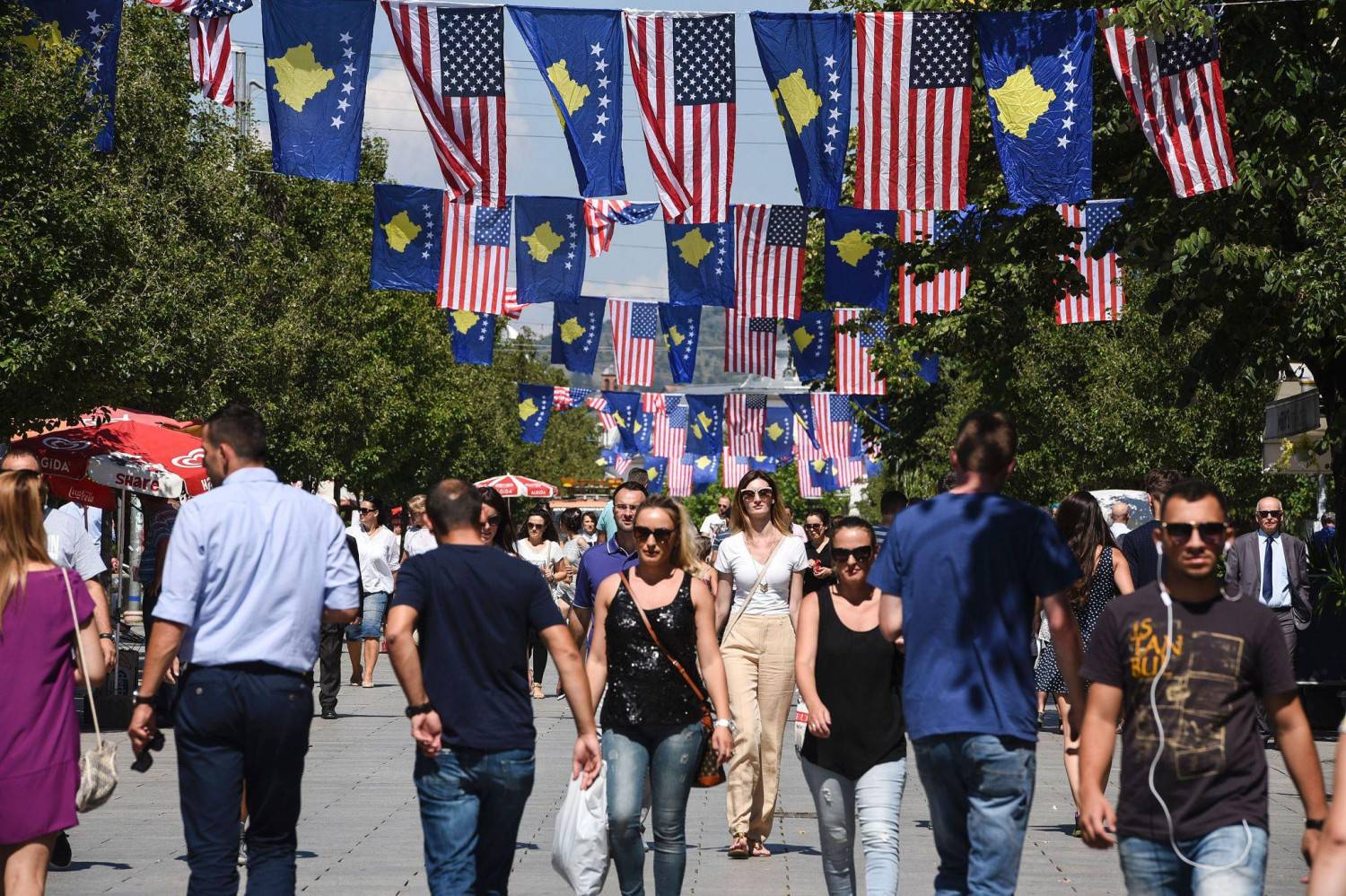
Kosovo chose the United States long before anyone asked it to prove the choice.
By Albatros Rexhaj | 29 September 2026
I do not believe the Wall Street Journal story. I say it at the top so nobody reads the rest as a hedge. The Secretary of State called the ambassador to Greece an "incredibly effective advocate for the President's agenda", and that is where I stand. What goes on between American newspapers and the American government, or between factions inside one party, is not my fight and I will not enter it.
But the damage is done, and it was done to us as much as to anyone.
For two years this administration built a ledger in the Balkans it could point to: no engineered governments, no envoys picking prime ministers, deals on the table and the choice left to the capital. That ledger was worth something here. It was the answer to Belgrade's oldest argument, that Pristina stands on permission. Last Friday a single article in New York burned it. The article did not mention Kosovo. It did not need to. The region reads the Balkans as one room, and a story about a dinner in Athens and a government in Bucharest was on every Pristina screen by Saturday with the same two words attached. March 2020.
I refuse that reading. I do not accept that such projects exist or that such intentions were ever held. The 2020 episode has an envoy's denial on the record, and I take the denial at face value. What is happening now is a hybrid political war against the White House and the State Department, fought with anonymous sources and the region's worst memories, and the Balkans are being used as the ammunition. We are not going to load the gun.
But we live in the room where the ammunition lands. In June a clock was set for this country over gas: connect or be the only one left outside. I wrote then that the dread it produced is renewed on a schedule, and that a frightened people is a governable people. Now the same clock has been handed a story to go with it, and every man in Pristina who hesitates over a pipeline is told he is testing the alliance. That is the pressure. It is real, and it is being paid for with a currency the administration itself said it would not use.
Kosovo is small. Its gas demand is nil. It makes no difference to any energy contract, any corridor, any balance sheet in this region, and it never will. If alliances are measured by deals, Kosovo is not on the page. That is arithmetic, and no pipeline will change it.
Measure the other way and the page fills.
Kosovo is a secular democracy with a Muslim majority, and it is the most pro-American country on earth. There is no other place where that sentence is true. Washington has spent a generation and a fortune looking for proof that Islam and democracy can share a state, and that a Muslim people can choose the United States freely, with no oil, no base agreement and no aid to be lost. The proof exists. It flies the American flag on its own holidays without being asked.
The proof also carries a badge. When the caliphate recruited in the Balkans, Kosovo passed the law, in 2015, that criminalised joining foreign wars, and recruiting and paying for them. In 2019, with American help, it brought home 110 of its citizens from Syria, four men, 32 women and 74 children, and put the adults before its own courts, when most of Europe would not answer the phone. That is the public ledger. Kosovo's police, prosecutors and intelligence service have worked the counterterrorism file with their American counterparts for years, and on that file Kosovo has delivered every time it was asked. The people in Washington who have worked it know what the public record does not show. Ask them how reliable Kosovo is.
The record runs the same way elsewhere. Kosovo is not in NATO. It has no Article 5 guarantee, no vote at the alliance's table and no treaty obligation to spend at alliance levels. Its 2025 budget put defence at 2 per cent of GDP anyway, and the government called it by its name: the NATO standard. This year the sequence on Gaza ran the way an ally's should. The government decided in March. The Assembly voted in April. By the end of April Kosovo's officers were on the ground with the force's planners, and in the spring the Assembly ratified membership of the Board of Peace. On 7 September Kosovo signed the participating-country agreement for the international stabilisation force, in Pristina, with the force's commander. Gallup has put Kosovo first in the world in approval of American leadership year after year, 85 per cent in 2015, 82 per cent in 2019, under Obama and under Trump alike. IRI's polls have 94 per cent of Kosovars ready to vote for NATO membership and 77 per cent naming the United States as the country's most important ally.
Whatever has been asked of Kosovo, Kosovo has delivered. It has not delivered because it was paid. It delivers because it is brave, determined and reliable, and because it decided long ago which side of the world it lives on.
Do not let the people who wrote last week's story define the terms of this alliance. Measured in cubic metres, Kosovo is missing and will be called disloyal. Measured in what Kosovo is and what it has done when asked, it is the one ally in this region that has never needed persuading, and the one exhibit in the Muslim world that needs no explaining.
Build on that. The Prime Minister will decide on gas as he decides on everything, with the whole ledger in front of him. He should make that decision as the head of a reliable ally, not as a man sitting a test that was never his.
Kosovo is not for sale. It has never been for rent. It was, and remains, on your side.
