Brussels waits for Serbia to converge. Belgrade waits for the world to change. Only one of them is paying for the interval.
by Drizan Shala | 1 September 2026
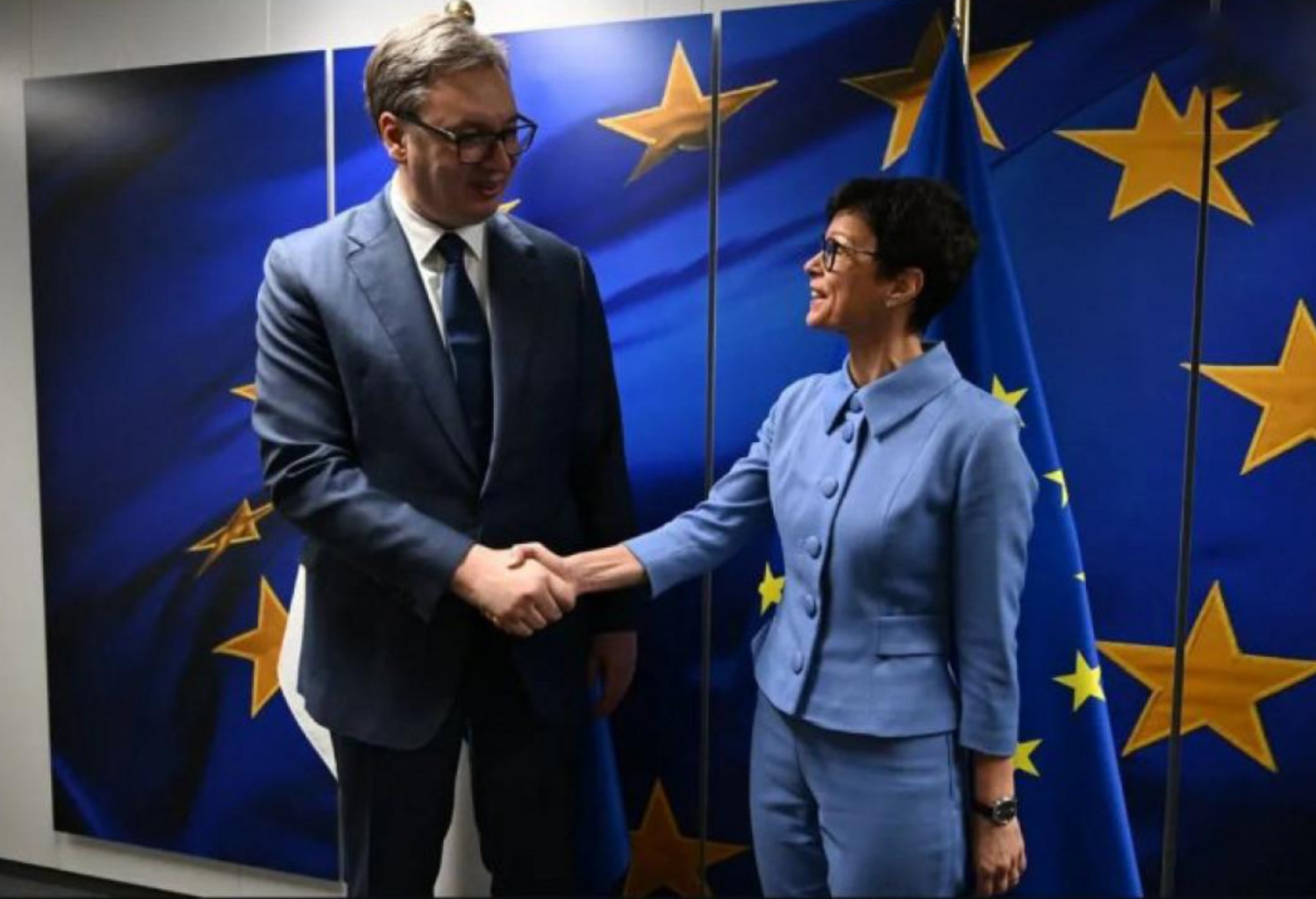
On 1 September at Bled, the EU's enlargement commissioner Marta Kos said on camera that Ratko Mladić was a convicted war criminal, that glorification of war criminals "has no place, not in the member states and not also in our candidates," and that she hoped "the government in Belgrade knows what is at stake." She named the stake. It would be "the basis on which we will also assess developments." She flies to Belgrade on 9 September.
A Commission spokesperson had used the same formula four days earlier, and used it again when asked about a Montenegrin speaker's condolence note. At the time of writing, neither the Commission president nor the High Representative has spoken. That is the institutional record against a justice minister who told a Banja Luka broadcaster that "Mladić is a general and the protocols are known."
Take the commissioner's sentence literally. What is at stake? A tranche has not been named. A cluster has not been named. Nor a chapter, a visit, a Council decision or a date. Everyone who has ever paid Belgrade a bill could tell her what a stake looks like, and it looks like a number with a deadline attached. Conditionality with no consequence attached is commentary. She travels to Belgrade with a warning whose price has never been quoted.
We do not think this is a lapse. We think it is the arrangement.
The account is documented. Serbia's allocation under the Reform and Growth Facility is €1.58 billion of the €6 billion regional envelope. Pre-financing was paid. The first release was approved on 12 January 2026 while the previous June's reform steps were still unassessed; independent monitoring found six of the thirty four end-2025 steps implemented by March. The Commission's latest report puts Serbia's alignment with EU foreign policy at 63 percent, and no release has ever been withheld for it. In July the Commission recommended opening Cluster 3.
The Facility was built on a theory, and the theory deserves to be stated fairly. Enlargement assumes that time works for Europe: two decades of investment, law, market dependence and institutional exposure make the alternative to membership steadily less thinkable, and bringing some of membership's benefits forward speeds the process up. That is not a foolish theory. It has worked before. So measure it against the candidate it has been applied to longest.
Twenty years into Serbia's accession, has the state's dependence on non-European security relationships shrunk? Serbia's military spending, by SIPRI's count, went from $1.8 billion in 2023 to $2.3 billion in 2024 and $2.8 billion in 2025. Twelve Rafale fighters were purchased from an EU member state. Conscription, abolished in 2011, is funded in the 2026 budget with a first intake announced for the end of this year. On 24 August Serbia's defence minister received a Chinese Central Military Commission delegation for the second session of their military subcommittee, thanked Beijing for its position on Kosovo, said Chinese arms purchases "significantly enhance" the army's capabilities, and confirmed a third session on equipment and technology before the year ends. The same week Serbia's deputy foreign minister held security consultations in Moscow. The Facility subsidises the civilian side of the balance sheet from which all of this is paid. Every one of these choices was made inside the process, and none of them narrowed it.
The candidate's own theory of time is on record. In September 1997 Serbia's current president told a German correspondent that "we too will be patient in order to regain our land." On 10 August this year, hours after KFOR announced its drawdown, he said things in the world were changing slowly, that Serbia must be "patient," and that the question was whether it would have "more freedom or less freedom in its actions in the future." Twenty nine years, the same verb. Brussels waits because it believes waiting produces convergence. Belgrade waits because it believes waiting produces opportunity. Both are right about the waiting. Only one of them has been reading the other's calendar.
A state that adds capability while telling its public to be patient, and prepares to bury its wartime general with honours, is describing the last war as unfinished business. Whether it ever decides to finish it is a question we cannot answer, and neither can its president, because that decision belongs to a moment he has said is not yet here. What is being bought now is the range of choices Serbia will have when he decides the moment has arrived.
The Facility has narrowed the economic distance between candidate and member. Nothing has raised the political cost of remaining a candidate. For Belgrade, the road has become more profitable than the destination. For Brussels, the road is the proof that enlargement is still happening. Serbia does not have to become European, and Europe does not have to admit it has lost Serbia. On 9 September the commissioner arrives to administer the waiting room, and neither side has asked for the process to end, because the process is the deal.
Drizan Shala is a security researcher and doctoral candidate at the University of Sarajevo. He writes on defense, private security, and the security architecture of the Western Balkans.
