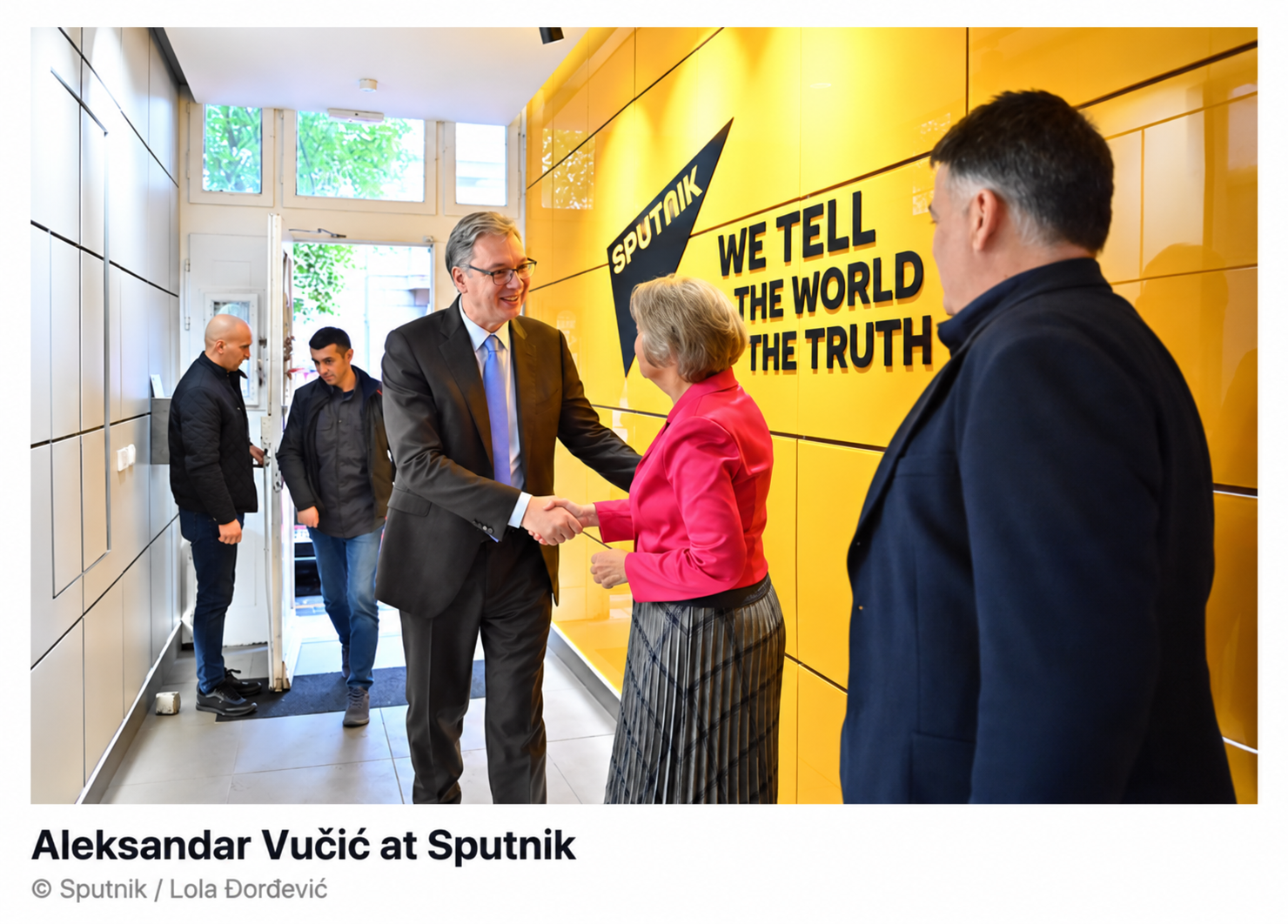
Serbia’s campaign closed with an interview to Moscow’s outlet, in which the candidate listed the conditions he will not meet. Brussels had every one of them on file, and the record of what it did with them is the story.
Ngadhnjim Brovina | 23 October 2026
The last interview of Serbia’s election campaign was given on Thursday evening to Sputnik Srbija. Its editors recorded that Aleksandar Vučić sat in the same chair on the last day of the previous campaign. The slot is reserved, and he treated it as a place to speak plainly.
Since March 2022 the Union has prohibited its operators from broadcasting Sputnik and RT, and it expects candidate countries to align with the decision. Serbia has not, and Vučić explained why. A Baltic president, he said, offered to vote for opening Cluster 3 and bring the others along on one condition: “only if I shut down Sputnik and RT”. “I answered him: thank you and goodbye!” The interviewer corrected him, saying he was not partly but entirely responsible for her newsroom’s existence. He accepted the correction and named the president: Gitanas Nausėda of Lithuania.
One member state attached a condition to a cluster. The candidate refused it on the record. The twenty-seven never adopted the condition, and Cluster 3 stayed on the agenda as the reward under discussion. Belgrade drew the lesson and stated it on Thursday: “why would we change our strategic policy and put the ball in our court? Let it stay in theirs.”
He then gave Moscow’s audience the three reasons the West wants him gone. None concerned domestic governance.
The first is sanctions. “I am in their way because for four and a half years I withstood the pressure and did not introduce sanctions on Russia. They cannot trust me if judgment day comes, a conflict between Europe and Russia.” In September 2025, after he stood beside Putin at the Beijing parade, the Commission’s spokesperson said relations with Russia “cannot be business as usual”. In November the Commission’s report asked Serbia to improve alignment “as a matter of priority”. On 12 January 2026 the Commission adopted Implementing Decision C(2026) 18 approving the first release of Growth Plan funds to Serbia, with three of seven reform steps assessed as achieved. When payments were later halted, the stated reason was judicial backsliding. Alignment with the Union’s foreign policy is not a payment condition, and the money was certified with Russia outside the test. On Wednesday the spokesperson repeated “business as usual” to Radio Free Europe. On Thursday the candidate described business as usual as the policy he asks voters to renew.
The second is Kosovo. He will not allow a settlement in which “one way or another the independence of the southern Serbian province is recognised”. Ohrid does not ask Serbia for formal recognition. It asks for the “one way or another”: recognition of Kosovo’s documents and symbols, no objection to its membership of international organisations, a legally binding agreement on comprehensive normalisation as the end state. That is what he excluded, in a phrase chosen to cover every route. On 22 September Kaja Kallas met him in New York and wrote afterwards that the agreements reached through the dialogue, “in particular the Ohrid Agreement, are binding”, and that the Union “will continue to be an even-handed arbitrator”. The arbitrator now has, from one party, a statement of what the binding agreement will never be allowed to produce. The other party has been asked to keep implementing.
The third is Srebrenica. After the General Assembly resolution, he said, Sergey Lavrov told him: “Aleksandar, remember my words, they will never forget this and never forgive you.” September tested the forecast. On the 4th, Marta Kos cancelled her visit to Belgrade because the glorification surrounding Ratko Mladić’s death was, she wrote, incompatible with the values on which the EU path is built. Vučić called her explanation “stupid, as usual”. On the 7th the state buried Mladić with military honours. On the 9th, the day Kos had been due in Belgrade, Emmanuel Macron received Vučić at the Élysée. Paris is not the Commission, and that is the charge. A commissioner imposed a cost on behalf of the Union, and five days later a founding member state showed Belgrade the cost was optional. Conditionality enforced by one institution and waived by another is a price list.
Asked which European leaders support him, Vučić named Robert Fico and “two or three other people whom I know are on our side but do not want to say so publicly”. Asked about Moscow, he named Putin, “my friend Ushakov” and Dmitry Peskov, and thanked Putin for endorsing him by name.
If the opposition wins, he said, sanctions on Russia follow, and “not most likely, it would happen”. To his host he added: “if there is a change of government in Serbia, not even six months will pass before they close down your newsroom.” He meant it as a threat to voters. Read from Brussels, it is a precise description of the alignment the Commission requests in every report, and a statement from the candidate that his government is the obstacle to it.
“As prime minister, my task will be to pull Serbia out of the coming conflict.” A repeat of 1999 would be difficult, he said, because “everything we need is still arriving” and the alliance’s losses would be “a hundredfold greater”. A candidate for membership measured his army against NATO’s casualties, on Moscow’s outlet, two days before a vote. Neutrality is a position. This was a threat, and it was addressed to the Union’s own members.
None of this was concealed. It was broadcast at five in the afternoon, in the language the Commission’s Serbia desk reads, and it repeated positions the Union has held in its files for four years. The problem is not that Brussels failed to understand Vučić. The problem is that understanding him did not change what Brussels was prepared to do.
This publication wrote in September that Vučić is the incumbent both Moscow and Brussels can live with. Thursday’s interview is the proof, in his words. Lithuania set a price and the Council did not adopt it. Kos set one and Paris waived it. Kallas called Ohrid binding and he published its ceiling. The Commission said no business as usual on Wednesday and he described business as usual on Thursday. On Sunday Serbia votes, and whichever list wins, the Union cannot say it was not told. It was told four years running, and the final telling was reserved for Sputnik.