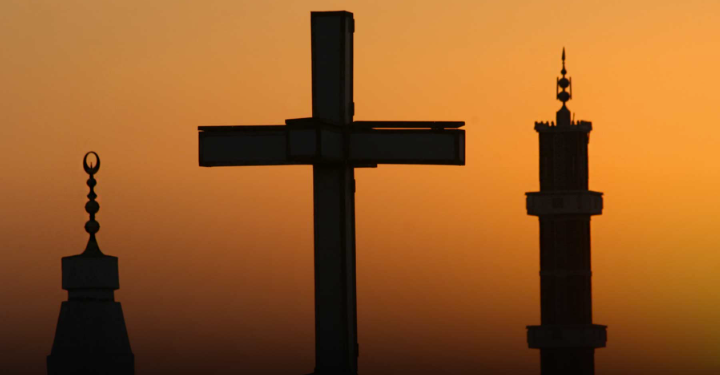
Serbia's president has stopped saying that Serbs in Kosovo face pressure and begun saying that Orthodox Christians face terror. The relabeling has a purpose, a price list, and, in Moscow, a licensor, and its finished product is sainthood for the prosecuted. Europe has seen the grammar before, and the grammar is always published before the act.
The Kosovo Dispatch | 3 August 2026
On Sunday, in the courtyard of a monastery in Bosnia and Herzegovina, Aleksandar Vučić declared that Serbs in Kosovo endure "a horrifying terror", that the world is silent on "the suffering of Orthodox Christians", and that "there is no difference between Bishop Sergije, Father Slaviša, me and anyone else". Milorad Dodik stood beside him. A fuller address on the unity of the Serb nation is promised for Tuesday.
For three decades Belgrade's grievance in Kosovo spoke the language of nation: Serbs, their rights, their municipalities, their votes. The vocabulary at the top of the Serbian state has now changed register. Belgrade will answer that concern for Orthodox sites was always part of its Kosovo file, and that is true; the event is the promotion of religious vocabulary from one element of the dispute to its governing frame. Whether that promotion was designed in one office or arrived by instinct, it behaves strategically, and effects, unlike intentions, leave records. Whether a persecution exists is a settled matter for Europe's own institutions, which hold the file, audit Kosovo weekly, and criticize it freely; supervision is what candidacy means. What should occupy Europe is why the frame changed. We count four reasons, and each is an alarm.
The first is that the national account is unpayable and the religious account is empty. The Serb nation's twentieth-century project carries a ledger adjudicated by international courts, and that ledger is being actively extended: in the week of the Rmanj speech, excavators at Kalludra e Vogël (Mala Kaludra) reached the remains of civilians abducted in 1999, a court ordered detention for two suspects, and Serbia arrested the man it believes told Kosovo where to dig. Relabel the nation as a faith and the account transfers to a debtor with no record, and the debts convert into credits: the suspect held for a massacre becomes a Christian in the hands of the faith's enemies, the witness who mapped the grave a traitor to the besieged. This is already running practice. The Serbian Patriarch has decorated the investigating judge whose staged crime scene at the Reçak (Račak) massacre an international judgment records, and the decoration's citation spoke of devotion to truth. In Belgrade a man convicted of the Srebrenica genocide looks down from a mural the authorities declined to remove, and in Republika Srpska the convicted lend their names to public buildings. Criminals become saints and martyrs. The religious label is how.
The second reason is that a nation can be audited and a faith cannot. A walkout can be examined, a warrant read, a demolition order appealed. A martyrdom admits no evidence. The new register moves the entire dispute from forums where Belgrade keeps losing into one where nothing can be lost.
The third is that the label sells. The suffering of Orthodox Christians is a product with documented buyers in American Christian nationalist circles: the lobbying contracts Milorad Dodik's Republika Srpska signed with insiders of the American president's orbit are public record, the pastor presented as that president's spiritual adviser toured Kosovo's monasteries in July, and the returns flow back as sanctions relief and a joint statement in Washington that fell silent on Kosovo and the Church, with Europe's own far right fed the same content in passing.
The fourth reason is that the label is licensed, and the licensor is Moscow.
Everything in Sunday's speech has a Russian original. The doctrine that a people sacralized by one Church may live in many states while owing unity to one mother state is the russkiy mir, and its Serbian franchise even carries the licensed name, srpski svet. Vučić's formula at Rmanj, we are all Serbs, we can live in different states, we seek no borders, only national unity, is a close translation of the essay Vladimir Putin published about Russians and Ukrainians in July 2021, seven months before the tanks moved. The sacralization has its Russian original too: a council convened under the Russian Patriarch has proclaimed the war on Ukraine a Holy War in a published decree. And the pretext architecture, endangered coreligionists whose mother state acquires a duty above borders, is among the oldest instruments in Russia's diplomatic cabinet, asserted against the Ottomans in the eighteenth century and against Ukraine in this one. Nor is the connection our inference: Russia's and China's ambassadors to Belgrade published a joint article in Politika this July naming Kosovo among the deliverables of the multipolar order.
This is why a normal Europe should read Sunday as an alarm rather than a nuisance. The grammar assembled at Rmanj, a sacralized nation, a besieged faith, a mother state with extraterritorial duty, a warning already issued to neighboring governments over how they may name Serbs, has repeatedly preceded intervention, and the one occasion on which Europe watched it run to completion ended on the same soil where Sunday's speech was delivered, in an adjudicated genocide, beside a man who denies it. A candidate for membership of the European Union is deploying Moscow's mobilization language, about a neighboring state, from the territory of a third, while the Union weighs opening new chapters with it.
Europe does not need to defend Kosovo; the record defends itself, defects included. Europe needs to decline the relabeling, in public, in its own communiqués, before the label finishes its work. The last time this liturgy was read on European soil, Europe swore it had learned to read it. Sunday was a reading test, and Tuesday, we are told, brings the next page.