The evidence of Serbia’s alignment is cumulative and consistent. What remains unresolved is the EU’s response to it.
the Editorial Board | 3 April 2026
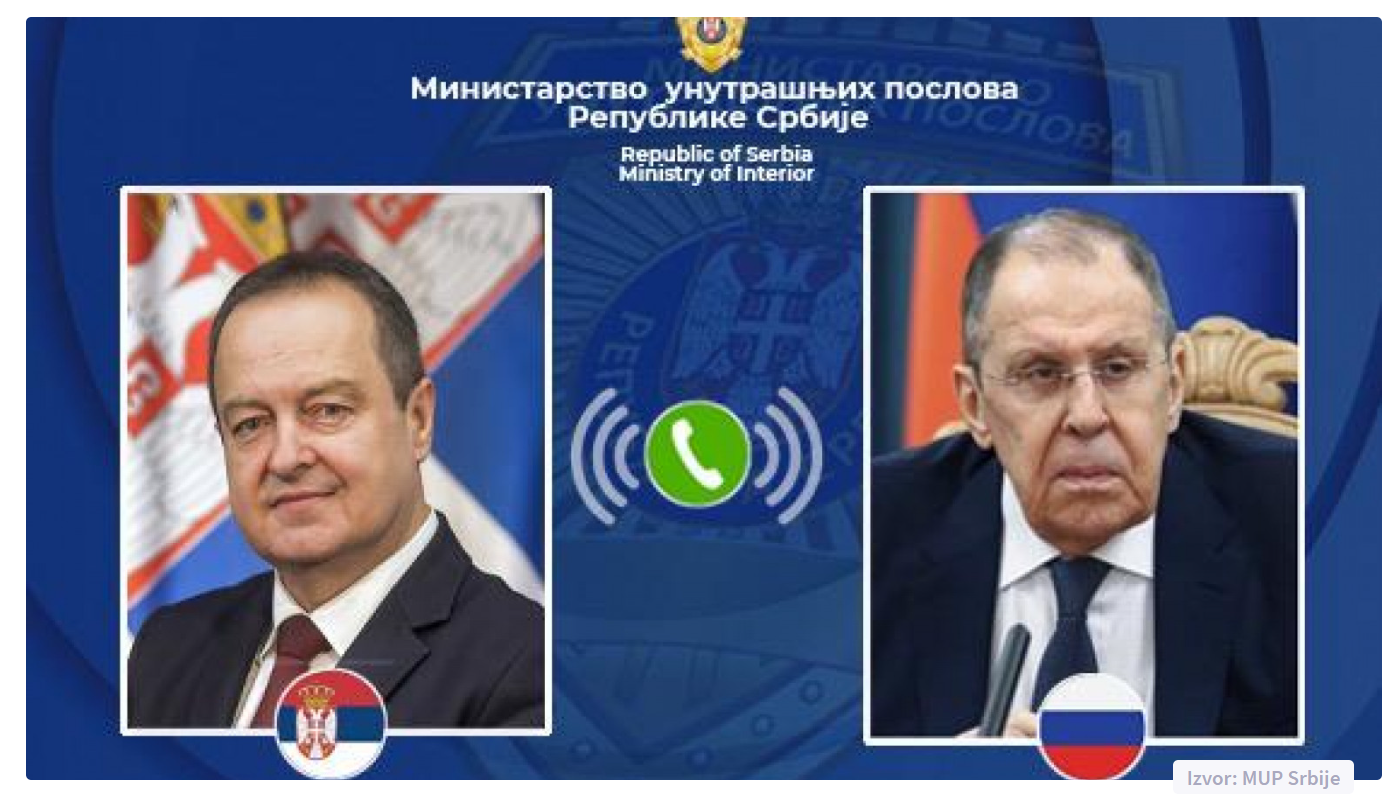
The communiqué from Belgrade's Ministry of the Interior this week carried the careful language of diplomatic routine. Ivica Dačić, Serbia's Deputy Prime Minister and Interior Minister, telephoned Sergey Lavrov. The two men reaffirmed their "strategic partnership." Lavrov reiterated Russia's "principled position" on Kosovo. They praised the policy line of their presidents. Dačić thanked Lavrov for a letter of personal encouragement sent while Dačić lay in intensive care.
It was, in other words, a perfect distillation of what Belgrade has become: a government whose Interior Minister calls the foreign minister of a sanctioned aggressor state for emotional sustenance, and then issues a press release about it.
Brussels should read that press release carefully. And then stop pretending not to understand what it says.
The phone call did not happen in isolation. Three days earlier, Vučić had called Putin to secure a three-month extension of Serbia's gas contract, emerging from the conversation to tell Serbian media that the country would have the second or third lowest gas price in Europe, likely second only to Belarus. The comparison was not accidental. It was directional. Belarus is not a candidate country. Belarus is a Russian satellite. The Kremlin confirmed that the two presidents also discussed Kosovo and reaffirmed the fundamental importance of UN Security Council Resolution 1244 for its settlement. Resolution 1244 is, for Moscow, the legal instrument that keeps Kosovo permanently subordinate to Serbian sovereignty. When Vučić and Lavrov invoke it together, they are not speaking the language of international law. They are coordinating a position.
The defense in Brussels is familiar: Serbia is balancing, constrained by energy dependence and the unresolved Kosovo file. But balancing implies movement between poles. What Belgrade has demonstrated instead is consistency. On sanctions, on energy, on diplomatic coordination with Moscow, the direction has not shifted. It has held. Nowhere is this clearer than in the military domain. When Serbia's Chief of the General Staff confirmed in January 2025 that several contracts for Russian weapons had been cancelled, he was careful to add that others had been postponed, in his own words, "in the hope that the situation in international relations at the global level will normalize and allow the implementation of the contracts." This is not the language of strategic reorientation. It is the language of a waiting room, one that faces east. Belgrade is not balancing. It is arbitraging.
None of this is new, and that is precisely the point. Serbia has refused to join international sanctions against Russia following the 2022 invasion of Ukraine, prompting the European Parliament to pass a resolution strongly regretting Belgrade's non-alignment and noting the damage to its own accession process. That was four years ago. Since then, the European Commission's own 2025 enlargement report found that Serbia had yet to show genuine political will to deliver on EU-related priorities, with deep societal polarisation and persistent anti-EU rhetoric running counter to its stated accession objective. The Commission's analysts classified Serbia in the institution's own enlargement taxonomy as a backslider. Not a laggard. Not a slow reformer. A backslider. The EU's own framework now groups candidate countries into four tiers: key enlargement partners like Montenegro and Albania; laggards with lingering political issues; the backslider, Serbia; and outsiders like Turkey and Georgia. Serbia is not in the waiting room. It is in a category of its own.
What does Brussels do with this information? Apparently, very little. The formal process continues. Chapters remain technically open. Intergovernmental committees prepare to meet. The language of conditionality is repeated in reports that Belgrade files away without consequence. The EU's engagement with Serbia has become a ritual whose purpose is the ritual itself, not its outcome.
This is a choice too, though made in slow motion and with far less honesty than Belgrade's.
The Dačić-Lavrov call is not a scandal. Scandals imply surprise. What it represents is confirmation: Serbia's government has internalized the Russian framework across every relevant register, from energy pricing to Kosovo doctrine to the personal loyalties of its senior officials. When a country's Interior Minister thanks a foreign minister who is himself subject to international sanctions for moral support during a hospital stay, and when this is announced as a matter of routine diplomatic business, the alignment is not rhetorical. It is structural.
The European Commission's own annual enlargement report highlighted Belgrade's lack of alignment with EU sanctions against Moscow, even as Vučić stood at EU summits defending his relationship with Putin in the present tense, not the past. "I will not justify myself for having spoken to anyone," he told Euronews. This is not the language of a country navigating a difficult geopolitical position. It is the language of a country that has decided.
The irony is that the decision is visible everywhere except in the capitals that most need to acknowledge it. Warsaw sees it. Riga sees it. Pristina certainly sees it, and lives with its consequences daily, as Moscow and Belgrade coordinate their positions on Resolution 1244 and Belgrade's military procurement doctrine, even in its current constraints, explicitly holds open the door to Russian re-engagement the moment sanctions lift. But in Brussels, Paris, and Berlin, the preferred posture remains strategic ambiguity: keep the process alive, issue the reports, and avoid the political cost of naming what everyone in the room already knows.
That cost is not being deferred. It is being paid now, in policy incoherence, in the credibility gap between what the EU says it requires and what it tolerates, and in the strategic drift that accumulates every quarter Serbia renews its gas contract with Moscow and calls it energy security. A Serbia that has locked in Russian gas pricing, coordinates its Kosovo position with the Kremlin, and maintains warm personal relationships at the cabinet level with Moscow's foreign ministry is not a country suspended between East and West. It has resolved the tension. It resolved it some time ago.
The question Brussels now faces is not whether Serbia has made its choice. The evidence answers that. The question is whether the EU is willing to make its own: to treat Serbia's trajectory as what it is, and to build a Western Balkans policy that does not depend on the fiction of Belgrade's eventual arrival.
Continuing to pretend otherwise does not preserve the option. It simply allows one party to benefit from the ambiguity while the other pays for it.