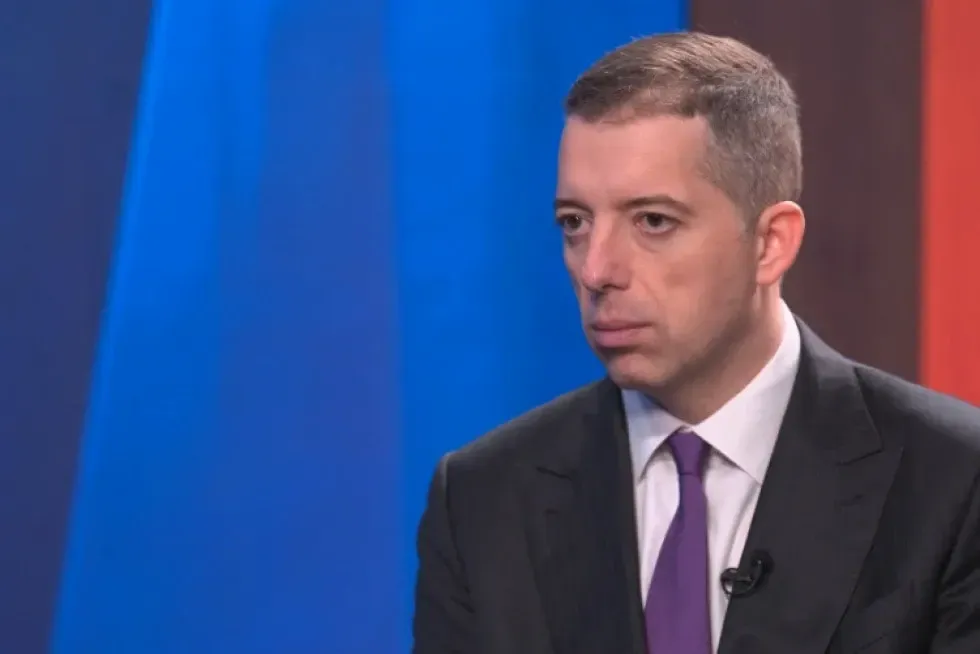
Kosovo Dispatch is publishing the full, verbatim interview of Serbian Foreign Minister Marko Đurić as a matter of record and transparency, followed by a brief editorial note flagging specific claims of relevance to Kosovo, the EU-facilitated dialogue, and regional stability. The purpose is not rebuttal, but clarity: to allow readers and partners to assess Belgrade’s stated positions in full, while identifying factual, legal, and policy implications that bear directly on EU enlargement, minority rights, and Kosovo’s international standing.
6 January 2026
Kosovo Dispatch is publishing the full, verbatim transcript of Serbian Foreign Minister Marko Đurić’s interview with Newsmax Balkans in the interest of transparency and accurate public record.
The interview offers a comprehensive articulation of Belgrade’s current foreign-policy narrative — on EU enlargement, relations with the United States, regional security, and Kosovo. As such, it is relevant not only for audiences in Serbia, but for Kosovo, the Western Balkans, and Kosovo’s European and transatlantic partners.
Alongside the transcript, we are publishing a brief editorial note identifying specific issues raised in the interview that merit attention from EU and U.S. policymakers. This note is not a rebuttal, nor an opinion piece. It is intended as a focused clarification of factual, legal, and policy-relevant claims that bear directly on regional stability, the EU-facilitated dialogue, and the integrity of the enlargement process.
Publishing the interview in full allows readers and partners to assess the statements as delivered, without selection or interpretation. Publishing the accompanying note reflects Kosovo Dispatch’s responsibility to contextualize claims that touch upon Kosovo’s security, minority rights, EU conditionality, and commitments undertaken in EU-brokered agreements.
We believe that transparency, precision, and documentation — rather than polemics — best serve informed debate and constructive engagement. This approach allows our readers and partners to distinguish between stated positions and verifiable obligations, and to evaluate the implications accordingly.
_________________
The bellow interview was broadcasted on 5 January 2026.
In a little over a month, we will be able to say that the Russia–Ukraine war has effectively completed four years and entered its fifth. At the same time, we will be able to say that one year of Donald Trump’s rule in America is behind us. Both of these developments have profoundly disrupted global geopolitical dynamics.
On the one hand, from a kind of bipolar world, we have moved—or are expected to move—toward a multipolar one. Has this shift, and to what extent, shaken Serbia’s foreign policy? How much have we adapted to these newest global developments? These are the issues we discuss today in “Position of the Day” with the Minister of Foreign Affairs of Serbia, Mr. Marko Đurić. Good evening, and thank you for speaking with Newsmax Balkans TV.
Good evening. It is a pleasure to be your guest.
In the introduction to this conversation, I mentioned two of the most important developments we have experienced and witnessed over the past three or four years. There are many others, of course. But has Serbia’s “four pillars” foreign policy been shaken? Let me remind viewers: the four pillars are cooperation with the United States, Russia, the European Union, and China.
First of all, Serbia is not a leaf in the wind, bending under the blows of what are episodic or temporary geopolitical changes. Even tectonic changes of the kind we are witnessing do not automatically mean that Serbia has decided to change its principles, its convictions, or its foreign-policy course overnight.
Friendships and alliances in foreign policy are shaped by numerous factors—some historical, some economic, some security-related, and even geographic. In that sense, I can say that Serbia is very firmly anchored when it comes to its foreign-policy orientation. We pursue a multivector foreign policy in which Serbian national and state interests are placed at the absolute center. And that is how it should be. Everyone takes care of their own interests.
But how realistic is it to maintain such a policy going forward? How much pressure is there on Serbia—pressure that seems to be increasing—to choose one side?
Our policy is, at the same time, a policy of realism. Seventy-seven percent of our trade is conducted with countries on the European continent and in our immediate surroundings—15 percent with the region and 62 percent with the European Union. As responsible and serious people, we must take care that Serbia continues to grow and develop economically.
Thanks to the economic policy whose driving force over the past decade was President Vučić, Serbia has managed to double its gross domestic product. That would not have been possible had we not opened our doors wide to cooperation with European countries. Nor would it have happened without the boom in cooperation with the United States, particularly in high technology.
We should not forget that the United States has become Serbia’s number-one partner in services—especially IT, software, and the digital sector. We have annual exports measured in billions, which are not affected by tariffs because they fall within the domain of services.
Objectively speaking, despite the difficulties we face, Serbia has one of the lowest prices of energy—both gas and electricity—on the European continent. This is, among other things, the result of cooperation our country has had with the Russian side. These are objective, measurable, non-ideological parameters that clearly influence our positioning on many issues.
Another important fact is that the People’s Republic of China has become the second-largest investor in Serbia, while Germany is the number-one investor. These are facts we must take into account when assessing our situation. Of course, we also face other challenges, foremost among them the issue of Kosovo.
We will come to Kosovo, but what I want to ask you now is whether such a policy remains possible and whether it remains economically viable. From the European Union, we increasingly hear criticism that Serbia has not imposed sanctions on Russia. If we were to impose sanctions, it is questionable at what price we would then be able to procure energy. The United States—yes—but tariffs have been imposed on Serbia, among the highest in the region and among the highest in Europe.
What I believe is that we must be pragmatic and adaptable, because adaptability is the recipe for success in an era in which things are changing extremely fast. At the same time, we must understand that we cannot and should not become something we are not.
If our economy has more than doubled over a decade thanks to cooperation with several key international actors, we cannot simply abandon all partnerships without clear economic, security, and political alternatives, and focus exclusively on ideological preferences promoted by parts of our environment.
Serbia has approached European reforms very seriously. For the fifth consecutive year, the European Commission has given a positive assessment of reforms implemented in Serbia. If we measure these reforms meritocratically, based on clear criteria, Serbia—along with Montenegro—ranks first in the region across various reforms, whether institutional or economic.
We have been told that Serbia is technically ready to open Cluster 3, but that this will be “considered later.” What does that mean, and why later?
Because of political reasons. Some EU member states would like Serbia to adopt a different stance toward relations with Russia. That is no secret. Some are also unhappy with Serbia’s position on Kosovo and Metohija, but that is a smaller part of the problem.
We also assess the broader dynamics of EU enlargement. We must see whether, in the 2028–2034 budgetary period, the European Commission will even envisage new member states. Look at the case of North Macedonia. For thirty years, they did everything that was asked of them. They changed their name. They amended their constitution countless times. They did absolutely everything. They allowed Albanians to take more than a third of power in North Macedonia. And none of this resulted in them advancing or becoming frontrunners.
When I spoke with colleagues from North Macedonia, they told me, “We have already been frontrunners three times.” Yet a single member state lowered the barrier. What I want to say is this: it is in Europe’s interest that Serbia—a country that accounts for 53 percent of the Western Balkans’ economy, located at a key strategic crossroads, with nearly seven million inhabitants, and with millions of its people living across Europe—becomes a full and equal member of the European Union. That is also our interest.
Whether and how fast this will happen does not depend solely on us. Our obligation is to do everything within our power—above all for ourselves. We need better institutions, a more efficient system, clearer criteria across society. This process helps us in that regard.
But I fear that if Europe does not cut through this Gordian knot and take a decisive step toward enlarging to the Western Balkans, that will be another reason for its lagging behind other global actors.
Why, then, are we late on some basic issues? We have not had a functioning REM for a year, which is one of the conditions. Amendments to the voter registry law took over a year, also a condition. It is not that we have not made mistakes.
Serbia received clear signals that if it amended its constitution to strengthen judicial independence, clusters would open. Serbia held a referendum; the constitution was amended in 2023. Unfortunately, the cluster did not open. We then adopted the law on a unified voter register fully in line with proposals from civil society and the opposition. When it came to the REM law, chaos followed—not due to the government, but due to parts of the opposition and civil society failing to respect agreements reached with the European Commission. Serbia has effectively become a hostage to conditions that do not depend on the state.
But all of that is still us—opposition, NGOs, citizens.
Yes, but unlike some other countries in the region, here there is often no sense of contributing added value to the collective effort of moving Serbia toward Europe. Instead, there is a “the worse, the better” philosophy—blocking Serbia’s progress in order to strike at the government, without understanding that bringing down a government must not be done at the expense of national and state interests.
At the same time, power must not be exercised solely to preserve the interests of those currently in office. We strive for a fair approach.
Let me ask about security. Serbia insists on military neutrality, yet continues to arm itself and profits from arms exports. Who are Serbia’s enemies?
We are not the only ones arming ourselves—the entire region is doing so. Serbia has a long tradition of independently safeguarding its security. Our comparative advantage lies in a strong defense industry and the fact that, by all objective measures, Serbia has the strongest armed forces in the region. This is a factor of peace and deterrence.
Serbia is firmly and permanently committed to peace. We openly support President Trump’s initiative for peace in Ukraine. Peace is sacred to us. To preserve peace, we must strengthen our capabilities and diversify sources of armaments. We have concluded a major agreement with France and cooperate with many other countries, while investing even more in our own capacities.
But the largest budget item for 2026 is the payment for French Rafale jets. Do we need that?
Serbia does not have the geographical fortune of Costa Rica. On a continent where a major war occurs roughly every fifty years—and where we are living through such an era—having an army means existing. Switzerland, despite centuries without war, maintains a massive defense system. Austria, though militarily neutral, has a serious army. Serbia, in the turbulent Balkans, must strengthen its defense—not because we see others as enemies, but to protect what is ours. That is our fundamental right.
Turning to Ukraine: Ukraine opposed Kosovo’s independence, yet Serbia sells weapons to Ukraine. Was that inevitable?
Ukraine has opposed Kosovo’s independence since 2008, even under strongly pro-Western leadership. We respect that. Regarding our defense industry, Serbia adheres strictly to UN norms and does not export weapons to countries engaged in armed conflict. President Vučić introduced an additional layer of oversight through the National Security Council to prevent any indirect contribution to conflicts.
Let us turn to the United States, the fourth pillar. Have there been diplomatic missteps, and what are relations like with the current U.S. administration?
Our approach differs from that of 2009. For us, Serbia comes first—just as the Trump administration says “America First.” I spent four years working to improve Serbian-American relations as ambassador in Washington, and today, as foreign minister, I am working to accelerate that progress.
And are you succeeding?
I believe we are. Over the past year, we have had excellent meetings and warm communication with top U.S. officials. After 18 years, I was officially welcomed at the State Department. President Vučić was among the first European leaders to speak with President Trump.
What is often forgotten is that the Trump administration suspended strategic dialogue with Kosovo over the position of Serbs, improved the situation regarding Republika Srpska in Bosnia and Herzegovina, lifted sanctions on dozens of its officials, and abandoned policies aimed at weakening the Dayton Agreement.
Is lifting sanctions on Dodik dependent on Dodik himself or on Serbia’s leadership?
When Serbian interests are at stake, we act together. We believe this will be the year of strategic dialogue between Serbia and the United States. Serbia maintains a balanced foreign policy—this is our DNA. As Saint Sava said, we are the West in the East and the East in the West.
Finally, Serbia did not attend a recent EU–Western Balkans meeting. Why?
Many in the public understood the message. Five years of reforms were not recognized. Sometimes absence and silence send a stronger message than words. This was not a step away from the EU, but a step intended to accelerate integration.
On Kosovo: the EU asks Pristina to form the Community of Serb-majority Municipalities—an obligation for over a decade—while asking Belgrade not to obstruct Kosovo’s international integration. Is any of this realistic?
I do not wish to attack decision-makers in Brussels, but truthfully, lifting measures against Pristina is not justified when Kurti’s government has done nothing to improve relations with Serbia. If holding elections is rewarded while attempts are made to ban the Serb List, something is wrong with the criteria.
Serbia has fulfilled every fundamental obligation from the Brussels Agreement. I participated in over 220 rounds of dialogue. Serbia has been responsible, sometimes overly silent, in the interest of peace and stability. Time does not work in favor of separatists. Whether it works in Serbia’s favor will be seen in 2026.
Mr. Đurić, thank you for being our guest.
Thank you. I wish everyone a successful year ahead.
____________________________________________
Non Paper: Key Issues Raised by Serbian FM Marko Đurić Interview (Newsmax Balkans)
Purpose: Flagging factual distortions and destabilizing narratives relevant to EU and U.S. policy.
1) Inversion of EU enlargement logic (“Europe needs Serbia”)
Đurić repeatedly asserts that Europe needs Serbia as a member state.
Why it matters: EU enlargement is merit-based, not entitlement-based. This framing seeks to dilute conditionality and recast accession as a geopolitical necessity rather than a reform process.
2) Ethnic mischaracterization of North Macedonia
He claims North Macedonia “allowed Albanians to take more than one third of power.”
Why it matters: This is a factual and political misrepresentation of the Ohrid Framework Agreement—a Western-backed peace settlement establishing civic, multiethnic governance. It reframes constitutional equality as ethnic concession and undermines an EU/NATO-supported model.
3) Cluster 3 blockage framed as purely political
Đurić presents Serbia as technically compliant and blocked mainly due to political disagreements, while attributing institutional failures (e.g., media regulator) to opposition/NGOs.
Why it matters: This externalizes responsibility and seeks to pre-empt EU conditionality on rule of law, media freedom, and governance fundamentals.
4) Categorical denial on arms exports to Ukraine
He states Serbia does not export weapons to countries engaged in armed conflict and implies airtight oversight.
Why it matters: The categorical nature of the denial conflicts with widely acknowledged indirect flows via third countries. This reflects dual-track signaling: public neutrality, private deniability.
5) Reframing U.S. policy toward Kosovo
Đurić claims the U.S. suspended strategic dialogue with Kosovo “because of the position of Serbs.”
Why it matters: This mischaracterizes U.S. actions driven by governance and stability concerns as implicit validation of Serbia’s Kosovo narrative.
6) Assertion of full Serbian compliance in the Kosovo dialogue
He states Serbia has fulfilled “every fundamental obligation” from the Brussels process.
Why it matters: This is a sweeping, testable claim used to close the compliance debate by declaration, while Serbia maintains an active posture opposing Kosovo’s international integration.
7) Delegitimization of EU measures on Kosovo
Đurić criticizes EU steps toward Pristina as unjustified and frames Serbia’s absence from EU meetings as a corrective signal.
Why it matters: This seeks to rebalance EU pressure away from Belgrade and onto Pristina, without acknowledging the EU’s stated rationale tied to de-escalation and security.
Summary for Partners
The interview systematically reframes Serbian strategic ambiguity as realism, minority equality as excess, and non-compliance as victimhood—while attempting to convert geopolitical relevance into entitlement and shift EU/U.S. leverage away from Belgrade and onto Kosovo.
