Statements from senior Serbian officials linking Kosovo to attacks on U.S. military facilities highlight a widening gap between Belgrade’s diplomatic outreach to the West and the narratives circulating within its governing elite.
by Mark Gojcaj | 4 March 2026
Geopolitical crises often reveal governments’ strategic instincts more clearly than formal diplomatic statements. Over the past week, as tensions escalated between Iran, the United States and Israel, Serbia’s political messaging has exposed a striking contradiction between the country’s official diplomatic posture and the narratives emerging from within its own governing structures.
For years, Serbian diplomacy has worked to present the country as a pragmatic Western partner. Serbian officials regularly emphasize cooperation with Washington and Brussels while maintaining that Serbia’s long-term trajectory lies within the European Union. Much of this effort has been spearheaded by Marko Đurić, Serbia’s foreign minister, who has sought to cultivate the image of a government committed to dialogue, stability and constructive engagement with Western institutions.
Yet the rhetoric emerging from other senior Serbian officials during the current Middle East escalation paints a more complicated picture.
In comments following the recent U.S. and Israeli strikes on Iranian targets, Serbian President Aleksandar Vučić framed the events through a historical analogy deeply embedded in Serbian political memory: the 1999 NATO bombing of Yugoslavia. By invoking the NATO campaign against Slobodan Milošević’s government, Vučić suggested that the strikes against Iran reflected the same disregard for international law that Serbia has long attributed to Western intervention.
The comparison carried clear geopolitical undertones. By drawing a parallel between Iran’s position and Serbia’s experience in 1999, the Serbian president effectively echoed a narrative widely used by governments critical of Western military power — placing Belgrade rhetorically closer to those critiques than to the Western alliance Serbia formally seeks to engage.
If that framing alone might be dismissed as domestic political messaging, subsequent remarks from within Serbia’s governing apparatus made the broader narrative harder to ignore.
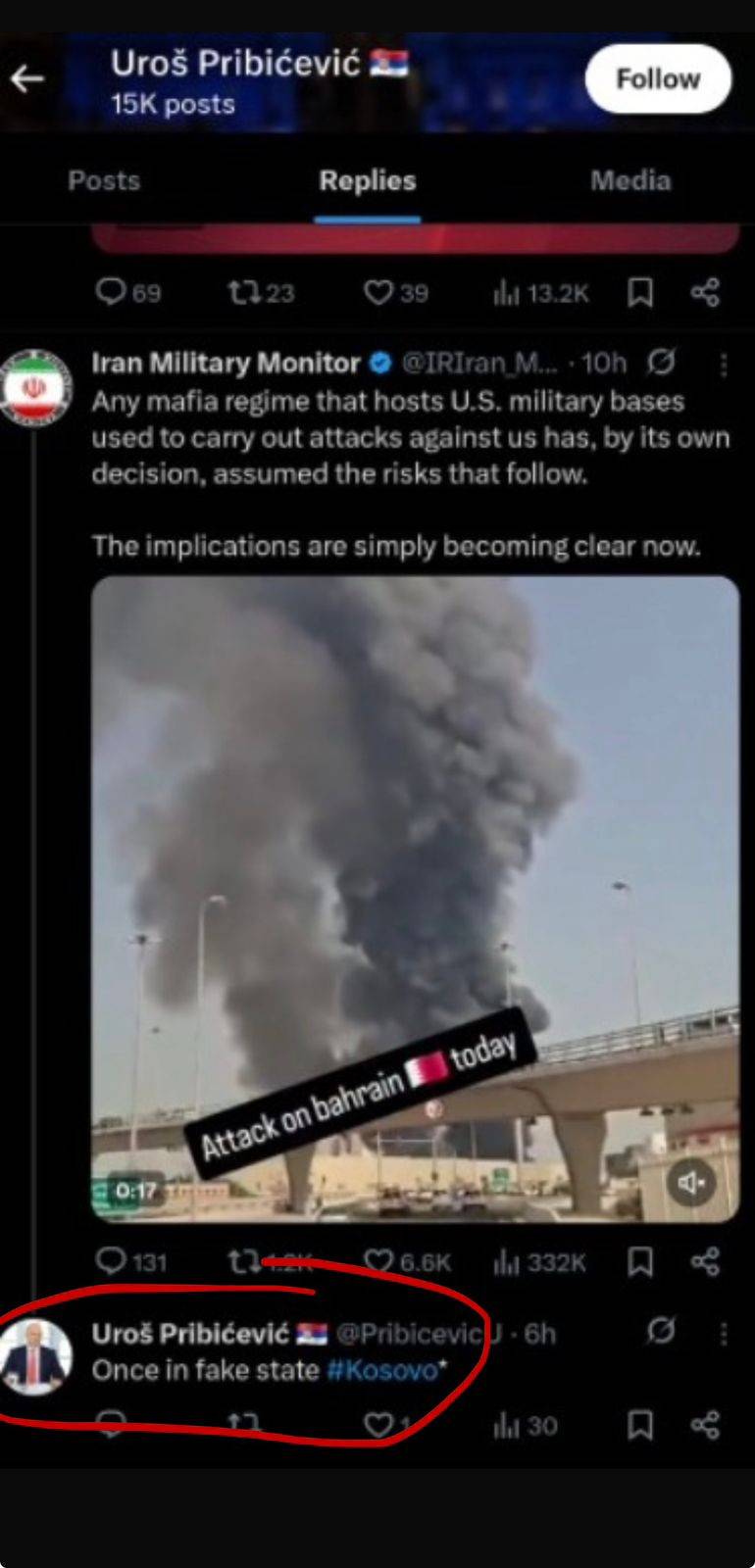
On social media, Uroš Pribićević, an Assistant Minister in the Serbian government, responded to footage circulating online of Iranian strikes on facilities linked to the United States in Bahrain with a comment that abruptly inserted the Balkan dispute over Kosovo into a global military confrontation.
“Once in fake state #Kosovo*,” he wrote.
The remark was brief, but its implications were unmistakable. By invoking Kosovo in the context of attacks on states hosting American military installations, the comment echoed a narrative circulating widely in pro-Iranian and anti-Western media ecosystems: that countries hosting U.S. military bases inevitably assume the risks of retaliation.
Kosovo hosts the major U.S. military installation Camp Bondsteel, which operates within the NATO-led KFOR mission. Established after the Kosovo war, KFOR remains one of NATO’s longest-running stabilization deployments in Europe, serving as a central pillar of deterrence and regional stability in the Western Balkans.
For a government official to invoke Kosovo in such a context — during an active regional confrontation involving the United States — is diplomatically significant. It implicitly reframes the Western security architecture in Kosovo not as a stabilizing mission, but as part of a broader geopolitical confrontation.
Taken together, these remarks illuminate a familiar but increasingly visible tension in Serbia’s foreign policy.
On the one hand, Belgrade continues to pursue economic integration with the European Union and maintains extensive diplomatic engagement with Washington. Serbia benefits from European markets, Western investment and ongoing dialogue with NATO structures.
On the other hand, the narratives frequently voiced by senior political figures reflect a worldview shaped by grievance toward Western intervention, sympathy for states opposing Western power, and persistent efforts to delegitimize Kosovo’s sovereignty.
This dual messaging — Western engagement combined with rhetorical alignment against Western interventions — has long been a defining feature of Serbia’s geopolitical balancing strategy. Belgrade has sought to maintain relations with multiple power centers simultaneously, cultivating ties with Western governments while preserving political and economic links with Russia, China and other actors skeptical of Western dominance.
Yet the strategic ambiguity of this approach has become increasingly difficult to sustain in the current geopolitical environment. Since Russia’s invasion of Ukraine, Serbia has remained one of the few European countries that has refused to align fully with Western sanctions against Russia, while simultaneously deepening economic cooperation with China and maintaining a steady flow of nationalist rhetoric questioning the legitimacy of Kosovo’s statehood.
For policymakers in Washington and Berlin, these patterns increasingly form part of a broader strategic picture: a country that benefits from Western integration while remaining politically ambivalent about the security architecture underpinning that integration.
Moments of global crisis tend to expose the limits of such balancing acts.
In Washington and Berlin, where policymakers increasingly view international politics through the lens of strategic alignment rather than diplomatic ambiguity, the signals embedded in political rhetoric carry significant weight.
For Western governments that continue to treat Serbia as a potential strategic partner in the Western Balkans, the recent episode raises a question that has lingered beneath the surface of transatlantic diplomacy for years: whether Serbia’s proclaimed Western orientation represents a genuine long-term strategic choice, or merely a pragmatic posture designed to coexist with a fundamentally different geopolitical outlook.
The episode also highlights a deeper structural dilemma confronting Western policy toward Serbia. For more than a decade, European and American diplomacy has operated on the assumption that sustained engagement would gradually anchor Belgrade within the Western strategic orbit. Yet each successive geopolitical crisis — from Russia’s invasion of Ukraine to the present confrontation with Iran — has revealed the persistence of narratives within Serbia’s political leadership that frame global events through a lens fundamentally at odds with the assumptions of the transatlantic alliance.
When senior officials of a government seeking closer integration with the European Union publicly equate Western military action with past grievances against NATO, while members of that same government insert Kosovo into narratives surrounding attacks on U.S. military infrastructure, the resulting picture becomes difficult to reconcile with the language of partnership that Serbia’s diplomats routinely present abroad.
For policymakers in Washington and Berlin, the question increasingly ceases to be whether Serbia seeks cooperation with the West. The more pressing question is whether Belgrade ultimately views the Western security architecture as a framework it wishes to join — or merely as a geopolitical reality it must temporarily accommodate.
In the long run, that distinction may prove decisive not only for Serbia’s European future, but for the stability of the Western Balkans itself — where the credibility of NATO’s security guarantees, the durability of Kosovo’s sovereignty, and the strategic direction of Serbia remain deeply interconnected.
About the Author
Mark Gojcaj writes from New York, where he examines the intersection of American conservatism and Southeast European political and security realities. He is a regular contributor to The Kosovo Dispatch’s transatlantic coverage, with a focus on U.S. foreign policy, NATO dynamics, and the Western Balkans.
