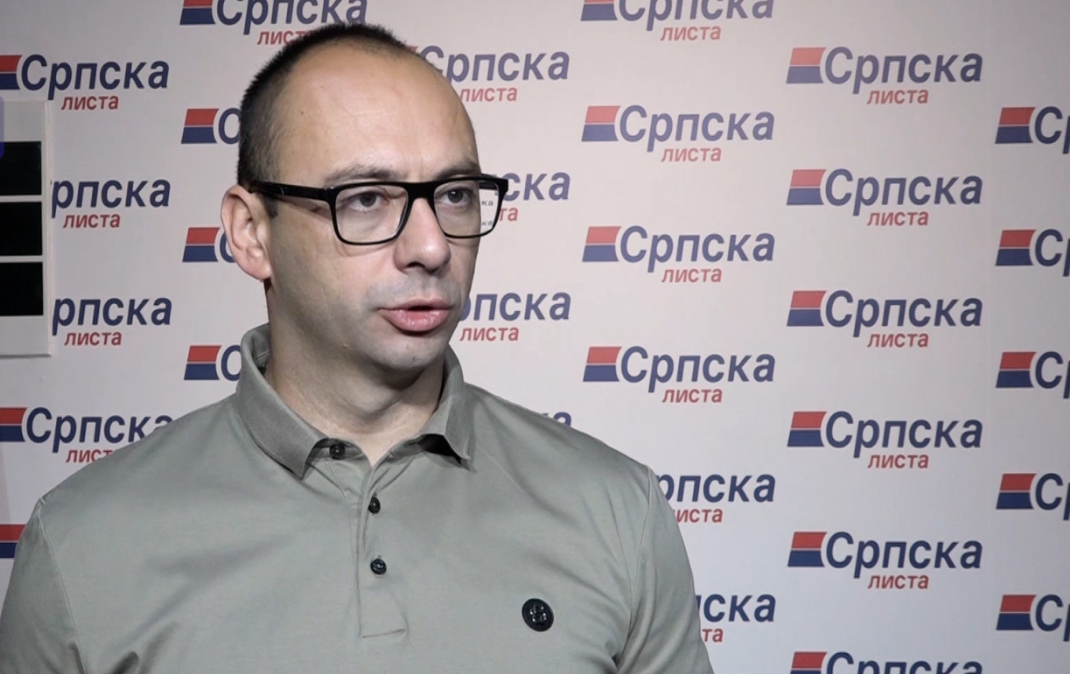
Igor Simić wants credit for a deal he spent the same breath undermining.
by Mark Gojcaj | 15 March 2026
Speaking to RTS on Sunday, the Srpska Lista Presidency member and Kosovo Assembly MP declared that the agreement reached on the Law on Foreigners had averted "a catastrophic scenario for the Serbian people." He praised the outcome. He claimed it as a victory. And then, in the same statement, he drew a hard line: there would be no integration of healthcare and education "as Kurti wanted," and Srpska Lista would never abandon its demand for the Association/Community of Serbian Municipalities — framed, as always, not as a minority management instrument within Kosovo's constitutional order, but as a structural counterweight to it.
His exact words on the core question: "Nema ni govora o integraciji zdravstva i prosvete onako kako je to Albin Kurti želeo" — there is no question of integrating healthcare and education as Albin Kurti wanted. And on the ASMM: "Stalno ćemo insistirati na tome" — we will constantly insist on it.
This is not a politician navigating a difficult compromise. This is a politician collecting the benefits of a state he is working to delegitimize.
The contradiction Simić did not address
Igor Simić is a member of the Kosovo Assembly. Srpska Lista is a party registered under Kosovo law, with a functioning caucus in Kosovo's legislature. The permits that will now allow Serbian teachers, doctors, and students to remain and work in Kosovo are being issued by Kosovo's administrative machinery — the same machinery Simić's party has spent years refusing to recognize as the expression of a sovereign state.
The agreement works precisely because Kosovo functions as a state. Kosovo's institutions are processing the lists. Kosovo's authorities are issuing the documents. Kosovo's legal framework is the basis on which 12-month renewable permits exist at all. Simić did not acknowledge this. He could not, because to acknowledge it would be to acknowledge the premise his entire political posture is built on denying.
On the vehicle law — still unresolved — the pattern repeats. Simić told RTS there are "promises" of no mass fines pending a solution. Belgrade is again extracting assurances while offering nothing reciprocal. The mechanism is identical; only the subject matter changes.
Instead of acknowledgment, Simić offered his constituents reassurance: Serbian children would continue learning under Serbian curricula, Serbian doctors would continue operating within Serbian institutional structures, Pristina had made no gains. The reassurance may be politically useful. It is not analytically honest.
The ASMM sleight of hand
Simić closed his remarks with a familiar demand: the Association/Community of Serbian Municipalities must be formed. He cited Peter Sorensen's own statement that "it is high time" the ASMM was established, and he is not wrong that it remains an unfulfilled obligation under the Ahtisaari framework and the Brussels and Ohrid agreements.
But the ASMM Simić demands is not the ASMM those agreements envisioned.
The instrument as designed is a minority self-management mechanism — a structure through which Kosovo Serbs exercise collective rights within Kosovo's constitutional and legal order. It is not a parallel administration. It is not a sovereignty corridor. It is not a vehicle for Belgrade to maintain institutional control over territory it does not govern.
Srpska Lista has consistently framed it as the latter. The demand for the ASMM's formation, in Simić's telling, is not a demand for managed inclusion in Kosovo's civic architecture. It is a demand for permanent structural separation underwritten by international guarantee. That is a different institution entirely. And the international community's failure to insist on the distinction has allowed a legitimate grievance to serve as cover for a maximalist position that has no foundation in the agreements invoked to support it.
The pressure that never comes
That distinction — between ASMM as a self-management mechanism and ASMM as a sovereignty instrument — is precisely the kind of question the international community should be pressing Srpska Lista to answer. It has not. And the Law on Foreigners crisis illustrates why that silence has consequences.
The crisis followed a now-familiar pattern. Pristina moved — in this case, by implementing legislation unambiguously within its sovereign prerogative. The international community applied pressure. Pristina accommodated. An agreement was reached that opens the path for integration of the remaining parallel structures. Srpska Lista declared victory and immediately signaled that the underlying posture had not changed.
At no point in this sequence was Srpska Lista asked to account for its own conduct — as a Kosovo-registered party, operating within Kosovo's institutions, systematically using those institutions to undermine the state that grants them legitimacy. At no point was Belgrade asked to explain how it squares its non-recognition of Kosovo with directing thousands of Kosovo Serbs to obtain Kosovo-issued permits. At no point did the diplomatic community publicly condition its engagement with Srpska Lista on any expectation of good-faith participation in Kosovo's constitutional life.
This asymmetry is not neutrality. It is a policy choice with observable consequences. It trains one party to demand and the other to accommodate. It tells Srpska Lista, in the clearest possible terms, that there is no cost to the double game.
The international community has spent considerable capital telling Pristina what it cannot do. It has spent almost none telling Srpska Lista what it must. That imbalance is no longer defensible. The credibility required to demand restraint from a sovereign government does not survive indefinite one-sided application. Kosovo has accommodated. Kosovo has negotiated. Kosovo has implemented. The pressure must now go where the obstruction is — and Sunday's statement from Igor Simić marked the point at which that redirection stopped being optional.
Mark Gojcaj writes from New York on American conservatism and Southeast European political and security realities. He is a regular contributor to the Kosovo Dispatch's transatlantic coverage.*
