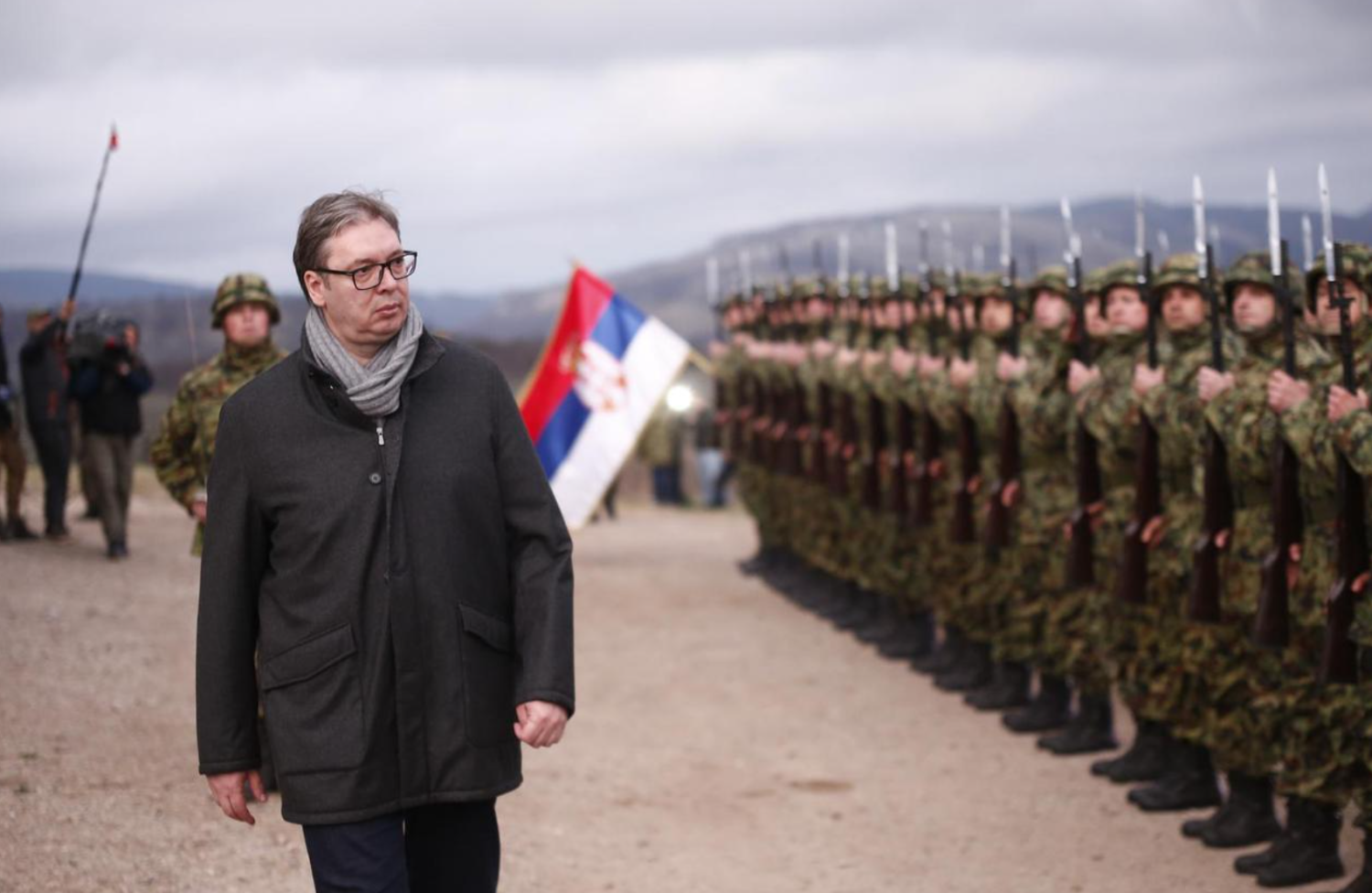
Asked about a bridge, Serbia's president answered with the world order. The answer is the policy.
By Drizan Shala | 23 August 2026
On 10 August, hours after KFOR announced it had begun reducing its permanent presence on the main bridge over the Ibër (Ibar) in Mitrovica, Serbia's president explained what governs Belgrade's response. "Slowly, things are changing in the world," Aleksandar Vučić said. "None of it moves simply, none of it moves certainly, but changes in the world order will gradually come, and we shall see whether we can have more freedom or less freedom in our actions in the future."
The subject was a bridge. The answer was the international system, and what Serbia might be free to do under a different one.
The plain meaning should be stated plainly. In that sentence, Serbia's Kosovo policy has one operative variable, and it sits outside the Balkans entirely. Kosovo's conduct does not appear in it. No agreement's terms appear in it. What appears is the world order, and the freedom of action Belgrade expects to recover when it changes. The letter Serbia later sent to NATO carries the security objections; this sentence carries the timetable.
In the same remarks, he named the required virtue: Serbia must be "patient, responsible and sufficiently smart." The word has a history. In September 1997, in his party's own magazine, a twenty seven year old Aleksandar Vučić explained that a world policeman stood in the way, that balances of power pass, and that "we too will be patient in order to regain our land," politically first, militarily if necessary. Patient then, patient now. Twenty nine years apart, the two statements share a grammar: the obstacle is the world's arrangement, the remedy is time, and the object is land.
To be sure, one sentence on one evening could be mood. It was not one sentence. He returned to the thought the following week while announcing his letter to NATO, complaining that the world is changing too slowly for Serbia's expectations. And the vocabulary is the tell. A government seeking normalization talks about its neighbor; this government talks about the balance of power. A neighbor speaks of relations. A claimant speaks of conditions, and keeps a watch.
The material record matches the language. A decade of rearmament has given Serbia strike systems with ranges measured in hundreds of kilometers, a modernized air force on order, and a network of military and gendarmerie forward positions along the boundary with Kosovo. The hardware exists, the doctrine exists, and the author has now stated which input is outstanding: time.
This matters most in Brussels, because Brussels runs a dialogue premised on two parties that want the file closed. One party has now explained, in 1997 and again this month, that it wants the file to outlast the current world. Normalization means the dispute ends. The August sentence means the dispute waits. A process built on that asymmetry produces signatures, and Belgrade supplies them the way a claimant signs a lease on a building he expects to inherit.
At the NATO summit in Ankara last month, Croatia's president asked what Serbia's arsenal is for, what threat assessment justifies it, and how Belgrade intends to use it. He was told the questions were strange. They have now been answered, unprompted, on the record: the freedom Serbia awaits is indexed to the world order, and the world order is under daily observation. An analyst's obligations here are modest. When a man says, across twenty nine years, that he is waiting for the world to change so that he can act, the professional response is to believe him.
Drizan Shala writes on security, institutions, and political violence for Kosovo Dispatch and Tirana Examiner. He is a doctoral candidate at the University of Sarajevo.
