Serbia’s governing parties explain their Russian alignment with Kosovo. Their biographies explain it better, and Brussels has read both.
Ngadhnjim Brovina | 17 October 2026
On 12 January 2026 the European Commission approved the first payment to Serbia under the Growth Facility. The annex to that decision records smear campaigns against civil society, attempts to delegitimise student protesters, political influence over the media and pressure on the judiciary. It then states: “Based on these elements, these preconditions are confirmed as met.” Nine months later the party that runs that system is still listed on the European People’s Party website as an associate member, since November 2016. The man who heads its electoral list spent this week thanking Vladimir Putin for endorsing him.
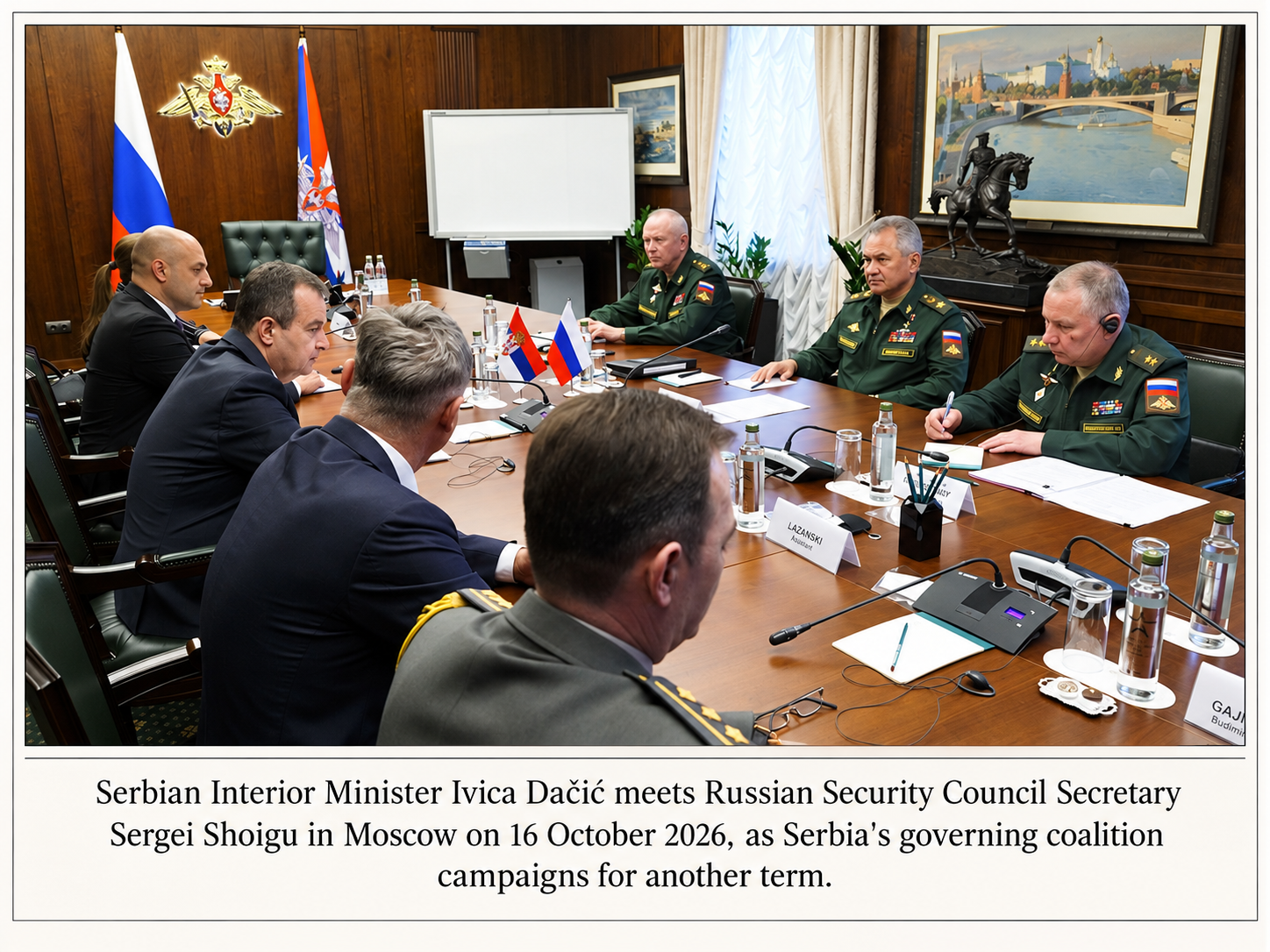
Ivica Dačić went to Moscow on 15 October as Serbia’s interior minister in technical mandate and as head of list number two. He met Dmitry Medvedev, Sergei Shoigu, Sergei Lavrov and the director of the Federal Protective Service, with whom he agreed “concrete steps, above all in training people” for the unit that guards Serbian officials. Lavrov, Dačić reported, “expressed great respect” for Serbia not joining sanctions. Medvedev posted that Moscow “wishes our partners success” and sees “attempts by the West to interfere in the electoral process through radical destructive forces”. The next evening in Novi Sad, Aleksandar Vučić said Putin “expects Aleksandar Vučić to be the new Prime Minister of Serbia”, and embraced Robert Fico, who had left the European Council early to be there.
Belgrade’s explanation has been the same for fourteen years: Kosovo. Russia holds the veto, so Serbia cannot afford to lose Russia. Brussels should listen to what Dačić has been saying these past days once the Kosovo sentences are removed.
“I am not a Russophile, I am a Serbophile.” Russia, China and “if possible America” are the three legs of Serbian policy; the European Union is not a leg. They tried to destroy us, he told his Belgrade rally, with “bombs, sanctions, wars, aggression, 5 October, The Hague, the extradition of Slobodan Milošević, wild privatisation”. In Požarevac, Milošević’s extradition on Vidovdan was meant “to humiliate the Serbian people”. Russia, he explained, is the country that “never bombed us”.
That is not a foreign policy. It is a biography. SPS is Milošević’s party, never refounded; Dačić was its spokesman through the 1990s and has led it since 2006. SNS was born in 2008 from Šešelj’s Radicals; Vučić was the information minister who brought the 1998 Public Information Law to parliament, the law that fined independent newspapers out of existence. Russia never asked either man to account for that decade. The alignment is older than the war in Ukraine and older than Chapter 35.
The students proved it. On 30 September the Student List published a foreign-policy programme committing Serbia to “a principled position of not imposing restrictive measures against the Russian Federation”. It has not called for recognising Kosovo and has not called for sanctions. Vučić nevertheless says it would impose sanctions “on the first day”; Dačić says its support for Russia “need not reflect the real views of all candidates”; Medvedev’s “radical destructive forces” needed no name in Serbia. Dačić named what the list threatens: “we must not allow a new 5 October.” Vučić called two years of protest “revenge on Serbia for not imposing sanctions on Russia”. The transfer of power in October 2000 is the event this establishment exists to prevent, and Moscow is the partner that has never held it against them.
Brussels knew. It released €111 million in pre-financing in 2025, approved a €56.5 million first tranche in January, and has paid nothing since the judicial amendments, without any decision to stop. Its largest political family opened a “thorough and swift” scrutiny of SNS on 25 September 2025. Thirteen months later the process has no result; the EPP condemned the state honours at Mladić’s funeral, kept the member, and told Euronews no decision would come before 25 October. Moscow had no such scruple. In the same week Medvedev wished “our partners” success, Shoigu wished the government’s course continued, and Serbia’s interior minister thanked both. The Commission wrote the description and approved the payment. The EPP condemned the funeral and kept the party. Moscow chose before the vote; Brussels is waiting until after it.