Marta Kos warned candidates who slide backwards. The country she named has never been made one.
By Artan Rugova | 12 October 2026
Eleven days ago the Editorial Board of this publication closed a piece on Kosovo’s unopened EU application with a request: let the ambassadors say when the Union intends to begin. On Monday the Enlargement Commissioner spoke. She did not say when.
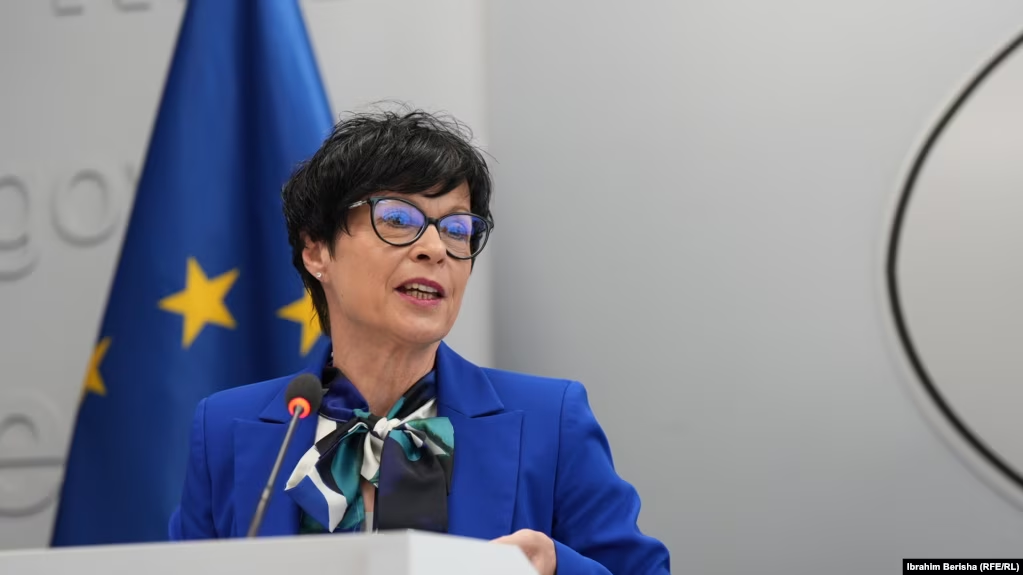
On her way into a meeting of EU foreign ministers in Luxembourg, Marta Kos stopped for the cameras and named one country. Kosovo’s amendment of the law on the Specialist Chambers, she said, “goes against Kosovo’s fundamental commitments to the EU.” She called it unacceptable. Changing the rules while a case is still before the judges, she said, defies every recognised standard of the rule of law.
Then came the price. As RFE/RL reported her words, enlargement is moving forward, and candidates who go backwards are on the wrong road and will not become members. The warning was addressed to candidates. The only country she had named is not one.
Kosovo applied on 15 December 2022, and the Council has never asked the Commission for an opinion on the application. Kos knows where the file sits. In February 2025 she and Kaja Kallas put in writing that the Commission will write its Opinion when the Council asks.
In the same remarks she turned to peace in the region. International law matters in the Western Balkans, she said, because after the death of a war criminal nationalist tendencies have returned, and the region has seen where they lead. She did not say his name. RFE/RL’s Balkan service supplied it in square brackets: Ratko Mladić. In the published accounts she did not name the state either.
That state is a candidate. Serbia got the status in 2012, opened negotiations in 2014 and has 22 of 35 chapters open. Mladić, convicted of genocide at Srebrenica, died in detention in The Hague on 27 August. He was buried in Belgrade with an honour volley, in the presence of Serbian officials, the leadership of Republika Srpska, the Serbian Orthodox Church and the Serbian Army. Brussels said then that glorifying convicted war criminals was unacceptable. It is the word Kos chose on Monday for a vote in Kosovo’s parliament.
She also stressed, by European Western Balkans’ account, that strategic alignment with the Union counts for more and more. Kosovo applies the EU’s sanctions on Russia. Serbia refuses them, and holds the status Kosovo is waiting for.
Edward P. Joseph of Johns Hopkins University made the comparison two days before she spoke. In an interview published in Albanian by Gazeta Express on 10 October, he said Brussels should have raised its objections to the law in private. It had done nothing concrete, he said, about a state-backed funeral for the worst war criminal of the Balkan wars, in a country that is a candidate for membership. The sentences on the four, he added, were grossly out of proportion to those the Hague tribunal gave for far graver crimes.
Kosovo did make a commitment. The Chambers rest on an exchange of letters in 2014 between President Atifete Jahjaga and Catherine Ashton, ratified by the Assembly. The EU has paid close to 400 million euro for the court. On 16 September the court convicted four former KLA leaders at first instance. On 6 October, with the appeal still open, the Assembly voted in second reading to narrow its jurisdiction. Brussels is entitled to object, candidate or no candidate. Kosovo’s own Prime Minister called the amendments rushed.
A commitment runs in two directions. Kosovo has kept the court for eleven years. It saw a president resign to face it. It has now watched four of its wartime leaders sentenced, at first instance, to 81 years between them, Hashim Thaçi to 25 for war crimes. The Hague tribunal convicted Serbia’s and Yugoslavia’s senior officials of crimes against humanity for driving hundreds of thousands of Albanians out of Kosovo in 1999. None of them left it with as much: Nikola Šainović 18 years, Nebojša Pavković 22, Vladimir Lazarević 14. In return Kosovo sent Brussels one letter, and the Council has not yet asked anyone to read it.
A country outside the queue passed a law and was told what it would cost. A country inside the queue gave state honours to a man convicted of genocide, and on Monday was not so much as named.
Kos is right that candidates who go backwards should not join. She could start with one that is a candidate.
