No inspector in Kosovo can forbid a candle. Srpska Lista invented one for an audience that had just refused to work with it.
By the Editorial Board | 23 November 2026
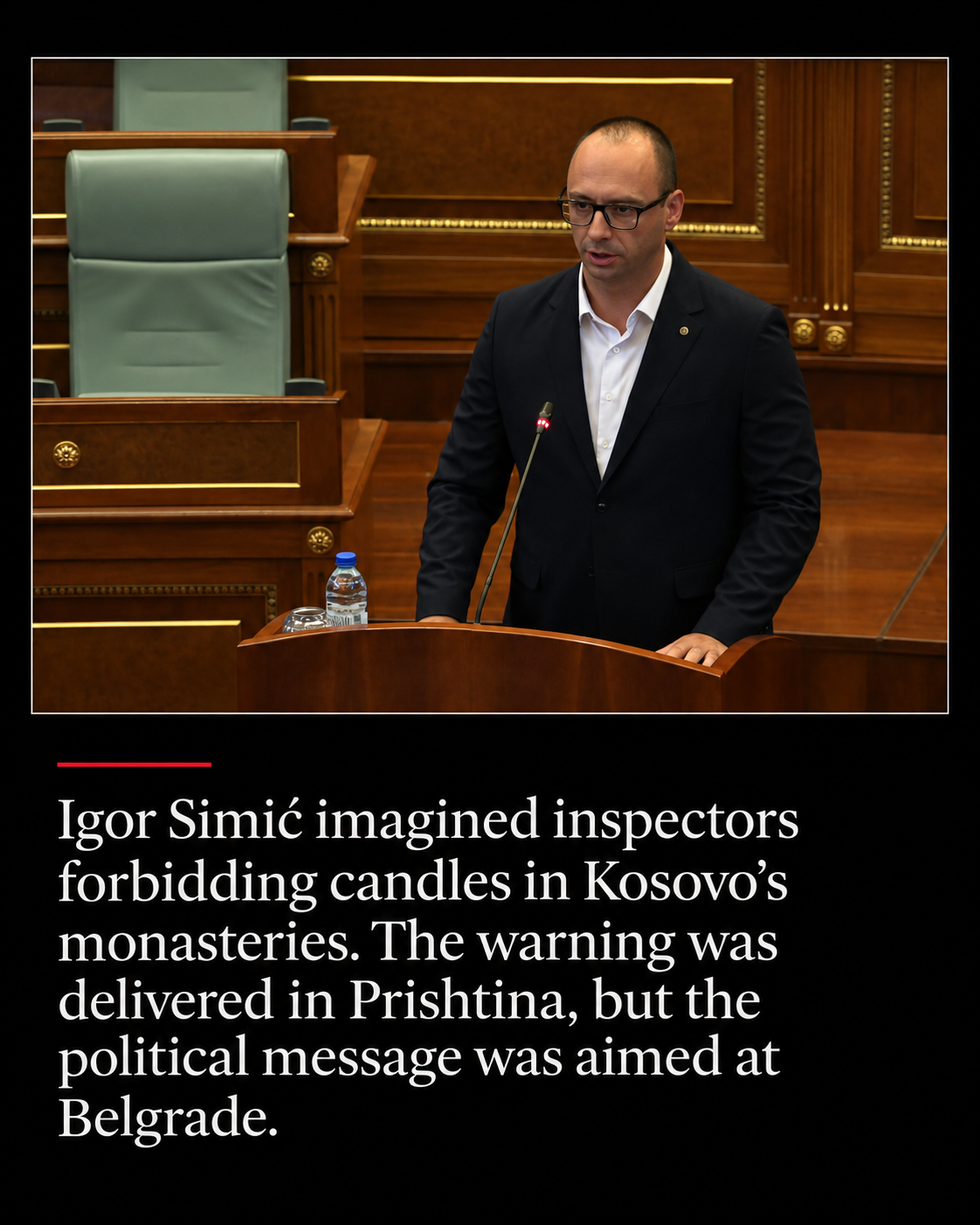
In the small hours of 20 November Igor Simić, who leads Srpska Lista's deputies, asked the Assembly of Kosovo to picture a scene. An inspector walks into a monastery and tells the monks they may not light candles, because candles damage cultural heritage, or may not serve the liturgy, because a crowd endangers the frescoes. Later that day his colleague Jovana Radosavljević said that the Church, the holy sites and "our survival here" (naš opstanak ovde) were under attack.
The draft before the Assembly turns an existing department into an agency. Kosovo employs two heritage inspectors for the whole country, and their business is building works and permits. The one time Radosavljević could cite an inspector at a monastery, at Graçanica (Gračanica) this year, the inspector stopped a monks' residence begun without the heritage institutions' consent; the papers were put in order and the building went on. No article reaches a candle. The scene is nonsense, and it is fearmongering. The draft does raise a constitutional question, about the majority it needs, and our Legal Desk has set it out. Srpska Lista raised that one too.
Then it lit the candle.
By the time Simić spoke, the leaders of the LDK, PDK, AAK and Vetëvendosje groups had declared for the draft, which passed by 62 votes to 8. Srpska Lista holds nine seats, one fewer than a referral to the Constitutional Court requires.
Nearly four weeks earlier, on 25 October, the party Srpska Lista had campaigned for lost Serbia's election; we reported at the time that the list had delivered it three votes in four at the Kosovo polling stations. Four days later Jugoslav Gašić of the winning Student List told Radio KIM there would be no cooperation with Srpska Lista, which he called the "contractor" (izvođač radova) of Vučić's party, its people preoccupied with what would become of them. On 7 November he said it again and announced a review of how Serbia's financial aid is distributed.
On Friday 20 November, the day of the vote, Srpska Lista announced that it would draft its amendments in coordination with the Diocese of Raška and Prizren. On Saturday the Diocese spoke. Its statement supports professional oversight of heritage and lists what the draft leaves out. It asks for consultation or a safeguard clause, and it warns of "consequences far more serious than restrictions on the Church's activities". On Sunday the Student Movement, whose list is about to govern Serbia, published its concern about the law, complained that the Church was not consulted, called on the international community to monitor, and placed the vote in the Assembly of the "so-called state of Kosovo" (tzv. države Kosovo). It left out the candles and kept the complaint.
Srpska Lista was making its pitch to the people who had ruled out working with it. It could not approach them directly. The Student List has one interlocutor in Kosovo, the Church, the only institution its delegation called on during its first trip this month. Nobody on the outside can say whether the Student Movement spoke on Sunday because of Srpska Lista or because of the Diocese. Srpska Lista announced the coordination before the Diocese spoke, and within a month of being called a contractor it had its issue on the agenda of the people who called it one. It had picked a subject on which they would not stay silent, and so forced their hand.
The Diocese played along, and it did not need to. Its questions were legal ones, with a second reading still ahead in which to put them. It put them in Srpska Lista's company and on Srpska Lista's timetable. The cost falls on the Serbs of Kosovo, told once more by their own representatives that their survival is at stake.
Nobody in Kosovo has forbidden a candle. The one lit in the Assembly on 20 November was meant for Belgrade, and Gašić's "no cooperation" now has to outlast it.