The West has spent 2026 defining Russia and China as strategic threats. Serbia read the assessments, read the silences that followed them, and learned what the words cost.
By Ngadhnjim Brovina | 27 August 2026
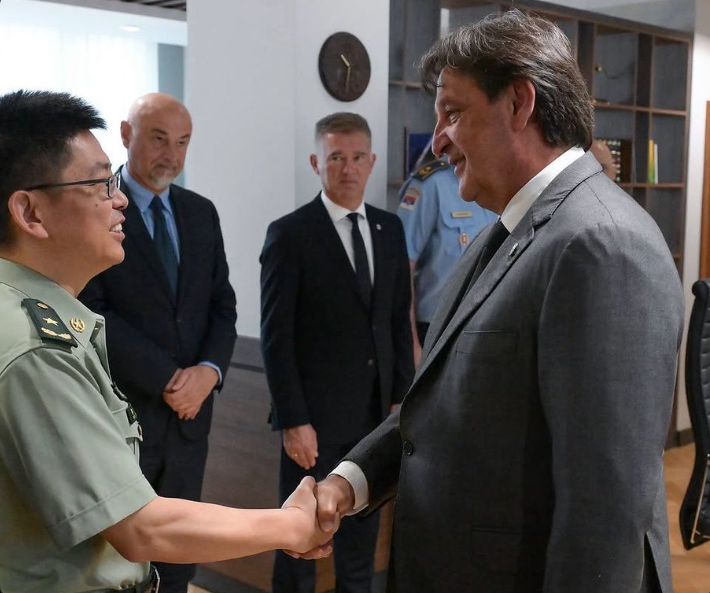
On 24 August, in a meeting room of the Serbian defence ministry, Bratislav Gašić sat across a table from Major General Guo Hongtao, deputy chief of the International Military Cooperation Department of China's Central Military Commission. Chinese and Serbian flags stood behind them. The occasion had a number: the second session of the two countries' Subcommittee for Cooperation on Military Matters. The same day, in Moscow, Serbia's deputy foreign minister for security policy, Miloš Jončić, met Sergei Ryabkov, the Russian deputy foreign minister whose portfolio is arms control and strategic stability. Jončić stayed on. The next day he sat down with Ryabkov's colleague Dmitry Lyubinsky, and the Russian foreign ministry's readout recorded an agreement to develop "the practice of regular consultations and close contacts in the field of combating international terrorism and other security challenges, both in the bilateral format and on key international platforms."
Two capitals, one deputy minister, a general from the Central Military Commission, and a numbered session. It was, by the standards of Serbian foreign policy, an ordinary week. What makes it worth examining is the year in which it took place, because 2026 has been an unusually productive year for Western threat assessment, and the August calendar reads differently once you set it against the documents.
Consider the record, in order.
On 18 March, the Office of the Director of National Intelligence in Washington released the 2026 Annual Threat Assessment, presented to the Senate by the DNI with the directors of the CIA, DIA, FBI, and NSA beside her. The document's central analytical claim treats China, Russia, Iran, and North Korea as coordinated and mutually reinforcing adversaries. It names China the primary strategic competitor. It assesses that China and Russia are "developing advanced delivery systems meant to be capable of penetrating or bypassing US missile defenses," within a threat picture the intelligence community expects to grow from more than 3,000 missiles capable of reaching the American homeland today to more than 16,000 by 2035.
On 20 May, in Beijing, Xi Jinping and Vladimir Putin answered the American document with one of their own: a Joint Declaration on Advocating a Multipolar World, issued alongside more than forty bilateral agreements and an extension of the 2001 friendship treaty, in the thirtieth year of their strategic partnership.
On 26 May, Ursula von der Leyen stood in Lithuania and described families sheltering and schools closing under air raid alerts on the territory of the European Union. "This is a deliberate strategy from Russia trying to destabilise our democratic societies," she said.
On 18 June, the European Council adopted conclusions stating that Russia's war of aggression against Ukraine remains "an existential challenge for the European Union." The same conclusions condemned the incident of 29 May, in which a Russian drone carrying explosives crashed into a residential building in Romania, noted the repeated violations of member states' airspace, and called for Europe's defence readiness to be decisively ramped up by 2030.
In July, the Union updated its formal assessment of its strategic environment for the first time since 2022. The document, endorsed by member state ambassadors on 8 July and adopted at the Foreign Affairs Council on 13 July, retires the 2019 formula that treated China as simultaneously a partner, a competitor, and a rival. The adopted text describes China as "a critical long-term strategic challenge" and as "a crucial enabler for Moscow" in the war against Ukraine.
Behind the documents stands money. European defence spending in 2025 ran close to eighty percent above its level before the full scale invasion; the Union is mobilising up to 800 billion euros under its readiness programmes; the High Representative told the European Defence Agency's annual conference that it has become "painfully clear that Russia will remain a major security threat for the long term," itemising the cyber attacks, the sabotage of critical infrastructure, and the interference campaigns the Union is fending off while it rearms.
That is the shelf of 2026. Serbia's August week belongs on it, because the meetings in Belgrade and Moscow were held with precisely the two states these documents describe, and because the Serbian side documented its own understanding of the relationship in its own ministry's prose.
The defence ministry's readout of the Gašić meeting states that procurement of arms and military equipment from China has "resulted in significant improvement of the operational capabilities of the Serbian Armed Forces" and constitutes "a strong basis for further development" of the military relationship. It confirms that a third session, this one of the subcommittee for cooperation in military equipment and technology, will be held before the end of the year. And it records the political price list. Serbia's defence minister, per his own ministry, "izrazio zahvalnost kineskoj strani na međunarodnoj podršci koju pruža Srbiji po pitanju statusa AP KiM": he expressed gratitude to the Chinese side for the international support it provides Serbia on what Belgrade files, under the acronym of its annexation vocabulary, as a status question internal to itself. The acronym in that sentence is doing the work the weapons are paid for. Beijing's support consists of blocking Kosovo's international standing; Belgrade's reciprocity, stated in the next breath, is continued fidelity to the One China principle; the procurement relationship sits inside that exchange as its material expression. No analyst inferred this structure. The ministry published it.
A defender of Serbian policy will object that Belgrade also buys French. Twelve Rafales are on order; the balance, the argument runs, is the policy. The objection deserves to be taken seriously, because it identifies the correct test. A hedge preserves the ability to leave. An aircraft purchase, even a large one, is a transaction that ends. What Serbia built in August is machinery that does not: a subcommittee holding its second session with a third scheduled, and a commitment to Moscow phrased as a "practice of regular consultations," which is the language of standing structure. Serbia already operates the Chinese FK-3 and HQ-17AE air defence systems; Serbia's president confirmed in June that the HQ-9 long range system will follow, making Serbia its first European operator; the country is, alongside Belarus, the only buyer of advanced Chinese weapons on the continent, with some 240 million euros of imports in two years. Long range air defence is an integration decision. It arrives with radars, datalinks, training pipelines, technicians, and a maintenance dependency measured in decades. The Rafale is compatible with leaving. The architecture is designed for staying. The objection, followed to its end, dissolves the hedging thesis it was meant to support.
So a classification problem remains. Hedging has failed its own test. Defiance does not fit either, because defiance is priced, and Serbia has been charged nothing: accession funds flow, growth plan disbursements proceed, and the candidacy continues undisturbed. The Commission's most recent enlargement report, adopted in November, records Serbia's alignment with the Union's foreign policy positions at 63 per cent, a figure improved from the year before partly through retroactive alignment with decisions the Union had adopted long since, in a region where fellow candidates routinely align in full; the Commission's own accompanying communication calls the rate low and its significant improvement a condition of advancing. A state cannot defy a consequence that does not exist. The next report is due this autumn. It will be drafted by officials who can read the defence ministry's August readout in the original.
What fits is reading. Serbian policy in 2026 is the product of close reading, and the texts it reads most attentively are the West's own. The reading has nothing scholarly in it; a housebreaker also studies floor plans, and studies them closely. Belgrade has read the Annual Threat Assessment, the June conclusions, the July strategic environment assessment. It has read them accurately, which means it has read them as descriptions to which no policy is attached. It has also read the silences. NATO's Washington declaration of 2024 named China "a decisive enabler" of Russia's war. The alliance's declarations at The Hague in 2025 and at Ankara this July do not mention China at all; the Ankara text confines itself to "the long-term threat Russia poses to Euro-Atlantic security and stability." Why Beijing disappeared is a question for the alliance to answer; that it disappeared is on the record. Belgrade noticed. When the institutions that wrote "decisive enabler" cannot agree two years later whether the enabler belongs in their communiqué, a careful reader is under no obligation to resolve the disagreement. He prices it. The month after the Ankara declaration was published, the subcommittee held its second session. Nothing in the alliance's text stood in its way.
Reading, though, is only the method, and the method launders nothing. The consultations Jončić agreed in Moscow are with the state whose drone the June conclusions condemn for crashing into a Romanian apartment building, whose deliberate strategy von der Leyen described from Lithuania, whose sabotage of critical infrastructure the High Representative itemised. The subcommittee Gašić co-chaired serves the power the Union's adopted assessment names as that state's crucial enabler. Belgrade did not stumble into those rooms while reading. It chose the rooms, in the year the documents were at their clearest, and the choice preceded the impunity: Serbia wanted these patrons before it confirmed they came free. What the gap in Western policy explains is the price Belgrade paid, which is nothing. It does not explain the appetite.
There is a name for trading on the distance between what an institution says and what it does, and the name is not diplomacy.
The cost of the distance does not fall on its authors. It falls where the exchange settles, and the Gašić readout identifies the settlement currency by name. Every year the July assessment's "crucial enabler" faces no consequence for enabling, the support Belgrade thanks Beijing for continues; every renewal of "regular consultations" in Moscow renews the veto that meets Kosovo at the Council. The distance between the Union's documents and the Union's disbursements is not an abstraction in Prishtina. It has a length, and Kosovo lives along it.
An unenforced assessment does more than fail to deter. It instructs. It taught Belgrade that the words are the whole of the policy, and Belgrade has built standing institutions on the strength of the instruction. Serbia sits in the front row of that classroom. The seats behind it are not empty.
Ngadhnjim Brovina teaches political science at UBT in Prishtina. He writes on enlargement, conditionality, and the institutional politics of the Western Balkans.
