Croatia's warnings about Serbia's rearmament are being read as commentary on a procurement list. They should be read for what they are: a neighbor's intelligence surfacing, one calibrated sentence at a time, on a schedule that is itself the message.
By Albatros Rexhaj | 27 August 2026
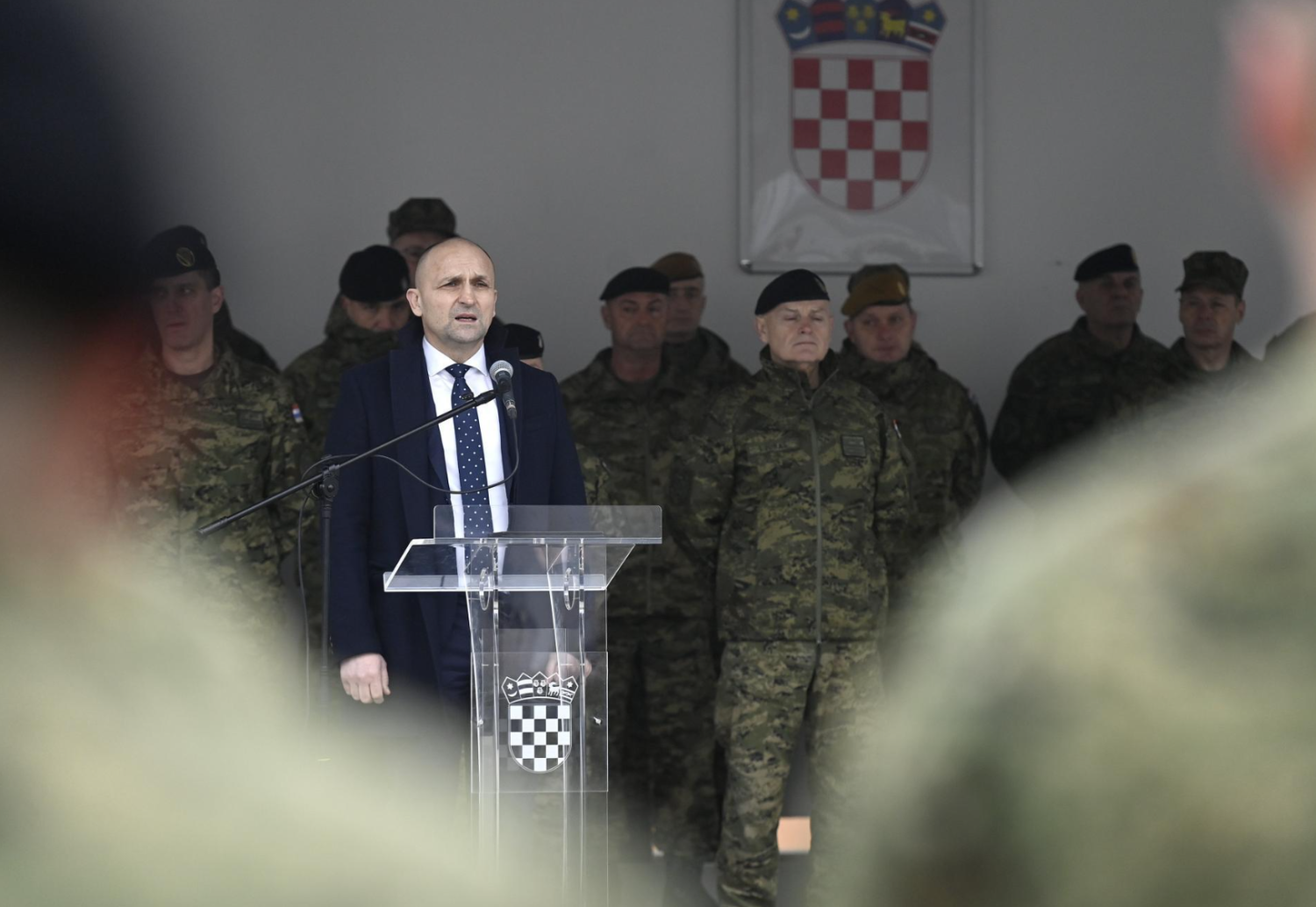
On Tuesday, 25 August, at the annual conference of Croatian ambassadors, consuls and military envoys in Zagreb, the speaker of Croatia's parliament said this: "Serbia is arming itself not only with defensive weapons, but with offensive ones, attack weapons," ofenzivnim, napadačkim in the original, the adjective doubled so nobody could miss it. "And that must be said to our Western allies. There is no running from it." Croatia's defence minister, Ivan Anušić, went further: "We must inform and familiarize our partners with this situation so that political pressure is exerted on Serbia." The EU's enlargement commissioner, Marta Kos, was at the same conference, and most of the coverage treated the remarks as one more round of commentary on Serbia's well publicized arms purchases.
I think that misreads the genre. Listen to the verbs. Anušić requested a briefing, which is a different act from offering an opinion. Informing and familiarizing partners is what a government does with a file, and nobody schedules briefings on material the allies can read in the defence press. Jandroković's sentence carries the mark of a disclosure decision, the phrasing of a man at the end of an internal argument about whether to keep saying this only behind closed doors. There is no running from it. And the pattern is not new. In July, after the Ankara summit, President Zoran Milanović told reporters that Serbia's purchases were established by data he would not further describe, that the hypersonic systems Belgrade has confirmed are "only one part of the picture," and that "there is more." He also said he had raised all of it in the closed format first. A state that knows only what the newspapers know does not talk like this. It does not ration.
No member of the alliance reads Serbia the way Croatia does. One language, a shared century, and intelligence services that were a single Yugoslav service within living memory and have been built against each other since the wars of the 1990s, watching without pause. Jandroković said as much himself, diplomatically: Western political elites often no longer understand the former Yugoslav space or remember the Greater Serbian politics of Slobodan Milošević. Translated, we can read this and you cannot. I cannot see the Croatian file, and I will not pretend to know its contents. The evidence is the public language, its verbs, its rationing, and above all its timing.
Because intelligence does not surface at random. Governments hold assessments quietly for as long as the scenario they concern stays distant, and they start spending them when it approaches. So mark the calendar of Zagreb's escalation. Strange, in July. Offensive, attack weapons, brief our partners, on 25 August. And mark what the 25th of August was: the day an American C-17 landed in Moscow carrying CIA director John Ratcliffe, who spent roughly eight hours delivering a warning in person, no escalation against the Baltic states, amid American assessments, reported by the Wall Street Journal and Politico, that Russia may attempt to probe NATO's eastern flank as early as this autumn. Two services, reading the same clock, moved on the same day. Washington warned about the flank Russia may test. Zagreb warned about the flank that becomes valuable to Moscow the moment it does. Croatia stopped rationing when the season started. That is not coincidence. That is convergence.
So let us not fool ourselves about what the file describes, because the unclassified record describes it too: four years of refused sanctions, a decorated service channel to Moscow, strike systems no neighbor requires deterring, and Serbia's president counting aloud the pace at which the world order loosens. Serbian neutrality is a peacetime arrangement, and it is priced accordingly in Belgrade. In a continental conflict, the neutrality act drops, and Serbia assumes the role for which it has been arming all along: the external military wing of Russia, the armed weight behind the alliance's southern shoulder, fixing NATO's attention and air defence at the exact hour they are needed in the north, and holding open a second emergency, in Bosnia or against Kosovo, at Moscow's most useful moment. I state that as my assessment, and I have yet to hear the rival explanation that survives the record.
On the northern file, the warning got an aircraft to Moscow. On the southern file, the neighbor holding the warning is still asking for the meeting. Croatia has told the alliance it has seen something, and that the time to hear it is before autumn. Somebody should ask to see the file. Nobody should be surprised by what is in it.
Albatros Rexhaj is an author, playwright, and analyst with a background in national security studies and nearly three decades of experience in political and security affairs. You can write to the author at [email protected].
