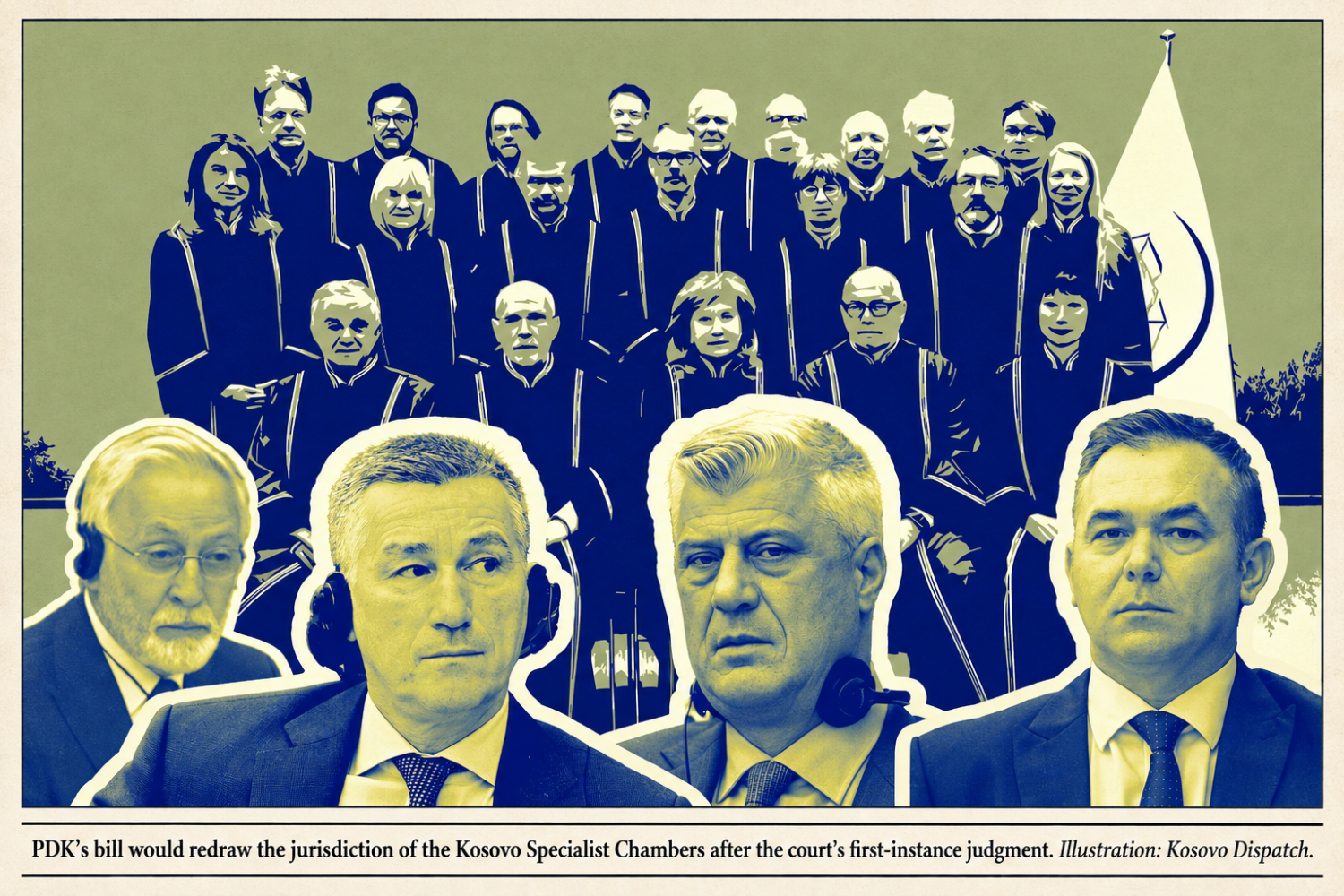
Whether the Assembly can amend or revoke the Law on the Specialist Chambers, what the PDK bill would do if adopted, where it can be challenged, and who decides
Kosovo Dispatch Legal Desk | 22 September 2026
PDK filed its draft law amending Law 05/L-053 on 21 September. Kosovo Dispatch has read the deposited text, in Albanian and English, and the explanatory memorandum that accompanies it. Where this briefing quotes the bill, it quotes the bill's own English.
Bedri Hamza said PDK has 22 signatures and needs 40 for an extraordinary session. Aleanca, with seven deputies, supports the initiative. LVV, with 53, replied the same evening that the Constitutional Court must first rule on the constitution of the Assembly, that the bill will be examined for its effects on the appeal, and that each of the four defence teams has its own strategy. LDK has no official position; its deputy Avdullah Hoti proposed instead a new Assembly resolution on state engagement during the appeal. Vlora Çitaku then offered to withdraw PDK's two Constitutional Court cases if LVV publicly commits to vote the bill, cover the defence costs and treat the process as a matter of state.
The XI Legislature was declared constituted on 13 September and the Kurti 4 government was elected the same day with 62 votes. PDK's challenges to both acts are pending. Until the Court rules, the Assembly is a functioning legislature; a bill can be introduced, sent to committee and voted. If the Court later finds a defect in the constitutive process, the fate of laws adopted in the meantime will depend on the remedy it chooses.
Amend, yes. Revoke, no.
Article 162(1) of the Constitution says the organisation, functioning and jurisdiction of the Chambers are regulated by that article and by a specific law. The specific law is Law 05/L-053. Deputies have legislative initiative under Article 79 and an ordinary law passes by a majority of deputies present and voting under Article 80. The two-thirds thresholds of 2015 applied to the constitutional amendment and to the ratification of the 2014 agreement, not to the Law. Nothing in the Constitution immunises Law 05/L-053 from amendment.
Revocation is a different matter. Under Article 162(13) and (14) the mandate continues, absent a notice of completion under Law 04/L-274, until the Council of the European Union gives that notice. An Assembly vote cannot substitute for it. The Specialist Chamber of the Constitutional Court said as much on 26 November 2020 when it struck down President Thaçi's proposed amendments to those two paragraphs, which would have ended the mandate on 3 August 2020: the proposals diminished the rights guaranteed by Chapter II, and the mandate "has continued and shall continue" until the Council's notification. Enver Hasani, former president of the Constitutional Court, made the same point in December 2017, when 43 deputies of the governing coalition asked for an extraordinary session to abrogate the Law: the Law cannot be abolished without revoking the constitutional amendment, and Kosovo cannot abolish an international obligation. That session never convened. The Assembly Presidency twice failed to reach quorum after LDK, Vetëvendosje and Srpska Lista stayed away, the State Department said the United States expected Kosovo to leave "the authorities and jurisdiction of the court unchanged," and the Commission's 2018 report recorded the attempt as raising serious concerns about Kosovo's commitment to its obligations.
So the question is which provisions the Assembly can change by ordinary law, and what happens to the changes when they meet the texts that sit above the Law.
What the judges said in 2021, and what the bill says back
On 23 December 2021 the Appeals Panel rejected the defence argument that the Chambers' jurisdiction was confined to the specific allegations in the Marty report. Article 6(1) of the Law requires a relation to the report, not identity with its case studies; a "mere relation" suffices. The Panel reasoned that the Assembly could have expressly limited jurisdiction to the report's allegations, but chose broader personal, territorial, temporal and subject-matter limits, and did so after the EU task force had said publicly that its investigation extended beyond organ trafficking and detention in Albania. It held that the report must be read as a whole, that its case studies cannot be separated from the events in Kosovo that belonged to the same conflict, and that the charges and the report share crucial common features. And it rejected the argument that charges beyond the report's findings turn the Chambers into an extraordinary court prohibited by Article 103(7): the Constitutional Court in KO26/15 had upheld the Chambers as a specialised court because of their specifically defined scope of jurisdiction.
The bill's memorandum builds its constitutional theory from those same sources and inverts them. It reads KO26/15 as requiring a jurisdiction "specified in relation to" the report, cites the Constitutional Chamber's decision of 13 June 2022 in Thaçi's own referral for the proposition that the Law's jurisdiction is wider than the report's allegations and that the drafters could have limited it expressly, and concludes that narrowing is therefore "not merely within the discretion of the Assembly but a constitutional obligation." The bill's Article 1 states its second purpose as preventing "the institutional degradation of the Specialist Chambers into an extraordinary court, which is prohibited under Article 103(7)." That is the Article 103(7) argument the Appeals Panel rejected in 2021, now put to the Assembly as a legislative premise. The memorandum's factual premise is that the 16 September judgment, which it at one point attributes to "the Constitutional Chamber," "criminalises not only certain individuals but the entire Kosovo Liberation Army." The judgment convicted four men of war crimes and acquitted them of crimes against humanity.
No court has said whether a later Assembly may redraw the jurisdiction around proceedings that have reached first-instance judgment. The 2021 Panel said the Assembly could have drawn the line narrower in 2015. It did not say the Assembly could redraw it around men already convicted.
Three texts above the Law
The first is Article 162 itself, which opens "notwithstanding any other provision of this Constitution." It binds the Chambers to Chapter II rights and to Articles 22 and 55. It creates a Specialist Chamber of the Constitutional Court of three international judges that decides "exclusively" on Article 113 referrals concerning the Chambers and the Specialist Prosecutor's Office. It says convicted persons "may" serve their sentences in a third state. And it ties the end of the mandate to the Council's notification.
The second is the Exchange of Letters of 14 April 2014 between President Jahjaga and High Representative Ashton, ratified by the Assembly nine days later as Law 04/L-274 with the letters annexed as an integral part of the Law. Article 19 of the Constitution gives a ratified agreement superiority over ordinary law. The letters were concluded on the EULEX mandate and carry the specialist-court commitments inside them. Jahjaga, invoking Articles 17, 18, 19 and 20 of the Constitution, committed Kosovo to a specialist court within its own system for "any trial and appellate proceedings arising from the SITF investigation"; to a seat in Kosovo with "sensitive proceedings, including hearing of witnesses" held outside the country and "filings and sensitive records" introduced and maintained "exclusively outside the country"; to dedicated chambers relocated to a third state and including "all levels of the court system, including the Constitutional Court"; to structures governed by their own statute "including provisions on the limitations on the issuance of pardons, detention on remand and the service abroad of sentences of imprisonment"; and to structures "staffed with and operated by EULEX international staff only." The letter also undertakes "consultations in the process of amending laws having an impact on the discharge of EULEX KOSOVO mandate as well as for the judicial proceedings arising from SITF investigation." Ashton's reply confirms that the task force's work "and any judicial proceedings deriving from it shall continue until such time as the Council of the European Union notifies Kosovo" that they are concluded.
That consultation clause is an obligation to consult while a law is being amended. It is not a veto over a vote in the Assembly. But the Constitutional Chamber went further in 2020, reading Article 162(13) and (14) as making the obligation a constitutional requirement of Kosovo's legislative process, and describing its omission that year as a procedural deficiency. The bill's memorandum has a section headed "Consultation (who was consulted and brief summaries of the responses)." It is empty.
The third is Law 05/L-053. It is lex specialis and prevails over any contrary provision of any other law. It makes the Constitutional Chamber "the final authority for the interpretation of the Constitution as it relates to the subject matter jurisdiction and work" of the Chambers. It forbids the government or authorities of Kosovo from subjecting the Chambers, their judges and staff to "any measure or action that may impact the free and independent exercise of their functions." It makes their archives and records immune from interference "whether by executive, administrative, judicial or legislative action," keeps them in a dedicated repository outside Kosovo and declares them inviolable wherever located. And it requires any residual arrangement, once every judgment is final, to be fully internationalised and outside Kosovo. The bill amends Articles 59, 61 and 62. It does not touch Articles 52 or 60.
What the bill does
The bill rewrites Article 6 so that the Chambers have jurisdiction "strictly and only to the extent that such crimes consist exclusively and directly of" organ extraction, removal and trafficking "as specifically identified and alleged" in the report, or killing, torture and cruel treatment "at the specific detention sites expressly identified" in the report and "in direct furtherance of, or in immediate connection with, the organ harvesting operations." A new paragraph 1A removes jurisdiction over "general war crimes, crimes against humanity, or political violence committed in Kosovo" that are not "an immediate and constituent element" of those acts, and says the broader conflict "shall not establish or confer jurisdiction." Temporal jurisdiction runs "strictly between 1 July 1999 and 31 December 2000." Territorial jurisdiction is confined to acts commenced or committed in Kosovo, with extraterritorial reach only where personal jurisdiction exists and the act has "a concrete link to the Report."
It inserts a review mechanism. At any phase, on application or ex officio, the judge or panel must decide within 15 days, or 30 with a hearing, whether the charges fall within the new Article 6, and if not "shall immediately declare its lack of jurisdiction ... and order the termination of the proceedings." A party dissatisfied with that decision, or faced with silence, "shall have the right to file an appeal with the Supreme Court of the Republic of Kosovo in Pristina," which "shall issue a final decision on the question of jurisdiction within fifteen (15) days." Terminated cases go to the Special Departments in Pristina and the Special Prosecution; the Registrar has 30 days to inventory and transfer "all original case files, evidence registries, physical materials, interview transcripts, and court records" and to transmit "all active witness protection orders, identities, and protective classifications" to the Kosovo Police and the Special Prosecution. Detainees are transferred within 15 days and brought before a Kosovo judge within 48 hours of arrival; the Chambers' detention orders lapse 30 days after the file arrives. A new Article 10D, "Application to existing proceedings," requires every case to be reviewed within 30 days of entry into force, severs mixed indictments, and provides that "where a non-final decision has been rendered and lack of jurisdiction is established regarding part of the charges, that portion of the decision shall be vacated."
It caps sentences at 15 years "in accordance with the principle of applying the more lenient law." It provides that sentences "shall be served in a correctional institution of the Republic of Kosovo." It provides that "notwithstanding the provisions of Law No. 03/L-101 on Pardon," persons convicted by final judgment "shall be eligible for an individual pardon" by the President, with that Law's criteria and procedures applying. It limits the Chambers' primacy to matters within the new jurisdiction, and lets the Supreme Court Specialist Chamber request transfer of an extraordinary remedy "only when directly connected to a case falling within the jurisdiction established by this Law." It amends the archive provisions so that certified files are delivered to the receiving Kosovo authority and originals "shall be transferred when permitted by law, international agreements, protective orders, and the conditions of the material provider," while "inviolability and protective measures ... shall continue to apply regardless of their physical location." It authorises the Presidency of the Assembly, by its own act, to appoint international organisations to monitor the Chambers, with access to "confidential materials, protected evidence, personal data, information concerning protected witnesses or materials from closed proceedings ... to the extent necessary," reporting to the Assembly.
Its Article 23 provides that "notwithstanding Article 49," the Constitutional Chamber "shall have jurisdiction solely and exclusively over constitutional referrals arising from decisions, orders or judgments" of the Chambers and "shall have no jurisdiction to conduct an abstract (preliminary), concrete or incidental review of the constitutionality of any law, including Law No. 05/L-053," and that review of the amending law itself "shall be conducted by the Constitutional Court of the Republic of Kosovo, sitting in its regular composition in Pristina." Article 24 nonetheless keeps amendments to the Rules of Procedure and Evidence under the Constitutional Chamber's review.
Its Article 26 provides that cases pending before a pre-trial judge, trial panel or appeals panel "shall continue to be adjudicated in accordance with the provisions of Law No. 05/L-053 that were in force," and that "this Law shall not apply to the cases referred to in paragraph 1 ... until the Court of Appeals Panel has rendered its judgment." From that judgment, "any appeal, request for protection of legality, or other legal remedy against that judgment shall be filed with and adjudicated by the Supreme Court of the Republic of Kosovo in Pristina, which shall have exclusive jurisdiction," and "the Supreme Court Panel of the Specialist Chambers shall have no jurisdiction over such cases." Its third paragraph: "Notwithstanding paragraphs 1 and 2 of this Article, Articles 15, 16 and 17 of this Law shall apply immediately upon the entry into force of this Law to all persons against whom criminal proceedings are pending and to all persons convicted by the Specialist Chambers, irrespective of the stage of the proceedings or whether the judgment has become final and binding."
The Law enters into force on the day of publication, not the customary fifteenth day after it.
Article 26 against Article 10D
The two provisions cannot both govern the Thaçi case. Article 10D orders a jurisdiction review of every existing case within 30 days and vacates non-final decisions on charges outside the new jurisdiction; the memorandum describes it as applying "immediately" to "all pending investigations, confirmed indictments, trials and appellate proceedings." Article 26 says the new Law "shall not apply" to pending cases until the Appeals Panel judgment; the memorandum describes that too. The new Article 10(4) is expressly "subject to the transitional provisions," though the bill cites them as Article 22, which is the monitoring clause; Article 10D carries no such qualifier.
On ordinary rules of construction Article 26 is the specific transitional rule and the later provision, and its words "this Law shall not apply" reach Article 10D. On that reading the four men stay in The Hague through the appeal under the present jurisdiction, and Article 10D bites only on retrial and on cases at earlier stages. The memorandum's own account of Article 10D says otherwise. The panels would have to resolve the conflict, and the defence would be entitled to argue either side of it, which is presumably why LVV said on Monday that each defence team has its own strategy.
Whichever reading prevails, three provisions reach the four men at once. Article 26(3) applies the 15-year cap, Kosovo imprisonment and pardon eligibility to everyone in proceedings or convicted, final or not. The cap therefore reaches Thaçi and Krasniqi at 25 years and Veseli at 18 immediately. Article 16 would apply immediately also to the final sentences of Pjetër Shala and Salih Mustafa, both serving abroad; physical transfer would still depend on the enforcement-state and host-state arrangements.
Provision by provision
Narrowing the crimes, the dates and the territory is within the Assembly's competence on the constitutional text. Nothing in Article 162 fixes 1 January 1998, lists the offences Article 6 must contain, or extends jurisdiction to Albania; it is Article 9(2) of the Law that reaches crimes against Kosovo nationals "wherever those crimes were committed," which is what brought Kukës and Cahan in. The consultation obligation attaches during the amending process, as a treaty term and, on the 2020 reading, as a constitutional one. The memorandum records no consultation.
The review mechanism, the transfer commands and Article 10D are a different kind of act. A prospective change to what a court may hear is legislation. A command that a court already seised review and surrender pending cases on a legislative timetable, a right of appeal on that question to a Kosovo court that "shall issue a final decision," and a statutory vacating of a judgment already delivered, operate on adjudication in progress and on judicial decisions. They engage the Law's bar on measures that impact the Chambers' independent exercise of their functions, which the bill does not amend; the separation of powers; the fair-trial rights of accused, victims and protected witnesses; and the Constitutional Chamber's final word on subject-matter jurisdiction, which the bill removes in words but cannot remove from Article 162(3). The 2014 letter's commitment to structures "operated by EULEX international staff only" is in direct conflict with a Pristina panel deciding the Chambers' jurisdiction; whether that commitment binds only the specialist structures or also precludes legislative transfer into the ordinary judiciary is one of the questions the Constitutional Chamber would have to decide. A legislature vacating a non-final criminal judgment by statute, for jurisdictional reasons the same legislature has just invented, is the provision the Constitutional Chamber would measure most severely against its 2020 reasoning on the uninterrupted operation of the mechanism and the rights of the parties before it.
Moving post-appeal remedies to the Supreme Court of Kosovo has no single constitutional sentence against it. The bill has done more work here than the press reports showed: it amends Article 54(4) so that the Chambers' Supreme Court panel can no longer pull an extraordinary remedy back to itself, and it amends Articles 59, 61 and 62 so that certified files and, conditionally, originals can go to Pristina. What it leaves standing is Article 52(2), which immunises the archive from legislative interference; Article 60, which requires a fully internationalised residual mechanism outside Kosovo; and the ratified letter, which promises sensitive records "exclusively outside the country." A request for protection of legality under Article 48(7) must allege a violation of the criminal law "contained within this Law" or of the Chambers' own Rules, so a Pristina panel would be adjudicating breaches of a statute and a rulebook it did not write. Reopening under Article 48 turns on new evidence, which means witnesses, whom the letter put outside the country for that reason. The bill's own Article 61(3) concedes the limit: originals move only "when permitted by ... international agreements." The agreement does not permit sensitive records covered by that commitment to be maintained in Kosovo.
Returning constitutional review to Pristina is the provision most directly exposed to invalidation. Article 162(3) says the Specialist Chamber "shall exclusively decide" Article 113 referrals relating to the Chambers, and the Chamber relied on that word in 2020 when it took the referral of amendments that concerned itself. Article 3(1) of the Law repeats it. The closing words of 162(3), "in accordance with a specific law," have prompted debate about how far the Law may delimit the Chamber's docket; nothing in that debate supports moving abstract, concrete and incidental review of laws to Pristina by ordinary statute. The 2014 letter had already promised a Constitutional Court level among the relocated chambers. Amending Article 49 does not reach the constitutional sentence; only a constitutional amendment under Article 144, itself reviewed in advance by the same Chamber, could. The bill also closes the door it will need: by stripping incidental review, it would prevent the Appeals Panel from referring the sentencing cap to The Hague and send that question to Pristina instead.
Serving sentences in Kosovo and restoring pardon are feasible on the constitutional text, since Article 162(8) only says convicted persons "may" be transferred abroad and pardon is a presidential power the Law excluded by statute. The bill amends Article 50 and Article 51 and overrides the Law on Pardon by name, so the domestic legislative work is done. What remains is the ratified letter's express commitment to "limitations on the issuance of pardons" and to "the service abroad of sentences of imprisonment." Articles 50 and 51 of the Law are the performance of that commitment. The bill repeals the performance while the commitment stands, and under Article 19 the commitment outranks the repeal. The 48-hour rule presupposes a detainee surrendered by the Netherlands, which holds him under the host-state agreement and not under Kosovo law; the bill's Article 59(2) acknowledges as much by making physical transfers subject to the host state's agreement.
Assembly-designated monitors are the least troubled provision in principle and the most troubled in detail. Detention is already inspected by the ICRC under Article 41(8) and a dedicated Ombudsperson exists under Article 162(11). Observation of hearings is unobjectionable. Access by monitors appointed by the Presidency of the Assembly to "information concerning protected witnesses" and "materials from closed proceedings," and monitoring of "the length of proceedings," are measures by a Kosovo authority touching the exercise of judicial functions and the protection of witnesses, and Article 52(3) marks the limit.
The 15-year cap is the provision with immediate effect on the four men, and Article 26(3) makes the effect explicit. Article 33(4) of the Constitution provides that punishment follows the law in force at the time of the act unless a later applicable law is more favourable; Article 7 of the Convention, as read in Scoppola v Italy, requires the same before final judgment. Article 44(2) of the Law directs the Chambers to "take into account" the sentencing range under Kosovo law at the time and "any subsequent more lenient sentencing range." The Supreme Court Panel held in Mustafa that the Chambers must identify the most lenient relevant Kosovo range and take it into account, and the Constitutional Chamber held in April 2025 that Law 05/L-053 is the only binding sentencing law before the Chambers, other Kosovo sentencing laws being considered rather than applied. A ceiling written into Law 05/L-053 itself is therefore a different object from the 1976 SFRY Code, which allowed 15 years as a general maximum and 20 where the death penalty was prescribed, as it was for war crimes against civilians. The defence will argue the SFRY ceiling on appeal with or without this bill. A statutory 15-year ceiling in force during the appeal would put a lex mitior question before the Appeals Panel that it could not ignore; Ehat Miftaraj of the Kosovo Law Institute made the point on Monday. Two further questions are new. The Albanian text amends paragraph 1 of Article 44; the English text amends "Article 44," which if read literally would delete the sentencing-range and mitigation provisions with it. And Article 26(3) applies the cap to judgments already final, which lex mitior does not require and which would reopen sentences the Chambers' own Supreme Court panel has confirmed. Whether the Appeals Panel treats the ceiling as a subsequent applicable law, and where it can refer the question once the bill has closed the road to The Hague, are open. Adoption would place a live lex mitior question before the panel handling the appeal. Whether it cuts any sentence is that panel's decision.
Where it can be challenged, and who decides
Inside the Assembly the bill goes through first reading, committee and second reading, and passes by a majority of those present and voting. The government was elected with 62 votes; PDK has 22 deputies, Aleanca seven, LVV 53.
On adoption, two doors open within eight days. The President may return the law once for reconsideration under Article 80, after which the Assembly can re-adopt it by a majority of all deputies; the office is held by Speaker Haxhiu as acting President, so the person who signs is the person who chaired the vote. Ten or more deputies may contest the law on substance or procedure under Article 113(5). Under Article 162(3) and Article 49(2) of the Law, that referral goes to the Specialist Chamber of the Constitutional Court in The Hague: three international judges from the roster, assigned by the President of the Chambers, sitting outside the Law on the Constitutional Court and the Pristina court's rules, which the Law disapplies. The bill's Article 23 says the referral goes to Pristina. The Constitution says otherwise, and the Constitution is not amended by the bill. The standard of review is Chapter II and Article 55 and, on the 2020 precedent, Article 162(13) and (14) read together with the ratified letters, consultation clause included.
After promulgation, the Government, the President or the Ombudsperson may refer under Article 113(2), and the Chambers' own Ombudsperson under Article 49(5). A panel of the Chambers may refer under Article 113(8) and Article 49(4) when a law it must apply is of doubtful constitutionality and its decision depends on the answer; that is the route the Appeals Panel could take on the sentencing cap, and on Article 10D if it is held to reach the Thaçi case, if it considers the constitutional question decisive to its judgment. Whether Article 23 of the bill has validly closed that route is itself a question only the Constitutional Chamber can answer, since Article 162(3) reserves it. The accused and the victims may refer individually under Article 113(7) after exhausting remedies. In 2020 the SPO sought and was granted leave to make submissions, and the High Representative and EULEX were invited to submit observations; the Chamber could do the same again.
The circularity is now written into the bill. Its Article 23 removes the Constitutional Chamber's jurisdiction over the constitutionality of the bill. Any challenge to Article 23 belongs, under Article 162(3), to the Constitutional Chamber. If no one refers within eight days and the law enters into force, the statutory clause still cannot displace the constitutional word. The bill cannot choose the court that decides whether the bill is constitutional.
Outside the courts, the EU cannot annul a Kosovo law and has no vote in the Assembly. It holds the consultation obligation, the Council's notification power over the mandate, and the funding and host-state arrangements through which the court exists; under Article 63 the Chambers' budget does not come from Kosovo's, and the memorandum's financial-impact section states that the bill "is not expected to have financial impacts," which will surprise whoever has to house, guard and try the transferred cases in Pristina. In 2017 the abrogation initiative never reached a session; the Assembly Presidency lacked quorum and the United States publicly demanded that the court's authority and jurisdiction be left unchanged.
Answer
The initiative can go through as legislation if it finds a majority. The Assembly is constituted and the Law is not immune from amendment. Adoption is not validity. The narrowing of future jurisdiction concerns a subject the specific law regulates, but its validity would still raise treaty and constitutional questions, including the consultation requirement the Constitutional Chamber treated as constitutional in 2020 and which the bill's own memorandum leaves blank. The pardon and domestic-enforcement provisions run against express commitments in the ratified letters. The transfer of constitutional review to Pristina, including incidental review, is the provision most exposed under Article 162(3). Article 10D, the review mechanism, the Kosovo Supreme Court's final word on jurisdiction and the transfer commands operate on pending adjudication and on delivered judgments, and are the provisions most exposed under the Law's independence guarantee, the 2014 commitment to international staffing, and the 2020 reasoning. The move of post-appeal remedies to the Supreme Court of Kosovo has been drafted more thoroughly than reported, but it leaves Articles 52 and 60 standing and cannot reach the letter's promise that sensitive records stay outside the country; the bill's own archive clause concedes that originals move only where the agreement permits.
Whether the bill reaches the four men before the appeal judgment no longer depends on a clause the desk has not read. It reaches them through Article 26(3): the 15-year cap, Kosovo imprisonment and pardon eligibility apply on the day of publication to everyone in proceedings or convicted. Whether it also reaches the judgment itself through Article 10D depends on a conflict the drafters left in the text and described both ways in their memorandum, which the panels would have to resolve and which the defence could argue either way.
On the criminal side, the panels of the Chambers decide. On the constitutional side, Article 162 has already named the judge: the Specialist Chamber of the Constitutional Court in The Hague, whose jurisdiction the bill's Article 23 seeks to remove, whose 2020 judgment on Thaçi's amendments is the closest precedent on the file, and which alone can say whether Article 23 is law.
