A Serb complaint entered the room. Before anyone established that a Serb right had been touched, the EU Office already knew which side needed reminding.
Kosovo Dispatch | 10 September 2026
Start with what did not happen on Wednesday in the Assembly of Kosovo.
Nobody moved to abolish the ten seats reserved for the Serb community. Nobody moved to remove the deputy-speaker post that Article 67 guarantees to a deputy holding one of those seats. Nobody denied the majority of the Serb-community deputies their right to nominate that deputy speaker — a right the Assembly's Rules vest in them, and which nine of the ten exercised. The written nomination it deposited with the administration was made in the Constitution's own terms and was valid; Albin Kurti confirmed as much later that day, distinguishing the written proposal, which he said complied with the Constitution, from what Simić had said aloud. No institutional entitlement of the Serb community was withdrawn, reduced or touched.
What happened was a sentence. Igor Simić, presenting the nomination orally, introduced it "in the name of the Serbian people, with the signatures of the majority of the deputies who hold the seats reserved for the Serb community, nine of ten." The newly elected Speaker, Albulena Haxhiu, read it back to him, called it contrary to the Constitution, asked him to withdraw it, and when he replied that he was a member of the Serbian people and that this right would not be taken from him, cut his microphone and adjourned to Friday.
Simić's sentence contains both categories, and he placed them in order. The Serb community supplies the legal authority for the nomination: the reserved seats, the required majority, the Constitution's word. The Serbian people is placed above it, as the authority in whose name the legal act is performed. He did not confuse one term for the other. He used the constitutional category to establish the right and the political category to state the authority in whose name he claimed to exercise it.
There is an easy answer to this already circulating: Simić used the term "Serbian people" in the 2021 constitutive session too, and nobody stopped the session. That settles nothing unless words are permitted to travel through five years of politics without acquiring a history. In July Simić supplied the history himself. The comparison with 2021 therefore runs the other way: the fact that nobody objected then does not require Haxhiu to pretend she had not heard what he said in July. It explains why the same words could be heard differently now.
What the phrase meant by September
By September, "the Serbian people" had a recent definition, and Simić had supplied it himself. On 15 July, on Radio Belgrade, he said that for all Serbs in Kosovo the capital is Belgrade, "so it was, so it is and so it will be"; that the term "Kosovo Serbs" is unacceptable, because Serbs are Serbs wherever they live; that "we are only Serbs"; and that it especially offends him that foreigners have accepted the other narrative. On 2 August, at the Rmanj monastery with Milorad Dodik beside him, Aleksandar Vučić said there are no Bosnian Serbs and no Croatian Serbs, only Serbs, and that the Serbian people will not be given geographic qualifiers in order to be divided. Two days later, at Mrkonjić Grad, he added the warning: governments and media in the region that persisted would be answered in kind.
By September, then, Haxhiu was not hearing a loose synonym for the community whose seats Simić holds. She was hearing language whose political meaning its own author had defined eight weeks earlier: one nation across borders, one capital, no adjectives. A man who had spent July attacking the geographic qualification of Serbs, and who on Wednesday used "Serb community" for the mechanism and "Serbian people" for the authority, did not stumble into the second phrase. The formulation was designed to carry political meaning; whether the reaction it produced was its purpose or merely its expected consequence, it was not a lexical accident. She reacted. So did Donika Gërvalla, whose remark that there is no Serbian people in Kosovo, only a Serbian community, is the statement Kosovo Online then took to the EU Office. Gërvalla put the point more broadly than the Constitution does. But the institutional distinction she was defending was real: for representation inside this Assembly, the Constitution knows the Serb community — Article 3 describes a multiethnic society composed of Albanians and the other communities, Article 67 reserves the post for the Serb community — and the Serb List's own written proposal used precisely that category. The party departing from the Constitution's terminology on Wednesday was the Serb List.
Nine signatures are enough to nominate a deputy speaker. Nobody disputes that. They are not enough to define who counts as a Serb in Kosovo, or to turn a constitutionally defined community into the local branch of a single transnational nation. The tenth deputy holding a reserved Serb seat, Nenad Rašić, rejects the Serb List's politics and did not sign. The nomination stands without him. The claim to speak for "the Serbian people" does not. That is the difference between nomination power and political totality.
The question and the reminder
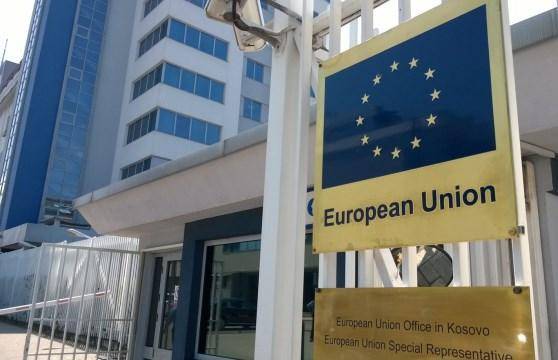
Kosovo Online, the Belgrade-linked portal, asked the EU Office in Pristina about Gërvalla's statement. The Office replied in writing. It would not comment on individual comments. It then wished "to recall that the representation and participation of members of different communities in Kosovo's institutions are regulated by laws and the Constitution, which are the foundation of Kosovo's multiethnic character."
Which right needed recalling?
A recall is addressed to someone who has forgotten, or is about to. Asked about a Kosovo politician's statement, the Office declined to comment on it and then volunteered that community representation is guaranteed. On Wednesday it was guaranteed, exercised and intact: the seats, the post, the nomination, all in the Constitution's words, all in the administration's file. The Office answered a minority-rights problem that did not exist. It was entitled to dislike Gërvalla's sentence. It was not entitled to convert dislike of a sentence into a recall about institutional representation when institutional representation had not been touched — and the side it addressed was the side that had used the Constitution's category.
The published response shows no sign that any of the obvious checks changed its premise or its conclusion: whether a community right had been touched; what the written nomination said; what Simić had said on Radio Belgrade in July, and what his phrase therefore meant in the chamber. None of it is in the answer, and the answer reads as though none of it was needed, because the frame arrived with the question and the recall was written inside it.
The reflex
The argument requires no coordination with Belgrade. The charge is that a Serbian actor implied a problem, a Kosovo actor was involved, and the machinery checked whether Pristina had infringed a Serb right before it established whether there was an infringement to check. Serb complaint, concern for Serb rights, recall to Pristina. The sequence a mission charged with reading this constitutional order owes the record is the other one: claim, facts, Constitution, context, judgment. It is slower, because it requires reading. On Wednesday the faster one was wrong at the first step.
The presumption underneath it is one Kosovo has met before, and this is a judgment from a Kosovo publication, not a census of the archive. When the Serb side says there is a rights problem, the international institutions are prepared to believe there might be one. When the Kosovo side says the problem is what the Serb List itself is doing, that proposition must first climb over the assumption that Pristina is the danger to be managed. When a Serb complaint enters the room, Pristina is the defendant before anyone has established that there is a case. This episode does not invent that hierarchy of suspicion. It exposes it with unusual cleanness, because for once the record is one page long and every item on it points the other way, and because the Office treated the reaction as the event worth policing without first examining the political act that produced it.
The consequence follows from the reflex, not the other way round. An EU Office statement has a value in Belgrade that no Serb List statement can match. Once the Office reaches for the language used when community rights need protecting, the episode is associated with the protection of community rights whether or not anyone intended it. Kosovo Online does not have to say that Serbs are under threat in Pristina. It prints the EU Office's recall directly beside Gërvalla's sentence and lets the pairing do the work. Simić's doctrine did not earn that. It was handed the premise it needs, by the institution best placed to have checked it.
What was left to rescue
Nothing had been taken from the Serbs. No constitutional right of the Serb community had been removed, and none needed rescuing. The seats were there before Simić spoke and after Haxhiu adjourned; the post was there; the nomination was there, valid. Into that record the institution charged with reading Kosovo's constitutional order volunteered a recall of a right nobody had challenged, and the recall now circulates as external confirmation of a minority-rights frame that the controversy did not carry until the reminder supplied it.
The failure was not a mistranslation of one Serbian word. It was that, before establishing whether any Serb right had been touched, the EU Office in Pristina already knew which side needed reminding.
