Three times in eight days, Serbia's president built the same sentence. The third time, it had a river in it.
By Drizan Shala | 10 August 2026
On Sunday in Prijepolje, Serbia's president told the traveling press that he threatens no one. "Ne pretim, što bih pretio bilo kome," he said. I do not threaten, why would I threaten anyone. He added that he is not Kurti, to go around threatening people, and that he is merely managing watercourses on Serbian territory under Serbian internal law. Then, in the same remarks, to the same cameras, he restated the threat: "Kada već toliko maltretiraju naš narod, da vidimo, imamo različite razloge za promenu vodotoka Ibra, pa ćemo da vidimo šta će da rade Albanci i kako će da se ponašaju." Since they mistreat our people so much, we have various reasons to change the course of the Ibër/Ibar, and then we will see what the Albanians will do and how they will behave.
The denial and the threat share a transcript.
He had rehearsed the construction eight days earlier, on 2 August, at the memorial cross in Janjila on the Petrovačka cesta, where Croatian aircraft struck a refugee column on 7 August 1995 and killed twelve civilians, four of them children, a documented crime for which no one has been prosecuted. Standing at that site beside Milorad Dodik, Belgrade's head of state put Serbia's army at fifty times the strength of the JNA and said: "Mi nikoga ne napadamo, već ćemo uvek da zaštitimo svoju zemlju." We attack no one, but we will always protect our country.
Same grammar both Sundays. The disavowal is the prefix, the menace is the payload, and the two are welded into a single breath so that any objection can be answered by pointing at the prefix. At Janjila the payload was capability, spoken at a grave. In Prijepolje the payload was a river.
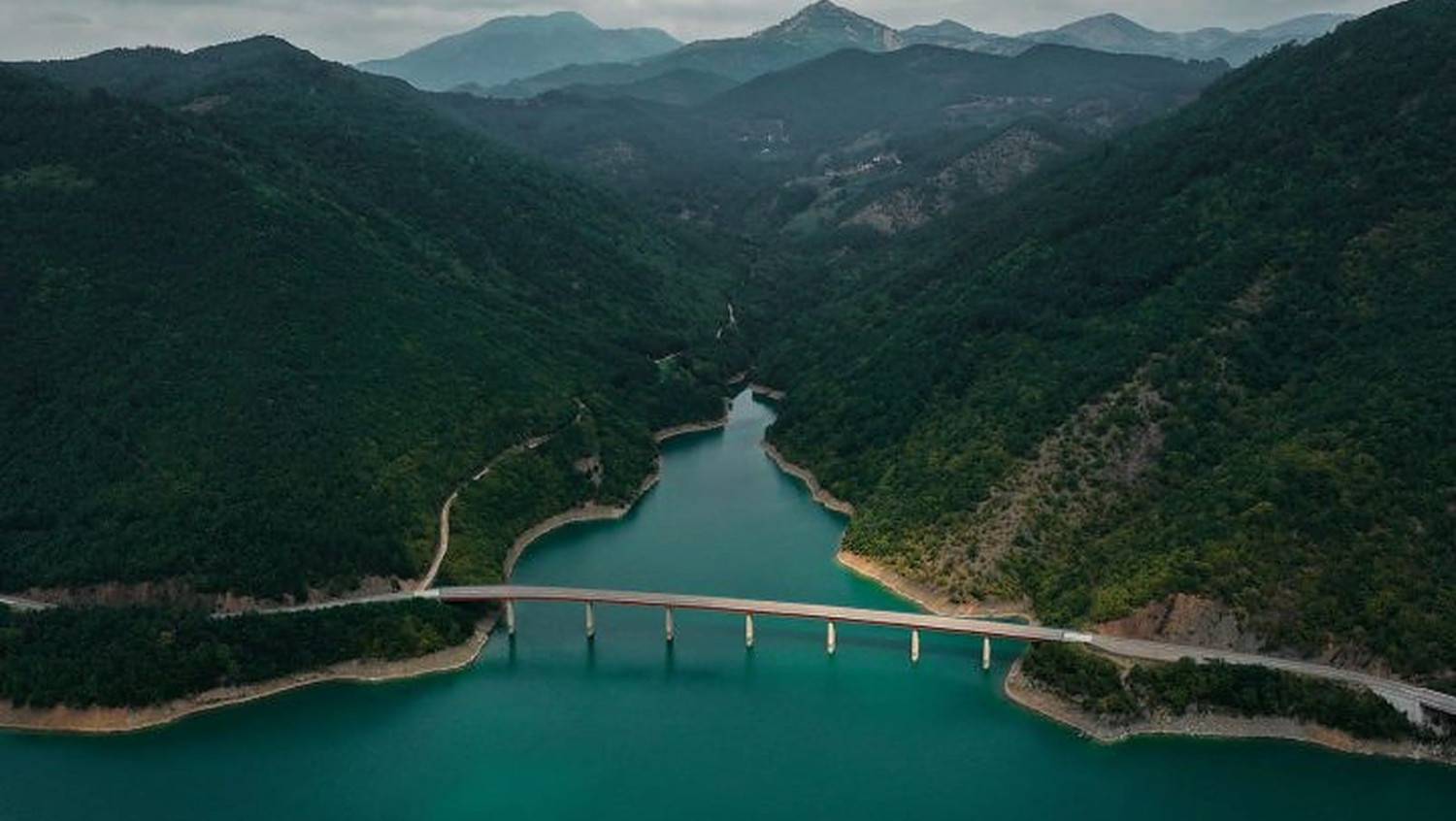
With the river, the doctrine acquired its first instrument. For a year the sentence stayed abstract: capability certified, protection pledged, and, at Mrkonjić Grad on 4 August, a promise that Serbia "will not wait or look for an excuse." On 9 August it received a proper noun. The Ibër/Ibar rises outside Serbia, crosses into Kosovo, fills Ujman (Gazivode), and returns to Serbia below Mitrovica. Ujman (Gazivode) feeds the Ibër-Lepenc canal, an artery of about fifty kilometers built in the 1970s that carries household water and the cooling water for the plants at Obiliq which generate most of Kosovo's electricity. In the World Bank's own project language, central Kosovo, the capital included, depends almost entirely on this canal to meet its water needs. A hand on that water is a hand on a population.
"Internal law" is the load-bearing phrase of the Prijepolje denial, and it fails on contact with what Serbia has signed. Serbia acceded to the 1992 Helsinki Water Convention on 27 August 2010, and its Article 2 obliges parties to prevent transboundary impact. The accession came with a detail worth the reader's pause: Belgrade filed a declaration under Article 22 accepting both compulsory means of settling disputes under the Convention, arbitration and submission to the International Court of Justice. The state now musing about the river volunteered, in writing, for the court. The customary rule beneath the treaty is older and binds regardless of recognition: a state may not use its territory to cause significant harm to the population downstream. The International Court of Justice restated the rule in Pulp Mills in 2010, and the Gabčíkovo judgment of 1997 shows what the rule does to a diversion executed on one's own soil: the Court held that Czechoslovakia, by unilaterally assuming control of a shared resource through works built entirely on its own territory, had deprived Hungary of its equitable and reasonable share of the Danube and breached international law. The location of the machinery did not save the act.
The ladder climbs higher on effects, though here the argument is ours and we state it as ours. The UN General Assembly's Definition of Aggression, Resolution 3314, lists blockade among the acts of aggression; a diversion that closes a population's water reaches the same result without a ship, and no lawyer for Belgrade should take comfort from the absence of the word river in a list drafted in 1974. The law of armed conflict, for its part, measures the gravity of the object: Additional Protocol I, Article 54, shields drinking water installations and supplies even from armies at war. That rule governs armed conflict and does not govern a peacetime project. We cite it for what it establishes about rank: the object Serbia's president reached for is one international law protects from soldiers.
Downstream states have never read this as plumbing. Anwar Sadat called water the one matter that could take Egypt to war again, and the Indus Waters Treaty exists because Delhi and Islamabad understood what an unregulated upstream hand would mean. The diversion schemes on the Jordan headwaters in the middle 1960s appear on every serious account of the roads to 1967. This is the company the Ibër/Ibar statement keeps by its own wording: a diversion announced conditionally, to see how the downstream nation behaves.
The obvious objection is that the project may be a fantasy. When the diversion idea first circulated in December 2024, Avdullah Nishori, then on the management board of the Ibër-Lepenc company, called it impossible even on economic grounds, a colossal investment, and other specialists judged it technically conceivable but a plain breach of international law. The objection defuses nothing, for two reasons. The first is on the record: the idea's December 2024 circulation followed by days the explosion of 29 November 2024 that damaged this same canal at Vragë in Zubin Potok, an attack Prishtina attributed to Belgrade, so the infrastructure in question has already absorbed one strike while the project was still nobody's official policy. What changed on 9 August is the signature: the canal someone attacked anonymously two winters ago is now the object of open presidential conditionality. The second reason is structural. A threat's currency is intent, and intent is what the wording supplied: the diversion was announced conditionally, indexed to how "the Albanians" behave, which means the water was never the deliverable. The test was. An infeasible project tests a neighbor and its guarantors exactly as well as a feasible one, at no cost, until someone answers.
Those in the business of managing Serbia's president should read the two Sundays as one text. The doctrine they have watched him assemble, an army certified fifty times stronger than the JNA and a pledge not to wait for an excuse to use it, has now named the first tool it would pick up. That is what changed this week. It changed in public, on the record, twice.
It is no longer 1995 on the Petrovačka cesta and no longer 1999 on the Ibër/Ibar, and this can be stated as fact rather than defiance. Kosovo hosts a NATO mission; Croatia, the subject of the Janjila staging, and Albania both sit inside the alliance whose troops ring the lake. The JNA that Belgrade's head of state multiplies by fifty counted its soldiers in the hundreds of thousands and its armor in the thousands of vehicles, and no order of battle in Belgrade today supports the arithmetic. Nobody at the memorial was expected to check the figure, only to repeat it.
A man who threatens the water supply of a territory under NATO protection, in the same eight days that he stages a grievance against a NATO member at a graveside, has moved past describing his strength and into testing it, because a statement of this kind exists to discover whether anyone will require its author to withdraw it. On Sunday he withdrew nothing. He said this instead: "Tamo gde je jezero Gazivode danas, gde je bilo juče, ne znam da li će biti i sutra ili gde će biti." Where the lake at Ujman (Gazivode) is today, where it was yesterday, I do not know whether it will be there tomorrow, or where it will be.
He offered that sentence as proof that he threatens no one. Read it again tomorrow.
Drizan Shala writes on security, institutions, and political violence for Kosovo Dispatch and Tirana Examiner. He is a doctoral candidate at the University of Sarajevo.