Three years after Banjska, the man who said he organised the attack remains in Belgrade. Kosovo is preparing to enter Gaza in the first wave of a US-commanded international force.
Drizan Shala | 25 September 2026
Three years ago, Kosovo spent 24 September counting the weapons recovered from armed men who had come to Banjska. On 23 September this year, the American commander of the Gaza International Stabilization Force told the Board of Peace in New York which countries would go in first. He named Kosovo and Morocco, with Albania and Kazakhstan to follow.
Three years ago, Kosovo was explaining to its allies what had happened on its own territory. This week, an American general was explaining to the world where Kosovo's soldiers fit in a mission somewhere else.
The Banjska record is short. In the early hours of 24 September 2023, an armed group blocked the bridge into the village with two trucks and opened fire on the police patrol sent to clear it. Sergeant Afrim Bunjaku was killed. The attackers withdrew into the fourteenth-century monastery, fought through the day, lost three men and retreated across the border into Serbia, leaving armoured vehicles, drones, mortar rounds and anti-tank weapons behind. Within days, Milan Radoičić, then vice-president of Srpska Lista, announced through his lawyer that he had organised the operation, to encourage Serbs to resist what he called the terror of Kurti's regime.
Kosovo indicted 45 people in September 2024. In April this year the Basic Court in Prishtina convicted the three men captured at the scene, at first instance, two to life and one to thirty years, finding that they had taken part in an organised plan aimed at the secession of the north. The other 42 are beyond its reach, most of them in Serbia, which opened an investigation and never filed an indictment. In June, asked why active Gendarmerie officers were guarding Radoičić, Vučić said he was on the Interpol list "because of Kosovo and Metohija," not for crime. This week the EU said it regrets that Serbia has not taken the steps needed to arrest and prosecute the suspects on its territory. On the anniversary, neither Vučić nor his ministers marked the day. Crvena zvezda did, posting eternal glory to the heroes of Banjska.
The state they attacked spent the same three years extending its authority in the north. The Kosovo Police stayed. The parallel structures that had operated there for two decades were wound down. Some of those steps drew objections in Brussels and Washington, and the disputes over the dinar and the pace of change are on record. The result is still measurable, and the most candid measurement comes from Belgrade. The analyst Ognjen Gogić told KiM radio this week that everything since, from the dinar ban to the closure of Serbian institutions and the trials, traces back to Banjska, because the attack gave Prishtina the argument and its partners the reason to accept it. The weekly Vreme called Banjska the turning point after which Serbia's old Kosovo policy collapsed.
In 2022 Kosovo adopted the European Union's sanctions on Russia and applied for EU membership the same December. This week in New York, Kurti asked Brussels for candidate status without further delay. And when the United States began assembling a force for Gaza, Kosovo was among the first five countries Major General Jasper Jeffers named in February, with Indonesia, Morocco, Kazakhstan and Albania.
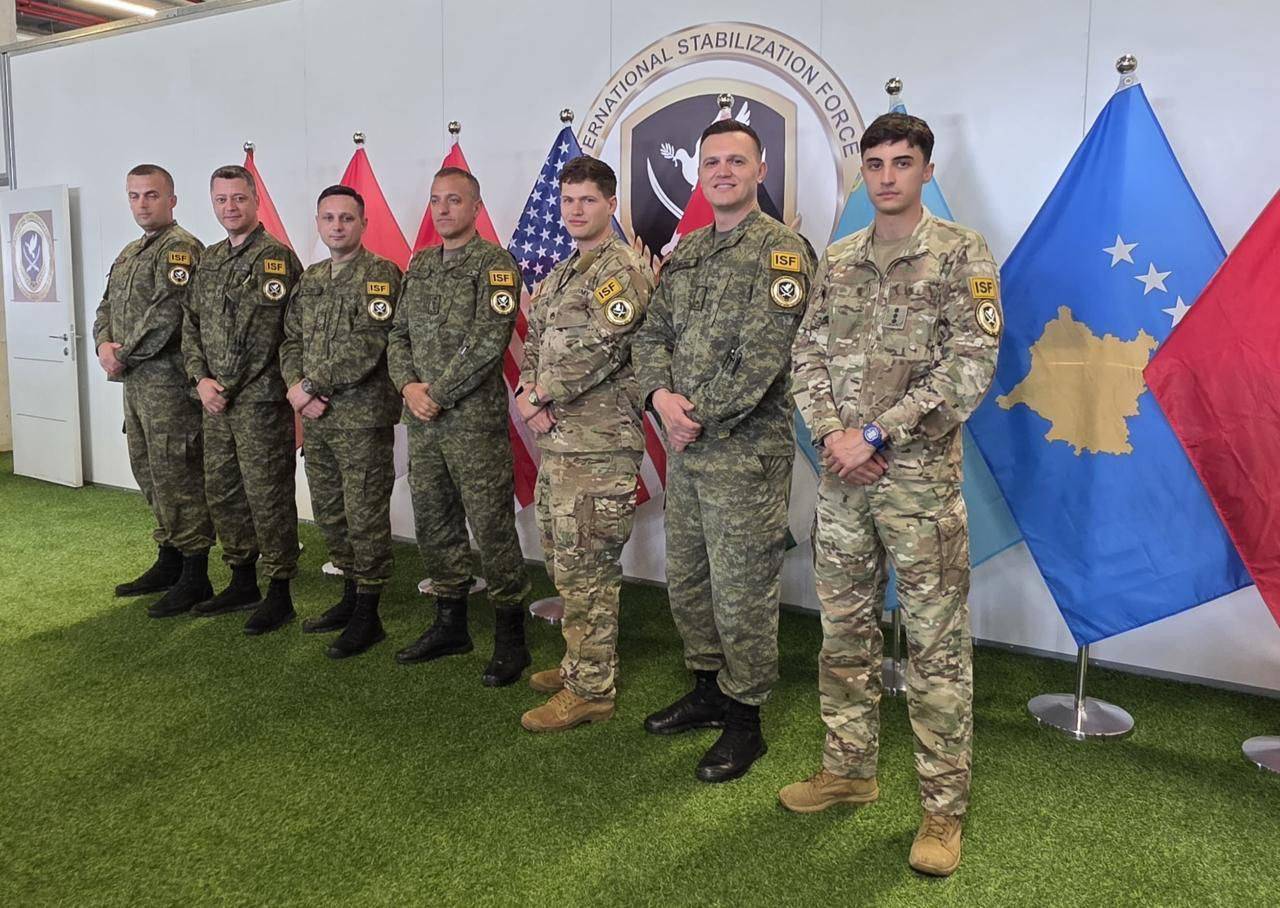
Since the spring, Kosovo Security Force officers have been at the ISF headquarters, where the Board says they lead planning across logistics, civil affairs and unexploded ordnance clearance. On 30 March, the government asked the Assembly for a deployment mandate. On 17 April, the Assembly approved it without a vote against, and the acting president, Albulena Haxhiu, signed the authorisation. A KSF team went to assess the ground in April. On 7 September, Jeffers travelled to Prishtina and signed the participating country agreement with the KSF commander, Lieutenant General Bashkim Jashari. The Board's own wording was that Kosovo "will provide critical support" to the mission.
Indonesia, which pledged 8,000 troops and holds the deputy command, has had its deployment on hold since the spring. Türkiye's offer was vetoed by Israel. When Jeffers set out who would enter Gaza first, he named a country of fewer than two million people that five EU members still do not recognise. The force he commands was authorised by Security Council Resolution 2803. Kosovo is not a member of the United Nations, and it is one of the countries now expected to carry out a task the Council mandated. In Jeffers's plan, the first wave's task is demilitarisation.
Plenty of governments agree with Washington. This one was handed a job. The United States sent its commander to Prishtina to sign, took Kosovo's officers into its planning cell, and put Kosovo's soldiers into the first wave while larger pledges wait. A government does that with a partner it expects to deliver.
In New York, Vučić met Kaja Kallas, who raised Banjska. On 24 September he met Germany's foreign minister, Johann Wadephul, and spoke about Serbia's European path. Then he met Sergey Lavrov, received Vladimir Putin's warmest greetings, thanked Moscow for its friendship and said he hoped to sign a new gas contract with Russia by the end of the month. Serbia is an EU candidate that has not aligned with EU sanctions on Russia, and in August its defence minister held the second session of Serbia's defence subcommittee with China. Belgrade keeps as many chairs as it can, and its partners have learned to ask, each time, which one it is sitting in.
The three years since Banjska produced a court that tried the men it caught, a parliament that voted its soldiers abroad, and an American commander who came to Prishtina for a signature. The man who said he organised the attack lives at a registered address in Belgrade, where N1 has reported that active Gendarmerie officers guard him. The soldiers of the state he attacked are in the first wave for Gaza.
Drizan Shala is a security researcher and doctoral candidate at the University of Sarajevo. He writes on defense, private security, and the security architecture of the Western Balkans.
